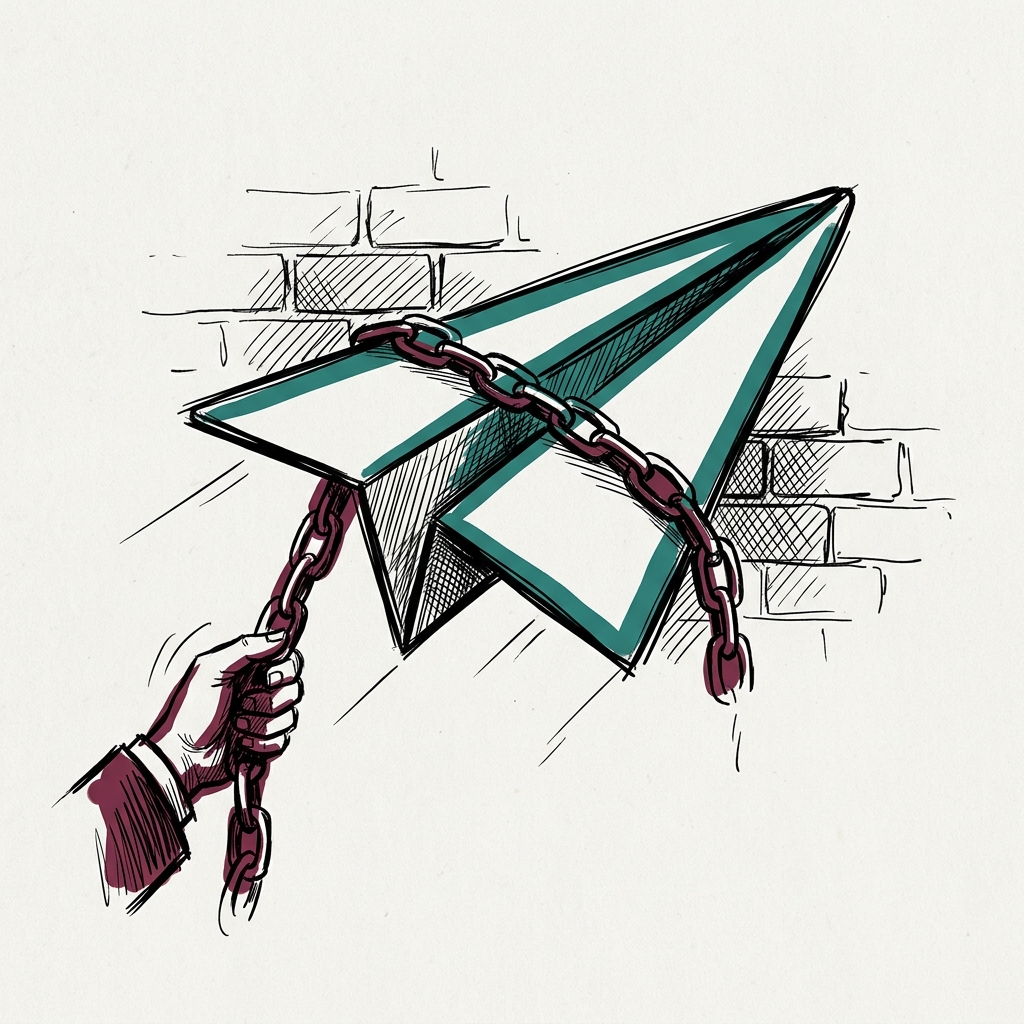
Telegram
Cloud messaging platform; key channel for war reporting, dissident communication, and state censorship battles.
Russia blocked Telegram on 1 April 2026, ordering users to the state-controlled alternative Max, in a crackdown that backfired: prominent pro-war bloggers publicly declared the war could continue for 100 years at the current pace.
Last refreshed: 3 August 2026 · Appears in 1 active topic
Why do authoritarian governments struggle to effectively block Telegram?
Timeline for Telegram
Mentioned in: Airdropped mine robot named as the ARK-1
Autonomous Systems: Land & SeaMentioned in: Medvedev likens Hormuz to nuclear arms
Iran Conflict 2026Mentioned in: Iran's drones, the US shield over Hormuz
Iran Conflict 2026Mentioned in: IRGC declares Hormuz shut, vetoing Iran's own deal
Iran Conflict 2026Mentioned in: Brent slips to $94.71 the day Hormuz is declared shut
Iran Conflict 2026Background
Telegram is a cloud-based messaging platform founded in 2013 by Russian-Born entrepreneur Pavel Durov and his brother Nikolai, originally in Saint Petersburg and now headquartered nominally in Dubai. It supports channels, groups, and direct messages with optional end-to-end encryption, and has grown to over 900 million monthly active users globally. Its combination of large public broadcast channels, minimal content moderation, and strong resistance to government takedown requests has made it the default platform for wartime information in multiple conflicts.
Russia blocked the platform on 1 April 2026, ordering users to the state-controlled alternative Max, a crackdown ISW assessed as producing harsher backlash than Moscow expected: prominent pro-war bloggers publicly declared the war could continue for 100 years at the current pace. Separately, Russian drone recruiter Alabuga Polytech has used Telegram to advertise for an unmanned-systems brigade, targeting video gamers via the platform's reach into young male demographics.
In Iran, Telegram has become central to the internet-censorship story: in May 2026, official Mohammad Sarafraz disclosed that Chinese Deep Packet Inspection hardware had already arrived, designed to enable a tiered, switchable censorship architecture that could seal off Telegram at will without paralysing commercial traffic. The platform's resilience as a censorship target in both Russia and Iran reflects its architecture: channels are hosted on Telegram's own servers rather than users' devices, making content takedown dependent on Telegram's cooperation, which Durov has historically refused.
Reference
Who founded Telegram and where is it based?
Is Telegram actually encrypted?
Where did the footage of a drone dropping a ground robot in Ukraine come from?
How is Iran trying to censor Telegram?
Why did Russia ban Telegram in 2026?
Who are the Russian war bloggers criticising the war on Telegram?
What is Max, the Russian platform replacing Telegram?


