Skip to content
You can now search across every topic, entity and event.What's new
Autonomous Systems: Land & Sea
3AUG

Airdropped mine robot named as the ARK-1

2 min read
10:02UTC

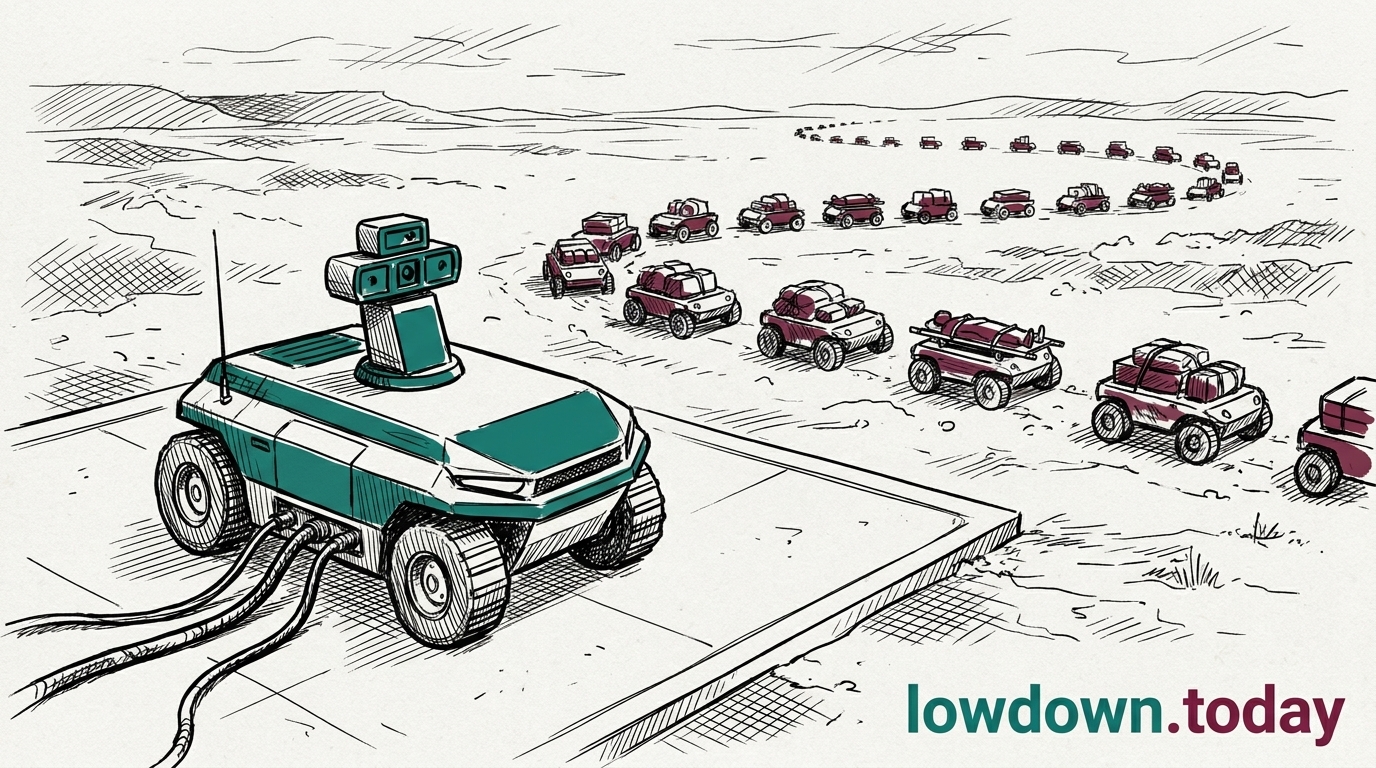
The ground robot Ukraine dropped by hexacopter behind Russian lines on 19 July was identified this fortnight as the ARK-1, a four-wheel-drive mine-layer tied to the Brave1 cluster.

TechnologyDeveloping
Key takeaway

The robot has a name now. The company that makes it still does not.

The platform Ukrainian forces airdropped by hexacopter behind Russian lines on 19 July was identified this fortnight as the ARK-1, a Ukrainian four-wheel-drive UGV associated with the Brave1 defence-innovation cluster, carrying TM-series anti-tank mines and rated to 45km/h 1. The delivery itself falls outside this window. The identification does not, and it counts as the new fact here. TechRadar reported the type independently of the Russian Telegram footage that first showed the drop, which matters because the original material came from the side being mined.

A hexacopter carries six rotors and enough lift for a heavy payload. Using one to place a mine-laying ground robot behind an opponent's positions collapses two delivery problems into one: the robot never has to cross the contested ground it is being sent past, and the drone never has to loiter over a target long enough to be engaged. Neither machine does anything novel on its own. Ukrainian operators chained the two in an order nobody had used before.

No source names the company that builds the ARK-1. It is described only as a Ukrainian firm working under Brave1, which is itself characteristic of how this supply base operates. Nineteen manufacturer contracts and fifty qualified designs went through the defence ministry in Kyiv in the first six months of this year . At that rate of qualification, a platform can be fielded, filmed and typed by open-source analysts while its manufacturer stays out of print entirely, whether for security reasons or because nobody has asked.


Deep Analysis

In plain English

On 19 July, Ukraine used a large hexacopter drone, a heavy bomber drone, to drop a small four-wheeled robot vehicle carrying anti-tank mines behind Russian lines. Footage of the drop first surfaced on a Russian military Telegram channel, but this fortnight the robot itself was identified as the ARK-1, a Ukrainian vehicle tied to the Brave1 defence-tech cluster, after Western outlet TechRadar confirmed it independently of the Russian footage. No one has said which company actually builds the ARK-1. It can drive up to 45km/h and is built to plant mines rather than carry troops or supplies.

Deep Analysis
Root Causes

Ukraine's rapid codification of new ground-robotic-complex types this year is broad enough that outside observers increasingly rely on footage analysis rather than official disclosure to identify which specific model appears in any given piece of frontline video, which is exactly the gap TechRadar's ARK-1 identification is filling.

Hexacopter delivery of a wheeled UGV behind enemy lines works structurally because the mine-laying payload, TM-series anti-tank mines, is light and modular enough to be dropped rather than driven in, separating the delivery method from the platform's own 45km/h road speed, which matters only once it is on the ground.

What could happen next?
  • Meaning

    Independent Western corroboration of a platform first shown in Russian footage gives open-source trackers a firmer identification standard for future frontline robot sightings.

First Reported In

Update #10 · Belgium's twelve robots are not autonomous

TechRadar· 3 Aug 2026
Read original
Different Perspectives
Thales
Thales
Thales converted its 6 July engaging accord with Exail into a definitive combination agreement on 30-31 July, but the tender offer for Exail's remaining shares now closes by early 2028, later than July's timetable implied. Thales integrates its new undersea prime while still bidding against Kongsberg and DRASS's 2027 target for the AUKUS Pillar II contest.
University of Limerick
The University of Limerick tendered on 3 August, the morning this briefing published, for a single coastal and offshore autonomous surface vehicle to survey rather than fight. Where Belgium bought certainty on a cable, a research fleet buys endurance and area coverage, because a lost survey mission costs a re-run, not a casualty.
Ukraine's UGV manufacturers
Ukraine's UGV manufacturers, Trinity Robotics among them, have already run resupply and casualty-evacuation robots at a scale the US Army's new 18-month Project Sustainment award is only now attempting to match. Every month the American programme spends prototyping is a month a wartime supply base keeps compounding its lead in fielded units.
Ocean Infinity
Ocean Infinity
Ocean Infinity's President of Solutions, Joe Robinson, said on 30 July that vessel Needlefish has logged more than 13,000 hours of continuous coastal security work in Kuwait since August 2025, an unaudited company claim. It is commercial security, not mine clearance, and not Omani waters, but the hours logged are real regardless.
Belgian Ministry of Defence
Belgium's Ministry of Defence published a tender for twelve tethered Underwater Remotely Operated Vehicles on 29 July, for its engineer divers, EOD service, Naval Mine Warfare Group and Special Forces Group. A human on the boat, not an algorithm underwater, decides what the manipulator touches near live ordnance.
American Rheinmetall
American Rheinmetall took the 18-month Project Sustainment prime slot on 31 July, fielding hybrid-powered autonomous resupply vehicles for company-sized element sustainment missions with Harbinger, Forterra and Primordial Labs, without disclosing a contract value. The award tests whether an Army acquisition office can match the production tempo Ukrainian UGV makers already run at industrial scale.