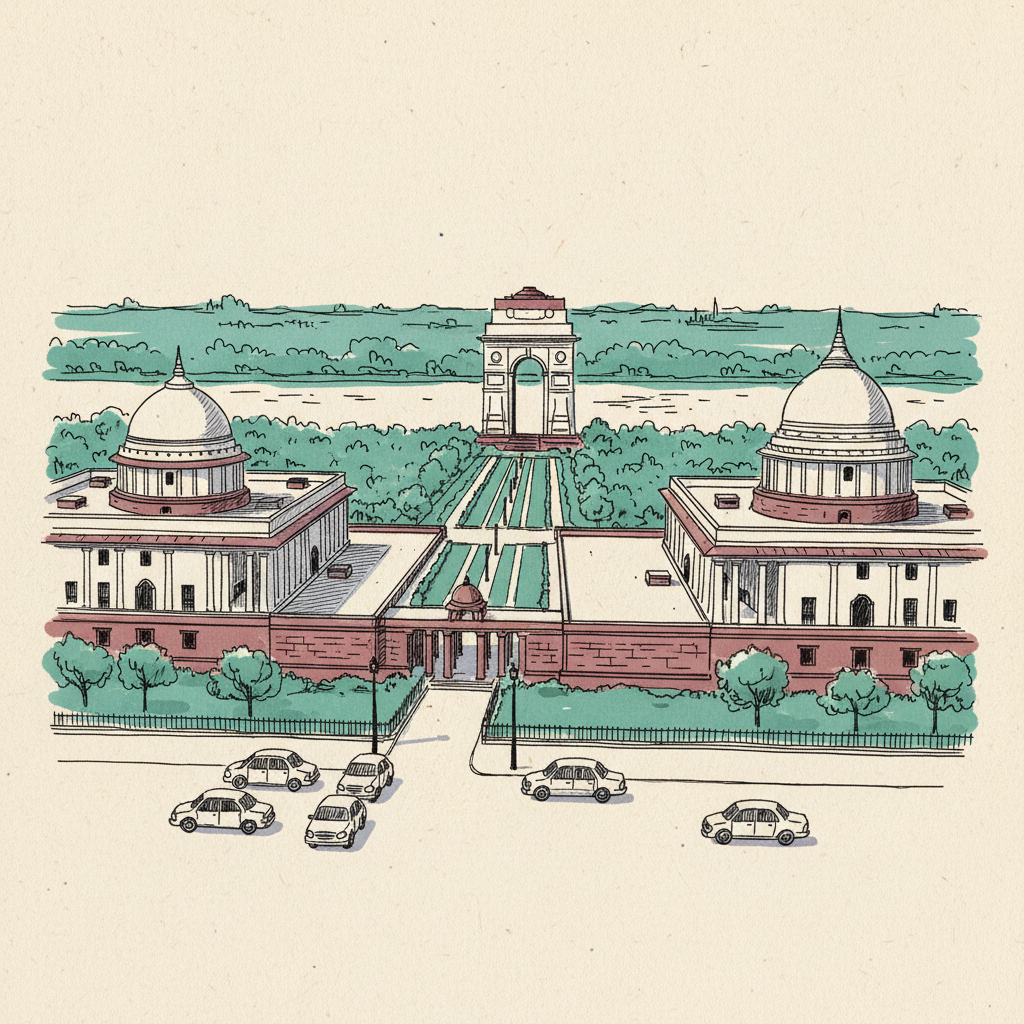
New Delhi
Capital of India, whose sailors have died to both Iranian and US Hormuz fire.
BRICS leaders meeting in New Delhi adopted the New Delhi Declaration on 12 September, a restraint call on The Gulf war that names no country, four months after the bloc's foreign ministers left the same city without any joint text.
Last refreshed: 12 October 2026 · Appears in 2 active topics
Has India's neutrality on the Iran war survived the IRGC attack on its tankers?
Timeline for New Delhi
Mentioned in: Torpedoes kill an Indian wiper off Oman
Iran Conflict 2026Mentioned in: Trump signs Graham Russia sanctions law
Russia-Ukraine War 2026Pezeshkian meets Abu Dhabi's crown prince in Delhi
Iran Conflict 2026BRICS adopts the text May could not agree
Iran Conflict 2026Background
New Delhi is the capital of India and the seat of its central government, including the Ministry of External Affairs, which runs the country's crisis diplomacy. When India summons a foreign envoy or hosts a summit, it happens here.
In 2026 the city carried an unusual diplomatic load because India held the BRICS chair. It hosted the bloc's foreign ministers in May, when Iran's Abbas Araghchi flew in aboard an aircraft renamed Minab168 after the schoolgirls killed in the war's opening hours, and the 18th BRICS summit in September. Cuba, among others, had sought a membership upgrade before that summit, which Russia declined to back.
The Iran war tested how far New Delhi could stay neutral. Indian sailors died to both Iranian and US fire in and around Hormuz, and the government protested to both capitals. The city is also where any Indian answer to US secondary sanctions on Russian oil will be decided, because India buys more than a third of Russia's crude exports.
The city hosted both halves of BRICS
India's year chairing BRICS put New Delhi at the centre of the bloc's split over the Iran war. The foreign ministers' meeting there on 14 and 15 May ended with no joint statement, because the United Arab Emirates, struck by Iranian drones on 10 May, blocked any text that did not condemn Iran. Tehran demanded condemnation of the US and Israel instead.
The leaders' summit in the city on 12 September went further. Negotiators worked until about 4am to bridge Iranian and Emirati language, and the resulting New Delhi Declaration expressed concern over The Gulf conflict and called for maximum restraint without naming anyone. On the margins, Iran's president met Abu Dhabi's crown prince, their first known meeting since the war began on 28 February.
Delhi summoned an envoy over cleared tankers
India's foreign ministry used New Delhi's diplomatic machinery against Iran on 18 April. It summoned Iran's ambassador after Revolutionary Guards fire struck two Indian-flagged tankers, Sanmar Herald and Jag Arnav, inside the strait of Hormuz after both had received radio clearance.
Foreign Secretary Vikram Misri personally warned the ambassador, Mohammad Fathali, of consequences. The summons came three days after the US Treasury had named Indian nationals and firms in an oil-smuggling network tied to Ali Shamkhani, so Delhi was handling pressure from both Washington and Tehran in the same week. India's refiners and shipping depend on Hormuz, which before the war carried most of the country's crude and liquefied petroleum gas.
Delhi summoned an envoy over cleared tankers
Why did India summon the Iranian ambassador in April 2026?
Why did India summon the US over Hormuz strikes on its sailors?
What is India's diplomatic role in the 2026 Iran war?
Is India buying Iranian oil during the 2026 war?


