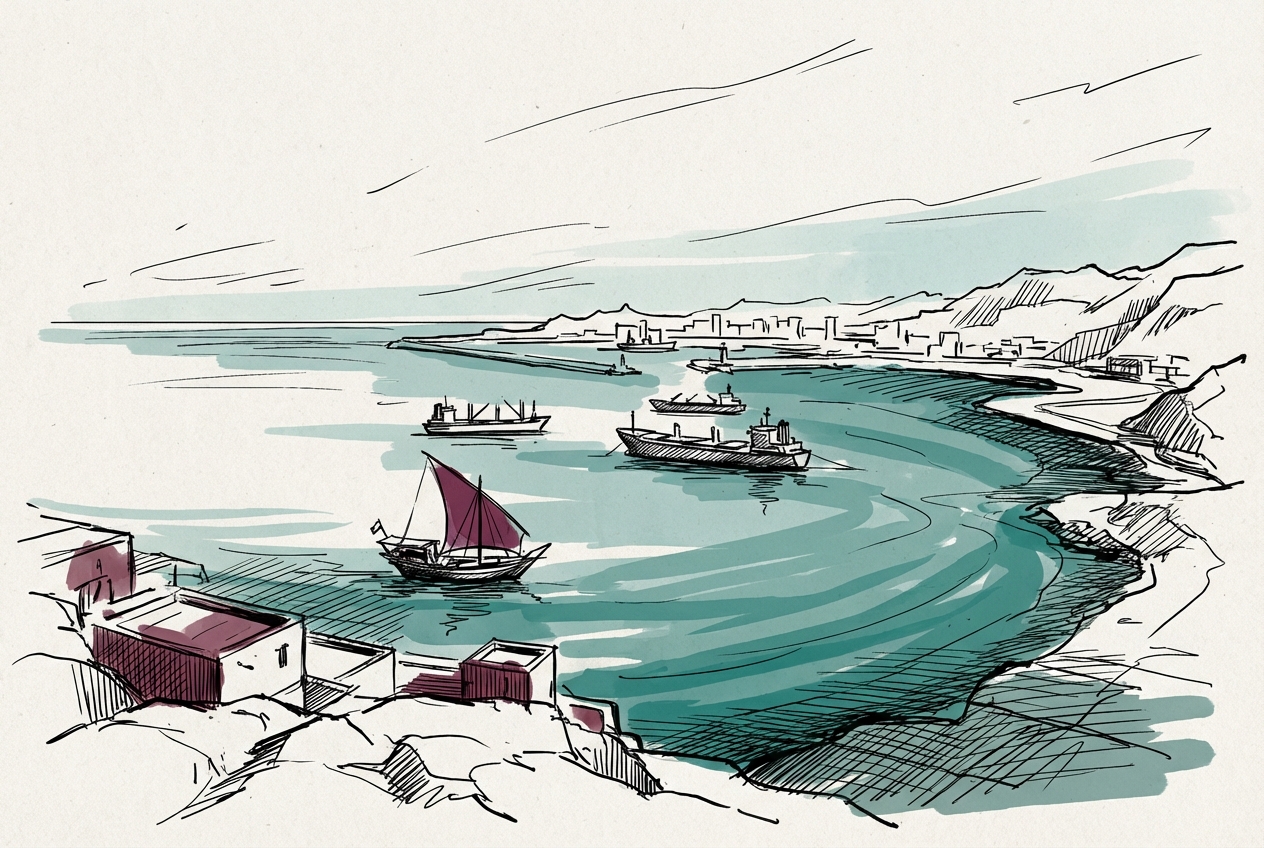
Gulf of Oman
Semi-enclosed SEA linking the Arabian Sea to the strait of Hormuz; Iran's eastern maritime frontier.
Iran's 9 September warning covered a restricted stretch from Chabahar into The Gulf of Oman, but supplied no coordinates, leaving its boundary unchartable for ship operators and insurers.
Last refreshed: 22 September 2026 · Appears in 1 active topic
Where does the US Gulf of Oman blockade end and maritime law begin?
Timeline for Gulf of Oman
Mentioned in: Torpedoes kill an Indian wiper off Oman
Iran Conflict 2026Mentioned in: Iran takes safe passage to Oman on Monday
Iran Conflict 2026Mentioned in: Iran and CENTCOM clash over one tanker
Iran Conflict 2026Mentioned in: Türkiye holds at 37% on energy risk
Iran Conflict 2026Mentioned in: Iran declares a restricted sea area
Iran Conflict 2026Background
The Gulf of Oman links the Arabian Sea to the strait of Hormuz between the Iranian and Omani coasts. It is the seaward approach for traffic entering or leaving the strait, rather than an alternative channel detached from it. The 18 April 2026 attack on a container ship north-east of Oman showed how a threat in these waters can affect the wider Hormuz corridor.
Its geography gives Oman and Iran overlapping stakes in maritime access, security and attribution. The Gulf is wider than the strait, with commercial and naval traffic spread across open water, making the location and source of an incident harder to establish than in a constrained shipping lane.
For shippers, The Gulf of Oman matters because risk at the mouth of Hormuz can remove a partial rerouting option before a vessel reaches the strait. The Olympic Life strike on 26 May 2026 demonstrated that effect in the approach waters near Muscat.
Iran leaves the zone undefined
Iran's 9 September notice placed restrictions on waters between Chabahar and The Gulf of Oman, without publishing a boundary ships could chart. Ship operators and insurers could not plot the boundary, leaving The Gulf's eastern approach subject to a warning that could not yet be enforced or priced as a normal exclusion zone.
The uncertainty extends the Hormuz routing dispute into waters beyond the strait itself. On 14 September, Iran was due to meet Gulf states in Oman on SAFE passage for shipping, while its foreign ministry said the talks excluded the nuclear file, sanctions and tanker exchanges. For The Gulf of Oman, the immediate question is whether a defined route emerges from those talks.
The gulf loses its bypass role
On 18 April, an explosive device damaged a container ship about 25 nautical miles north-east of Oman. CENTCOM reported that the CREW reached safety and the vessel headed for port, but did not attribute the device. The incident put an attack in The Gulf of Oman approach waters rather than inside the Strait of Hormuz.
On 26 May, the tanker Olympic Life suffered an unclaimed hull strike about 60 nautical miles east of the strait, near Muscat, releasing bunker fuel into The Gulf of Oman. That confirmed that vessels seeking distance from Hormuz could still face direct exposure in the surrounding waterway.
Reference
Why is the Gulf of Oman important for world oil supply?
What is the Gulf of Oman?
What is the difference between the Gulf of Oman and the Sea of Oman?
Which countries border the Gulf of Oman?
What is the difference between the Gulf of Oman and the Persian Gulf?
Are US Marines boarding ships in the Gulf of Oman?
Why did the US reinstate the Hormuz blockade in July 2026?
Why did the US strike a tanker in the Gulf of Oman killing Indian sailors?
Which tanker was struck near the Gulf of Oman in May 2026?
What is the ADCOP Fujairah bypass and why does it matter?
What is happening in the Gulf of Oman right now?
Where is Fujairah and why does it matter for Hormuz?
Why are tankers anchored in the Gulf of Oman?
Is the Gulf of Oman safe for shipping in 2026?


