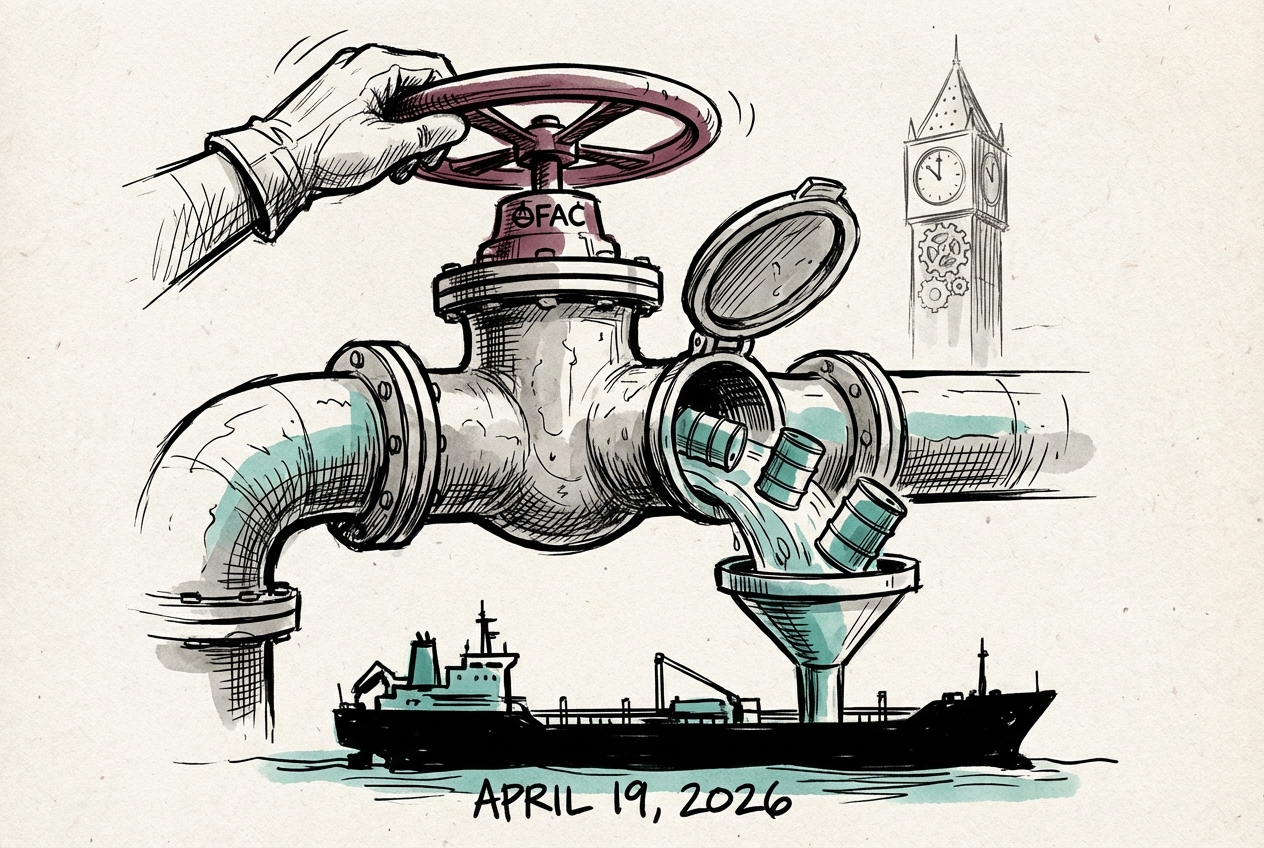
General License U
OFAC waiver authorising Iranian crude from pre-20-March vessels; expires 19 April — non-renewal confirmed by Bessent on 15 April.
Last refreshed: 7 September 2026 · Appears in 2 active topics
Does GL-U's April expiry give Washington leverage over Tehran?
Timeline for General License U
Iran's strait authority opens to silence
Iran Conflict 2026Mentioned in: Pentagon gives Congress Hormuz clock Trump has not
Iran Conflict 2026Mentioned in: Brent round-trips 9% down and 7% up in a weekend
Iran Conflict 2026Mentioned in: Seven VLCCs at Chabahar, three at Hormuz
Iran Conflict 2026Mentioned in: Northwood summit drafts Hormuz ROE without US
Iran Conflict 2026Background
US Treasury's Office of Foreign Assets Control issued General License U on 20 March 2026, authorising the purchase, transport, and delivery of Iranian crude oil and petroleum products loaded on vessels on or before that date. It is the first OFAC general licence ever to broadly authorise transactions involving Iranian-origin crude. The licence expires at 12:01am EDT on 19 April 2026. On 15 April, Treasury Secretary Scott Bessent explicitly confirmed non-renewal, pairing the announcement with a secondary-sanctions threat he described as "the financial equivalent of the US military's bombing campaign against Iran". Markets did not reprice: Brent crude fell on the confirmation. OFAC had issued zero Iran-specific actions in the 23 days between issuing GL-U and Bessent's statement, while amending Russia and Venezuela licences in the same window.
The practical effect was to allow existing cargoes in transit to reach buyers without triggering secondary sanctions. The first confirmed delivery under GL-U was the Aframax tanker PING SHUN, which delivered 600,000 barrels from Kharg Island to Vadinar, India, purchased by Reliance Industries, the first Iranian crude delivery to India since May 2019. GL-U does not authorise banking transactions, so in practice only buyers with existing settlement workarounds can execute under it.
GL-U's expiry creates a hard sanctions cliff three days before the Ceasefire window closes on 22 April. 325 oil tankers remain stranded inside the Persian Gulf and Hormuz as of early April, none transiting while the strait stays effectively closed. Non-renewal recriminalises all Iranian oil deliveries in transit, sharpening pressure on Tehran at a critical moment while simultaneously deepening the oil supply shock in markets already absorbing Hormuz's closure.
What is General License U?
Will General License U be renewed?
How many oil tankers are stranded because of Hormuz?
Who can buy Iranian oil under General License U?


