Skip to content
You can now search across every topic, entity and event.What's new
Russia-Ukraine War 2026
16JUN

EU 21st package squeezes shadow tonnage

3 min read
10:25UTC

Von der Leyen announced the EU's 21st sanctions package on 26 May, built on fresh shadow-fleet tanker listings and banks rather than a price-cap revision.

ConflictAssessed
Key takeaway

The 21st package hits freight and the Urals discount, thinning compliant tonnage as GL 134C nears its 17 June lapse.

Ursula von der Leyen announced the EU 21st sanctions package on 26 May, the European Commission President fronting a set of measures built around additional shadow-fleet tanker listings and bank restrictions 1. It is the follow-through on the 20th package's deferred maritime-services ban , which a lack of EU-27 unanimity had blocked in April. The choice of instrument matters more than the headline.

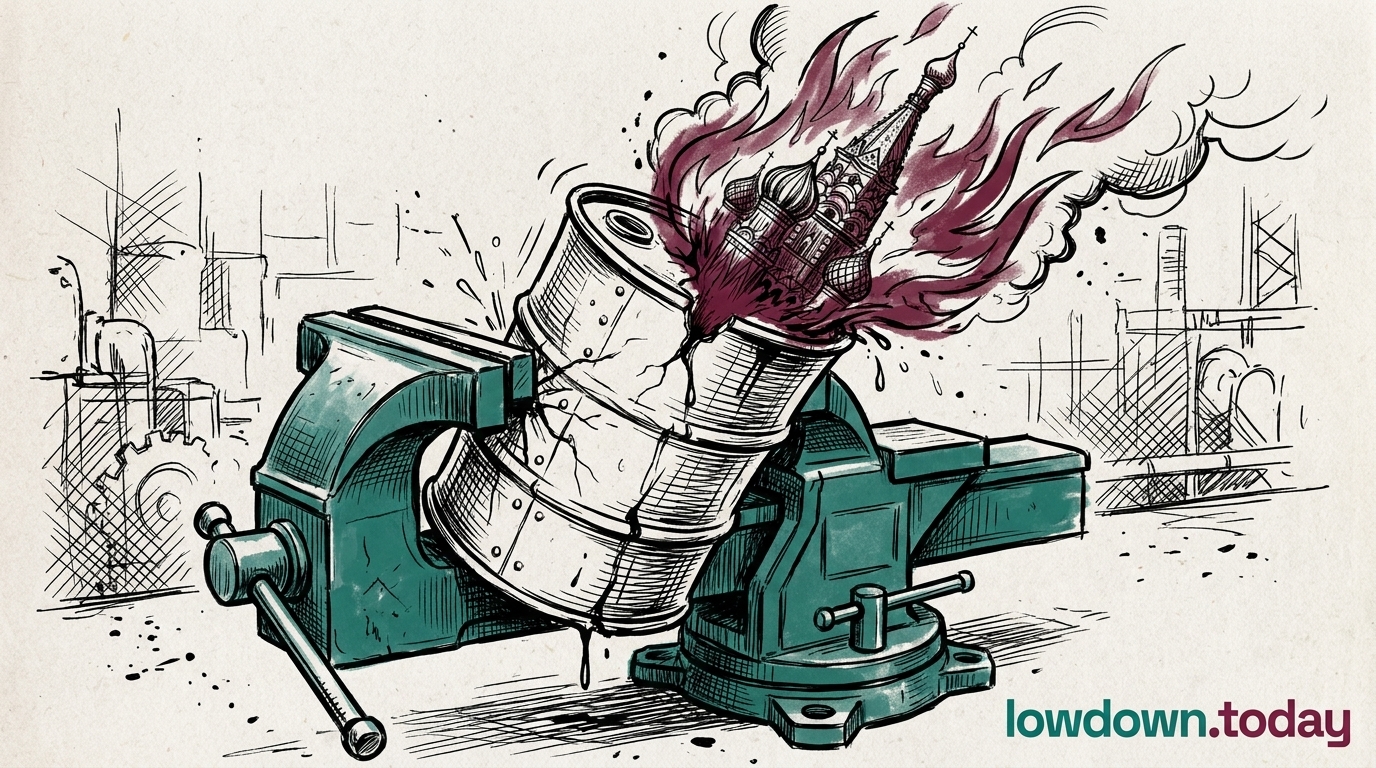
von der Leyen's package targets carry, not the cap: it raises the cost of moving Russian crude rather than revising its assessed value, so the pressure surfaces in freight rates and the Urals discount rather than in a price-cap number. That distinction routes the consequence straight to European spreads: every hull listed is a hull pulled from the pool that moves Russian barrels.

The timing stacks. Fresh shadow-fleet tonnage comes out via the EU package precisely as GL 134C nears its 17 June lapse , which had eased the Baltic Aframax compliance bid when it restored in-transit cover. The compliant pool thins from the Russian side just as in-transit cover is set to expire. The last hard freight read is the BDTI at 2,249 on 20 May ; the direction is set up, not yet printed.


Deep Analysis

In plain English

The European Union has been imposing sanctions on Russia since the 2022 invasion of Ukraine, targeting the oil trade that funds Moscow's government. Each new package adds more names to a blacklist and makes it harder (and more expensive) for Russian oil to reach buyers. This 21st package focused on the so-called shadow fleet: hundreds of tankers operating outside Western insurance and regulatory systems, used to move Russian crude without triggering Western sanctions. Rather than changing the price cap (the maximum price Western buyers are allowed to pay for Russian oil), this package raises the cost of shipping by listing more shadow-fleet ships. When a ship is listed, Western banks and insurers cannot touch it, which raises freight costs and eats into the discount Russia has to offer buyers to compensate. The result shows up in the Urals discount, not in headline prices.

Deep Analysis
Root Causes

The 21st package's carry-led rather than cap-led design reflects two distinct political constraints.

The EU-27 unanimity requirement for price-cap revision effectively vetoed a headline cap change: Hungary, Slovakia, and Austria have each conditioned cap-revision support on domestic supply guarantees that are not resolvable in one round of Council negotiations. Carry-led measures (freight cost, insurance, bank restrictions) require only qualified majority in some instruments and are tactically easier to advance.

The G7 Kananaskis summit on 12-15 June 2026 is the structural prerequisite for a full maritime-services ban. The 21st package advances what can be advanced before that summit to demonstrate EU resolve while preserving cap-revision as the summit deliverable.

What could happen next?
  • Consequence

    Carry-led packages widen the Urals-Brent discount and compress the freight margin available to shadow-fleet operators, reducing their willingness to accept Russian crude at existing freight rates.

    Short term · Assessed
  • Risk

    With 632 vessels now listed and no G7 insurance backstop withdrawal yet, the package hits diminishing returns on the listing-mechanism alone; volume disruption requires the G7 Kananaskis (12-15 June) insurance coordination step.

    Short term · Assessed
  • Precedent

    The 21st package confirms the EU is proceeding in parallel with OFAC rather than waiting for G7 summit coordination, setting a precedent for unilateral EU carry-pressure between G7 milestones.

    Medium term · Assessed
First Reported In

Update #3 · OFAC loads a June squeeze the screen ignores

Reuters· 29 May 2026
Read original
Different Perspectives
Belgium
Belgium
Belgium blocked outright confiscation of the roughly EUR 210bn in frozen Russian assets held at Euroclear in December 2025, because Euroclear would carry the legal liability. Ukraine has since proposed moving custody to the EU instead.
European Commission
European Commission
The Commission said on 2 September that Ukraine has drawn EUR 3.2bn against an EUR 8.35bn annual target, and that a revenue-mobilisation law stuck in the Rada is one of twelve conditions for the next EUR 3.7bn payment.
Steve Witkoff and Jared Kushner
The US envoys met Putin in Moscow on 5 September and Zelenskyy in Kyiv on 6 September without an announced result from more than three hours of talks. Their mediation continues with no public outcome to show for this round.
Robert Brovdi
Robert Brovdi
Brovdi said on 12 September that his Unmanned Systems Forces struck 285 Russian tankers in ten weeks. His own monthly breakdown sums to 79, and he has given no account of the remaining 206.
Sergei Lavrov
Sergei Lavrov
Lavrov said on 12 September that Russia is ready to negotiate but will not suspend military operations while it does. He treats talking and fighting as compatible policies, ruling out a ceasefire as a precondition for further talks.
Belarus
Belarus
Minsk announced completion of its own 37th Separate Airborne Assault Brigade near Gomel, under plans dating to August 2025 rather than a response to any single frontline event this window, keeping its hedge of hosting the war without formally joining Russia's mobilisation drive.


