Skip to content
You can now search across every topic, entity and event.What's new
Russia-Ukraine War 2026
16JUN

EU maritime ban stays on the shelf

3 min read
10:25UTC

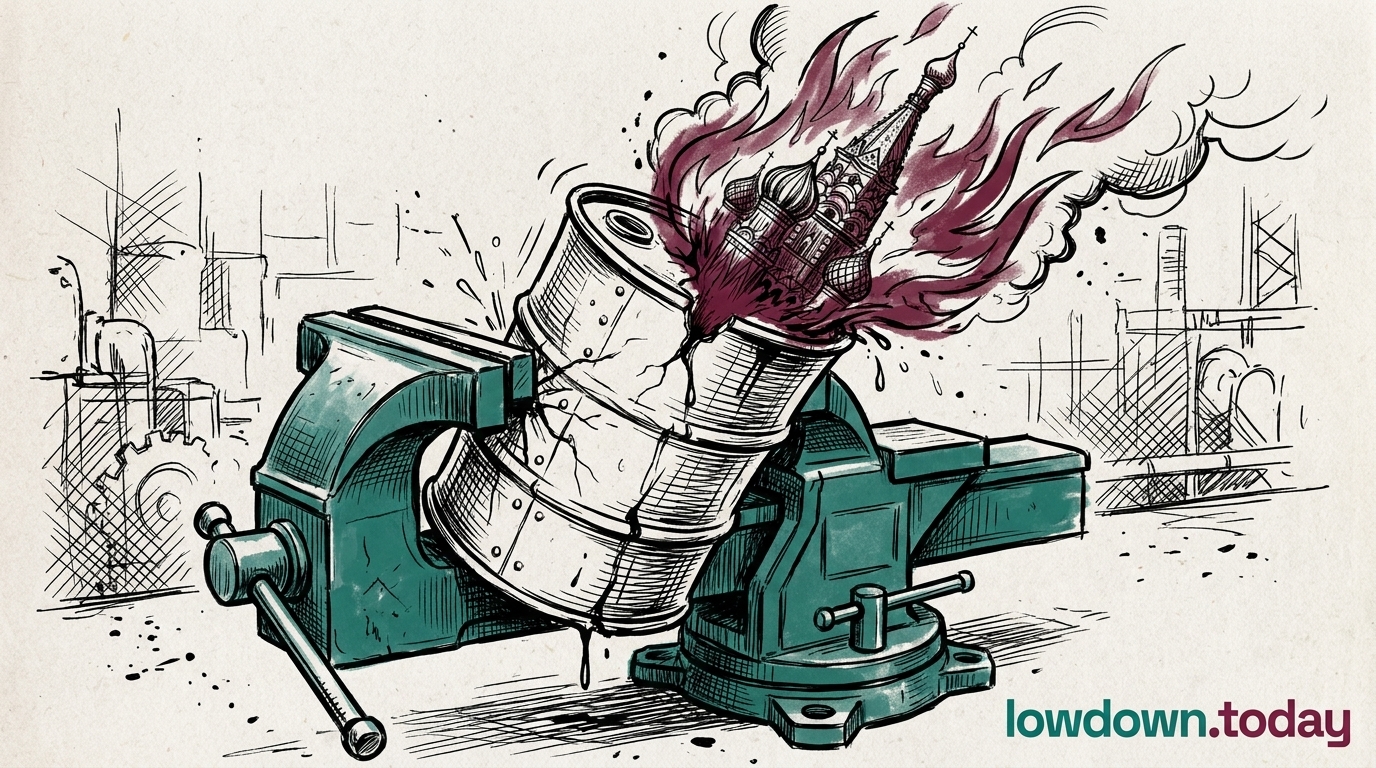
The EU's 20th package, adopted 23 April, left the full maritime-services ban out for lack of EU-27 unanimity, designating Karimun Oil Terminal in Indonesia but leaving the dark-fleet cost curve untouched.

ConflictDeveloping
Key takeaway

Port bans alone do not bite; the dark-fleet cost curve waits on a P&I withdrawal still stuck on G7 unanimity.

The EU's 20th sanctions package, adopted 23 April, left the full maritime-services ban on Russian shadow-fleet shipping out for lack of unanimity among the 27 member states, with any future adoption conditional on G7 and price-cap-coalition coordination 1. So 632 listed vessels now carry port bans, yet the P&I withdrawal that would actually reprice the dark-fleet cost curve is still pending. The shadow-fleet economics the KSE Institute tracked, with the Russian-flagged share leaping to 21% , have not moved on this package.

What the package did do was designate Karimun Oil Terminal, an Indonesian VLCC-to-smaller-vessel transfer point used to launder Russian crude origin, closing one transshipment route 2. That is a single-node closure, not a systemic squeeze. A port ban removes specific ships from specific berths; an insurance withdrawal removes the cover that lets the whole fleet sail, and only the second one changes the cost of moving a sanctioned barrel.

The G7 Kananaskis summit on 12-15 June is the next place that unanimity could be forced. Until it is, the systematic insurance squeeze stays a threat rather than a cost, and the dark fleet keeps absorbing barrels at the freight premium it has already priced. The summit sits five days after OPEC+ meets and five days before the 134C expiry, so mid-June stacks three policy hinges in a single window.


Deep Analysis

In plain English

The EU passed its 20th round of Russia sanctions in April, but left out the measure that would matter most for cutting Russian oil income: a ban on European shipping insurance and services for Russian oil tankers. Without that ban, the 632 Russian-linked vessels already barred from EU ports can simply use Russian or non-Western insurance to keep operating. The reason the ban was left out is political: all 27 EU countries must agree, and several Eastern European states depend on a pipeline from Russia and are reluctant to tighten the screw further. The next chance to force agreement is a G7 leaders meeting in Canada in mid-June.

Deep Analysis
Root Causes

The maritime-services ban's unanimity failure reflects a specific geographic dependency: the five EU member states that receive Druzhba pipeline crude (Hungary, Slovakia, Czech Republic, Austria, and Croatia) face no freight or insurance exposure from a seaborne ban ; they buy their Russian crude via pipeline ; but they have sufficient political weight to block measures that would structurally raise NWE seaborne crude costs.

This creates a perverse incentive: the states least exposed to the ban's costs are the ones that need to consent to it.

The Karimun Oil Terminal designation (Indonesia) is the EU's most operationally precise move in the package: it closes a specific VLCC transshipment route used to move dark-fleet barrels into the Asia-Pacific market without European port calls. This does not require unanimity ; port access designations under EU Regulation 833/2014 can be adopted with qualified majority on specific asset listings.

What could happen next?
  • Risk

    Without the P&I insurance pull at Kananaskis, 632 shadow-fleet vessels retain operational freedom on third-country cover; the shadow-fleet Russian-flag share rising from 3% to 24% in nine months accelerates toward full Russian-sovereign logistics.

  • Precedent

    The Karimun Oil Terminal designation establishes a precedent for targeting non-EU transshipment nodes under qualified-majority procedures, bypassing the unanimity requirement that blocked the broader maritime ban.

First Reported In

Update #2 · GL 134C reverses the cliff, Brent -$14

Hill Dickinson· 26 May 2026
Read original
Causes and effects
Different Perspectives
Belgium
Belgium
Belgium blocked outright confiscation of the roughly EUR 210bn in frozen Russian assets held at Euroclear in December 2025, because Euroclear would carry the legal liability. Ukraine has since proposed moving custody to the EU instead.
European Commission
European Commission
The Commission said on 2 September that Ukraine has drawn EUR 3.2bn against an EUR 8.35bn annual target, and that a revenue-mobilisation law stuck in the Rada is one of twelve conditions for the next EUR 3.7bn payment.
Steve Witkoff and Jared Kushner
The US envoys met Putin in Moscow on 5 September and Zelenskyy in Kyiv on 6 September without an announced result from more than three hours of talks. Their mediation continues with no public outcome to show for this round.
Robert Brovdi
Robert Brovdi
Brovdi said on 12 September that his Unmanned Systems Forces struck 285 Russian tankers in ten weeks. His own monthly breakdown sums to 79, and he has given no account of the remaining 206.
Sergei Lavrov
Sergei Lavrov
Lavrov said on 12 September that Russia is ready to negotiate but will not suspend military operations while it does. He treats talking and fighting as compatible policies, ruling out a ceasefire as a precondition for further talks.
Belarus
Belarus
Minsk announced completion of its own 37th Separate Airborne Assault Brigade near Gomel, under plans dating to August 2025 rather than a response to any single frontline event this window, keeping its hedge of hosting the war without formally joining Russia's mobilisation drive.


