Skip to content
Briefings are running a touch slower this week while we rebuild the foundations.See roadmap
Iran Conflict 2026
16MAY

Iran delivers 14-point ceasefire text via Pakistan

3 min read
12:41UTC

Foreign Minister Abbas Araghchi handed Islamabad a written 14-point ceasefire proposal on 1 May, with a 30-day deadline, war reparations and an end to the fighting in Lebanon among the conditions.

ConflictDeveloping
Key takeaway

Iran's fourth written text fixes Lebanon as a clause in the Tehran negotiation with a 30-day clock attached.

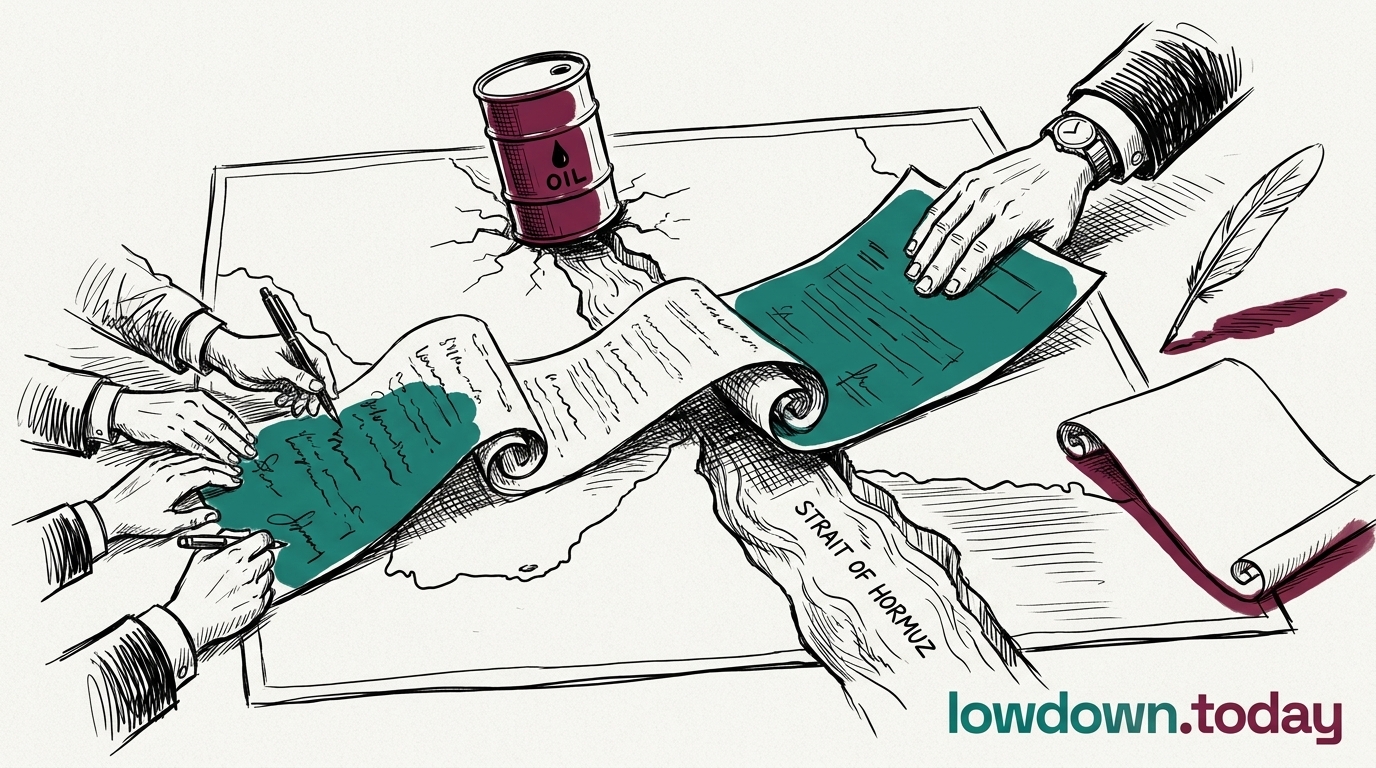
Iran's Foreign Minister Abbas Araghchi delivered a written 14-point ceasefire proposal to Pakistan for onward transmission to Washington on Friday 1 May 1. Pakistan has been the documented mediation channel for US-Iran exchanges since the opening weeks of the war; the new text advances the fourth-text framework already delivered through the same conduit . Where the earlier two-phase and three-phase proposals were sequenced negotiating sketches, the 14-point document is structured as a single ceasefire instrument with a 30-day deadline.

Tehran demands lifting of the CENTCOM naval blockade, release of Iranian foreign-currency reserves frozen under US sanctions, payment of war reparations, US withdrawal from Iran's periphery, an end to the fighting in Lebanon, and a new transit-governance mechanism for the Strait of Hormuz, the 33-kilometre chokepoint at the mouth of the Persian Gulf through which roughly a fifth of global oil shipments pass. The Hormuz clause asks Washington to negotiate around the IRGC's informal toll mechanism rather than dismantle it.

'An end to the fighting in Lebanon' inside the Iranian text is the document's most consequential structural move. Washington has treated the Lebanon war as a parallel theatre handled through its monitoring track in Beirut. Tehran has now pulled it inside the Iran negotiation as a deliverable. That linkage means any 30-day Iranian timeline now requires Israeli operational restraint in southern Lebanon to count as compliance. The Pakistani channel becomes the evidentiary trail for whether the demand is met; if the channel falters, both sides lose their record of what was offered and what was refused.

Deep Analysis

In plain English

Iran's foreign minister sent a detailed, 14-item peace proposal to the United States through Pakistan on 1 May. Think of it as a formal written demand list rather than a casual offer. Iran wants a ceasefire within 30 days, an end to the US naval blockade that is stopping Iranian ships, compensation for war damage, release of Iranian funds frozen abroad, US military bases pulled back from Iran's neighbourhood, an end to fighting in Lebanon, and a new agreed rulebook for who controls the Strait of Hormuz. The US has not yet produced any written reply.

Deep Analysis
Root Causes

Iran's civilian government, specifically Foreign Minister Araghchi, faces a structural problem: it negotiates in writing while the IRGC negotiates by fact on the water. Every written text Tehran submits that the US rejects strengthens the IRGC's argument that diplomacy cannot secure Iran's minimum demands.

The 14-point text is therefore as much an internal Iranian instrument as an external one: it commits the IRGC leadership to a written set of terms they cannot later deny, while giving Araghchi documented proof he pursued a diplomatic route.

The inclusion of war reparations and frozen-asset release reflects Iran's economic position: with OFAC GL-V wind-downs imminent and Chinese refineries under simultaneous legal pressure, Tehran needs dollar-denominated asset access to fund reconstruction whether or not the war ends. The 14-point text packages economic demands inside a diplomatic instrument to give them ceasefire legitimacy.

What could happen next?
  • Consequence

    Pakistan's role as text-carrier gives Islamabad formal status in any eventual ceasefire architecture; a US refusal to engage in writing leaves Pakistan holding an unanswered diplomatic instrument with no procedural mechanism to close the gap.

    Short term · 0.8
  • Risk

    The Lebanon clause (end to fighting in Lebanon as a condition) structurally links the Iran ceasefire timeline to IDF operational tempo in southern Lebanon; Israeli escalation in Lebanon directly undermines Iran's stated terms.

    Short term · 0.85
  • Opportunity

    The 14-point written format, unlike earlier verbal signals, gives negotiators on both sides a reference document from which individual points can be quietly dropped in back-channel exchanges without requiring public admission of movement.

    Medium term · 0.6
First Reported In

Update #87 · China blocks OFAC; Iran writes; Trump tweets

NPR· 3 May 2026
Read original
Different Perspectives
India (BRICS meeting host, grey-market beneficiary)
New Delhi hosted the BRICS foreign ministers' meeting on 14 May that Araghchi attended under the Minab168 designation, giving India a front-row seat to Iran's diplomatic positioning. India's state refiners have been absorbing discounted Iranian crude through grey-market routing since April; Brent at $109.30 means every barrel sourced outside the formal market generates a structural saving.
Hengaw / Kurdish human rights monitors
Hengaw's daily reports from Iran's Kurdish provinces remain the sole independent cross-check on Iran's judicial activity during the conflict. Two executions across Qom and Karaj Central prisons on 15 May and five Kurdish detentions on 15-16 May indicate the wartime judicial pipeline is operating independently of military tempo.
Pakistan (mediator and bilateral partner)
Islamabad spent its diplomatic capital as the US-Iran MOU carrier to secure LNG passage for two Qatari vessels through a bilateral Pakistan-Iran agreement, spending its mediation credit for direct economic gain. China's public endorsement of Pakistan's mediatory role on 13 May is the structural reward.
China and BRICS bloc
Beijing endorsed Pakistan's mediatory role on 13 May, one day after the BRICS foreign ministers' meeting in New Delhi. Chinese state banks are processing PGSA yuan toll payments; China has not commented on its vessels' continued Hormuz passage, but benefits structurally from a non-dollar toll system it did not design.
Iraq (bilateral passage partner)
Baghdad negotiated a 2-million-barrel VLCC transit without paying PGSA yuan tolls, offering political alignment in lieu of cash. Iraq's position inside Iran's adjacent bloc makes it the natural first bilateral partner and a template for how Tehran structures passage deals with states that cannot afford Western coalition membership.
Bahrain and Qatar (Gulf signatories)
Both signed the Western coalition paper while hosting US Fifth Fleet and CENTCOM's Al Udeid base, respectively. Qatar occupies the sharpest contradiction: it is on coalition paper while simultaneously receiving LNG passage through the bilateral Iran-Pakistan track, a position Doha has tacitly accepted from both sides.