Skip to content
Briefings are running a touch slower this week while we rebuild the foundations.See roadmap
Iran Conflict 2026
16MAY

Iran's fourth ceasefire text on 1 May

3 min read
12:41UTC

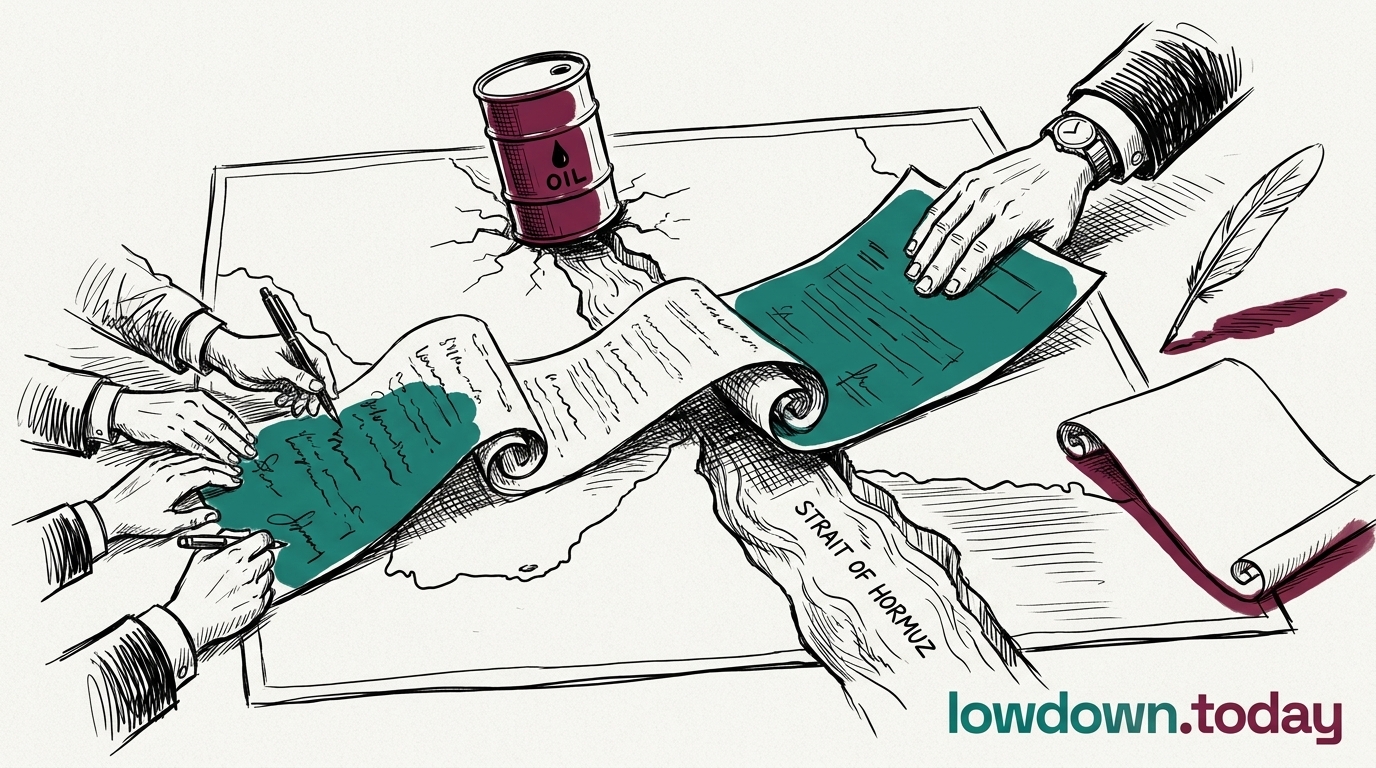
Tehran handed Pakistani mediators a fourth ceasefire text on 1 May offering Hormuz reopening for an end to the US blockade, with nuclear talks deferred to a post-war phase.

ConflictDeveloping
Key takeaway

A fourth proposal restating Hormuz-first, nuclear-last sequencing reaches Washington via Islamabad.

Iran delivered a fourth ceasefire text to Pakistan on Friday 1 May; Pakistani officials confirmed forwarding it to Washington the same afternoon 1. The proposal reportedly mirrors the two-phase structure Tehran put forward on 28 April , offering Hormuz reopening and a halt to attacks on shipping in exchange for the United States lifting the Hormuz blockade and ending the war, with nuclear talks deferred to a phase that would only begin once the war is formally over.

Pakistan has been the operational back-channel for every Iranian proposal of the war, which makes its role here mechanical rather than diplomatic: Islamabad receives Tehran's text and walks it across to Washington, without amending the terms. Sequencing remains the substantive sticking point. Iran wants the blockade lifted and the war declared ended before the nuclear file is reopened; Trump's public position requires the nuclear file resolved first. The two demands cannot both be the precondition for the same conversation.

Foreign Minister Abbas Araghchi asked Washington to drop its 'threatening rhetoric' and 'expansionist approach' after delivery. Mojtaba Khamenei, who succeeded his father as Supreme Leader in March, restated that foreign forces have no place in the Persian Gulf 'except the depths of its waters' . Both statements are maximalist openings rather than negotiating signals; the structural concession is the offer to reopen the strait at all, given the toll regime Tehran codified into domestic law in March.

The text has not been published. Whether the 1 May iteration moves on enrichment duration, monitoring architecture or sequencing, in any way the prior three did not, will not be establishable from open sources until Tehran or Washington chooses to release it. The market read of the proposal, captured in Brent's same-session move, is the next event.

Deep Analysis

In plain English

Pakistan has been acting as a go-between in this conflict, carrying messages between Iran and the United States because the two countries have no direct diplomatic channel. On 1 May, Iran sent its fourth proposed ceasefire deal through Pakistan, offering to reopen the Strait of Hormuz in exchange for the US ending its military blockade, with nuclear talks saved for a later phase. Both sides disagreed on the order of steps. Iran wants the Hormuz situation resolved first, then nuclear talks. The US wants nuclear commitments first, then Hormuz. Both sides are using the other issue as leverage, which is why the fourth proposal (like the first three) did not lead to a deal.

Deep Analysis
Root Causes

Pakistan's mediating role rests on a structural constraint: it is the only channel with civilian and IRGC buy-in on the Iranian side. Araghchi speaks for Pezeshkian's civilian government; Mojtaba Khamenei speaks for the IRGC-backed Supreme Leader office.

When both restate maximum positions after delivery of the fourth text, it signals that the document's submission does not represent a unified Iranian position, and that Pakistan is forwarding a proposal whose internal contradictions have not been resolved.

The Hormuz-last demand from Washington traces to Rubio's public framing in late April: the US will not allow Hormuz reopening to remove Iran's primary negotiating leverage before the nuclear question is resolved.

Iran's sequential demand inverts this: Tehran will not allow the nuclear programme (described by Mojtaba as a national asset that '90 million Iranians will protect') to be addressed while the country is under active military blockade. Each side's sequencing demand is a leverage-preservation mechanism, not a genuine procedural preference.

What could happen next?
  • Consequence

    With four consecutive ceasefire failures following the same sequencing structure, the probability of a breakthrough before the 11 May Murkowski AUMF deadline is low absent a new mediating framework or changed battlefield conditions.

  • Risk

    Pakistan's continued forwarding of proposals both sides reject publicly risks reducing Islamabad's credibility as a neutral channel, making subsequent rounds harder to construct on the same framework.

First Reported In

Update #86 · Trump signs paper. The paper ends the war.

Al Jazeera· 2 May 2026
Read original
Different Perspectives
India (BRICS meeting host, grey-market beneficiary)
New Delhi hosted the BRICS foreign ministers' meeting on 14 May that Araghchi attended under the Minab168 designation, giving India a front-row seat to Iran's diplomatic positioning. India's state refiners have been absorbing discounted Iranian crude through grey-market routing since April; Brent at $109.30 means every barrel sourced outside the formal market generates a structural saving.
Hengaw / Kurdish human rights monitors
Hengaw's daily reports from Iran's Kurdish provinces remain the sole independent cross-check on Iran's judicial activity during the conflict. Two executions across Qom and Karaj Central prisons on 15 May and five Kurdish detentions on 15-16 May indicate the wartime judicial pipeline is operating independently of military tempo.
Pakistan (mediator and bilateral partner)
Islamabad spent its diplomatic capital as the US-Iran MOU carrier to secure LNG passage for two Qatari vessels through a bilateral Pakistan-Iran agreement, spending its mediation credit for direct economic gain. China's public endorsement of Pakistan's mediatory role on 13 May is the structural reward.
China and BRICS bloc
Beijing endorsed Pakistan's mediatory role on 13 May, one day after the BRICS foreign ministers' meeting in New Delhi. Chinese state banks are processing PGSA yuan toll payments; China has not commented on its vessels' continued Hormuz passage, but benefits structurally from a non-dollar toll system it did not design.
Iraq (bilateral passage partner)
Baghdad negotiated a 2-million-barrel VLCC transit without paying PGSA yuan tolls, offering political alignment in lieu of cash. Iraq's position inside Iran's adjacent bloc makes it the natural first bilateral partner and a template for how Tehran structures passage deals with states that cannot afford Western coalition membership.
Bahrain and Qatar (Gulf signatories)
Both signed the Western coalition paper while hosting US Fifth Fleet and CENTCOM's Al Udeid base, respectively. Qatar occupies the sharpest contradiction: it is on coalition paper while simultaneously receiving LNG passage through the bilateral Iran-Pakistan track, a position Doha has tacitly accepted from both sides.