Skip to content
Briefings are running a touch slower this week while we rebuild the foundations.See roadmap
Iran Conflict 2026
3MAY

Day 65: China blocks OFAC; Iran writes; Trump tweets

4 min read
10:26UTC

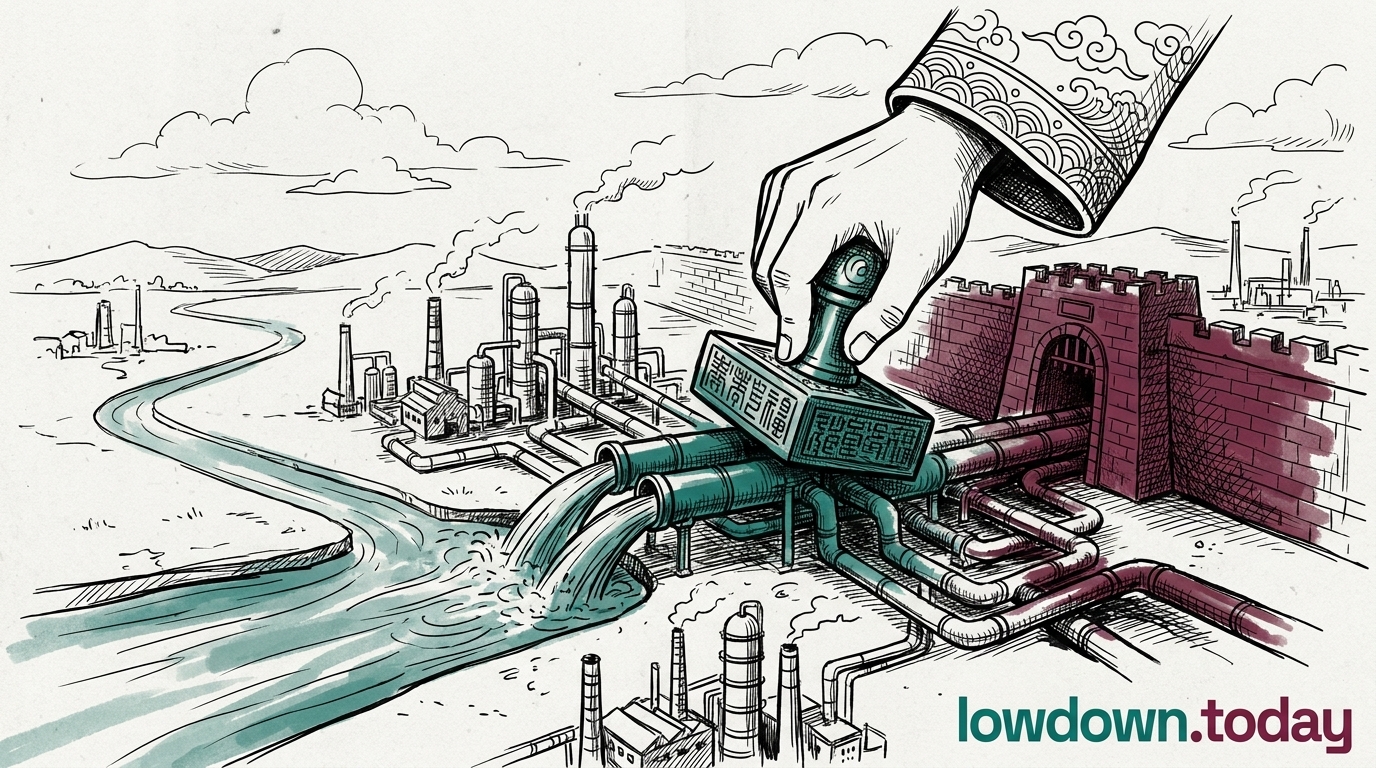
China invoked its 2021 Blocking Rules for the first time, naming five refineries that may not comply with US Iran sanctions. Iran's Majlis ratified a Hormuz sovereignty law and sent Washington a 14-point text. Trump's reply was verbal. A Kurdish protester was hanged at Urmia.

Key takeaway

Three actors signed paper on Iran's future this weekend; one tweeted.

This briefing mapped
Loading map…
Regulatory
Diplomatic
Military
Legal
Humanitarian

Beijing's MOFCOM named five refineries as legally barred from honouring OFAC's Iran sanctions, the first activation of the 2021 statute and the first Chinese countermeasure to outpace Brussels.

Sources profile:This story draws on neutral-leaning sources from China (includes China state media)
China

China's Ministry of Commerce activated its 2021 Blocking Rules on 2 May for the first time, naming five Chinese refineries it is now legally barred from following US Treasury sanctions orders. The move puts the refineries inside two contradictory legal frameworks simultaneously.

Any Chinese firm that complies with US sanctions can now be sued in Chinese courts under Article 9. China holds the UN Security Council presidency for May, giving Beijing simultaneous legal, diplomatic, and multilateral cover for the challenge. 

Foreign Minister Abbas Araghchi handed Islamabad a written 14-point ceasefire proposal on 1 May, with a 30-day deadline, war reparations and an end to the fighting in Lebanon among the conditions.

Sources profile:This story draws on centre-left-leaning sources from United States and Qatar
United StatesQatar

Iran's Foreign Minister Abbas Araghchi sent a 14-item written peace proposal to Washington through Pakistan on 1 May. It demands a ceasefire within 30 days, an end to the US naval blockade, war reparations, release of frozen Iranian funds, US base withdrawals from the region, and an end to the fighting in Lebanon.

Oil prices fell almost $15 a barrel on the news before Trump's rejection reversed the move. No US written reply has been issued. 

Sources:NPR·Al Jazeera
1 NPR

Donald Trump rejected Tehran's 14-point proposal on Truth Social on 2 May and warned reporters in Florida that strikes could resume; no written counter-text was issued.

Sources profile:This story draws on centre-left-leaning sources from Qatar
Qatar

Trump rejected Iran's 14-point ceasefire proposal on Truth Social on 2 May, saying Iran had 'not yet paid a big enough price' and warning that strikes could restart. Trump issued no written counter-proposal, marking the fourth consecutive verbal rejection of an Iranian written offer.

The pattern spans 65 days: Iran has submitted four written proposals; the White House has signed zero Iran executive instruments. Cabinet departments continue filing paper; the Oval Office does not. 

Sources:Al Jazeera

Iran's Revolutionary Guard told Tasnim on 2 May it is on full standby and disclosed that roughly 60% of its small attack-boat fleet remains intact, the first wartime self-quantification of asset survival.

Sources profile:This story draws on centre-left-leaning sources from Qatar
Qatar

Iran's Revolutionary Guard told state media on 2 May that roughly 60% of its small attack-boat fleet survived US and Israeli strikes since February, and that it stands at 'full standby' to resume fighting. The figure directly contradicts the US military commander's claim that Iran's sea trade was 100% halted.

Small fast-attack boats are the IRGC's primary tool for threatening shipping in the strait of Hormuz. A 60% surviving fleet retains enough craft for the swarm tactics the IRGC uses to close the strait

Sources:Al Jazeera

The National Security Committee of Iran's parliament cleared a 12-article statute on 2 May that permanently bars Israeli vessels and demands war reparations from 'hostile' states before transit; a full chamber vote is pending.

Sources profile:This story draws on centre-right-leaning sources from United Kingdom
United Kingdom

Iran's parliamentary security committee passed a 12-article law on 2 May claiming Iranian sovereignty over the strait of Hormuz, permanently banning Israeli ships and requiring vessels from 'hostile' states to pay war reparations before they can pass. A full 290-seat parliamentary vote is still needed.

International maritime law prohibits toll charges on international straits, but Iran never signed that convention. Whether the law holds depends on whether Iranian naval forces enforce it, not on lawyers. 

Mehrab Abdollahzadeh, a 27-year-old Kurdish barber arrested during the 2022 Woman Life Freedom protests, was executed at Urmia Central Prison on Sunday 3 May after a coerced-confession conviction and a denied retrial.

Sources profile:This story draws on neutral-leaning sources from Iran
Iran

Mehrab Abdollahzadeh, 27, a Kurdish barber from northwest Iran arrested during the 2022 protests, was hanged on 3 May at Urmia prison. A court convicted him on charges his lawyers said rested on a coerced confession; Iran's judiciary denied his retrial request.

Hengaw, a Norwegian Kurdish rights group, has documented 22 political executions in Iran in six weeks, one every two days, the fastest sustained rate since 1988. Three more prisoners were transferred from the same prison on 1 May. 

Iran's Permanent Mission at the UN told reporters on 2 May there is 'no legal limit' on uranium enrichment under IAEA supervision, the first explicit unlimited-rights claim since the Agency was locked out on 11 April.

Sources profile:This story draws on neutral-leaning sources

Iran's UN Mission told reporters on 2 May that Iranian law places no ceiling on uranium enrichment, provided international inspectors are watching. The UN nuclear agency has had no access to Iran's facilities since 11 April.

IAEA chief Rafael Grossi said on 29 April that 18 containers of high-enriched uranium at an Isfahan bunker are sealed but unverified by any inspector. Tehran's claim of unlimited rights under IAEA supervision depends on access it has simultaneously denied. 

Israeli strikes on Tyre, Bint Jbeil and Marjayoun districts killed 41 people in the 24 hours to 2 May, hitting roughly 70 military structures and 50 Hezbollah infrastructure sites by IDF count.

Israeli air strikes killed 41 people in southern Lebanon in the 24 hours ending 2 May (nearly triple the previous worst day of the conflict) hitting some 120 combined military and Hezbollah sites across Tyre, Bint Jbeil and Marjayoun.

Iran's ceasefire proposal to the US listed ending the Lebanon fighting as one of its 14 conditions. The strike acceleration directly complicates the 30-day ceasefire timeline Iran has set. 

Lebanese army chief Rodolphe Haykal met General Joseph Clearfield, head of the US-led ceasefire monitoring mechanism, in Beirut on Sunday 3 May; state media called the contact 'exceptional'.

Lebanon's army chief General Rodolphe Haykal met US General Joseph Clearfield in Beirut on 3 May for what Lebanese state media called an 'exceptional' meeting, the highest-tempo military contact since the 16 April ceasefire. The timing followed Israeli strikes that killed 41 people in southern Lebanon the previous day.

In ceasefire monitoring practice, 'exceptional' means both parties believe the mechanism itself is under stress. Whether Clearfield's body can constrain IDF operations remains untested. 

OFAC issued General License W and designated three Iranian foreign-exchange houses including Radin Exchange under SB0483 on 1 May; the only executive order Donald Trump signed that day was on Cuba.

Sources profile:This story draws on mixed-leaning sources from Qatar
Qatar

US Treasury's OFAC designated three Iranian money-exchange businesses on 1 May and issued a wind-down licence for newly blocked firms. No Iran executive order was signed by the White House, the 65th consecutive day without a presidential Iran instrument.

OFAC's actions run automatically under a 2020 Trump executive order requiring no fresh signature. Senator Murkowski has set 11 May as her deadline to introduce a bill that would force the first congressional Iran authorisation onto Trump's desk. 

Closing comments

Sideways with an upward ratchet. The kinetic tempo is not rising: no IRGC small-boat operations resumed, no new CENTCOM interdictions. But the legal architecture is tightening in one direction only. The specific mechanism that tips escalation upward: OFAC enforcement against any of the five named Chinese refineries after the 2 May Blocking Rules activation. That would force Chinese courts either to adjudicate Article 9 damages or absorb the diplomatic cost of non-adjudication. The named actor is OFAC's enforcement division; the dated trigger is 24 May 2026, when GL-V expires and Hengli's wind-down window closes. A second mechanism: Israeli strike tempo in Lebanon above the 41-killed-per-day threshold invalidates Iran's 30-day ceasefire clause before negotiations begin, removing the Pakistani channel's utility. The Murkowski 11 May AUMF deadline is the only de-escalatory forcing event visible on the calendar.

Different Perspectives
China (MOFCOM)
China (MOFCOM)
Beijing activated its 2021 Blocking Rules on 2 May, naming five refineries and creating civil-liability exposure for any firm that honours OFAC enforcement against them. China now holds the only domestic statute formally invoked against the live US-Iran secondary-sanctions framework, placing it ahead of the EU's never-invoked 1996 Blocking Statute.
Iran
Iran
Araghchi delivered a 14-point written ceasefire text via Pakistan on 1 May while the IRGC simultaneously declared full standby and disclosed 60% fleet survival. The civilian track is writing the diplomatic record; the corps is pricing its residual swarm capability into any settlement that removes blockade leverage.
Pakistan
Pakistan
Islamabad accepted Iran's 14-point text for onward transmission on 1 May and forwarded it without amendment, preserving its mechanical back-channel function. Pakistan's mediating value now rests on whether the channel it carries can produce a written US reply; a fourth unanswered text narrows its leverage without ending it.
Israel
Israel
The IDF killed 41 people in southern Lebanon in the 24 hours to 2 May, nearly triple the prior wartime high, while Iran's ceasefire text explicitly demands Lebanon de-escalation as condition 14. Whether the tempo was coordinated with Washington or unilateral determines whether Lebanon can be offered as a concession in the Pakistan channel.
United States (Trump / White House)
Trump rejected Iran's 14-point proposal on Truth Social on 2 May without a written counter-text, the fourth consecutive verbal dismissal of an Iranian written offer. The presidential-actions index records zero Iran executive instruments at Day 65; the only signed order on 1 May addressed Cuba.
Lebanon (Lebanese Armed Forces)
Army chief Rodolphe Haykal held an 'exceptional' emergency meeting with US General Clearfield on 3 May after 41 Lebanese were killed the previous day; Lebanon holds no enforcement authority over the IDF and no leverage in the Iran-US channel. Haykal is keeping a monitoring mechanism open in form while kinetic reality drains the content out of it.