Skip to content
Briefings are running a touch slower this week while we rebuild the foundations.See roadmap
Iran Conflict 2026
16MAY

Every named ally refuses Hormuz escort

3 min read
12:41UTC

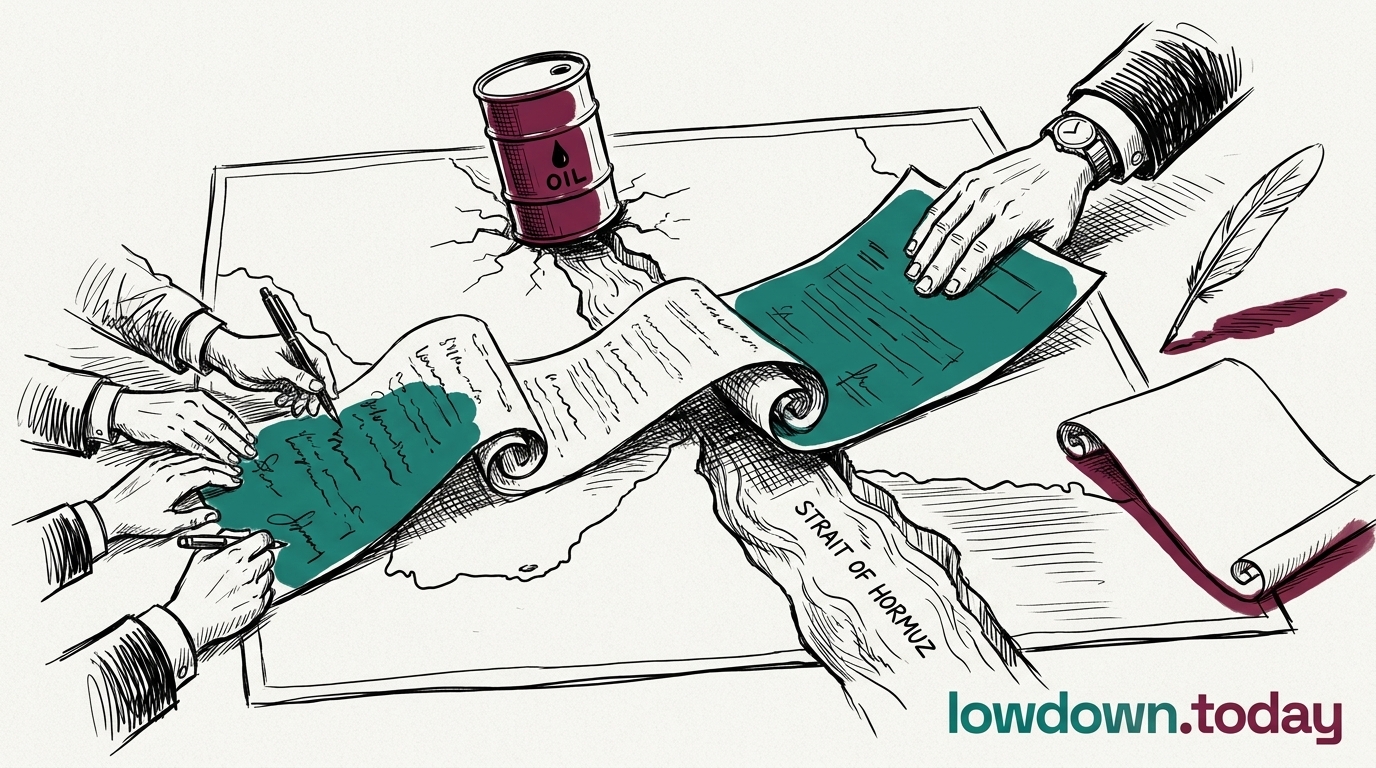
Within 72 hours, all five countries Trump named for a Strait of Hormuz escort coalition formally declined — no government will send warships into what America's own navy calls a 'kill box.'

ConflictDeveloping
Key takeaway

Allied refusal reflects the US's own 'kill box' characterisation making the mission untenable for any partner.

Australia, Japan, the United Kingdom, Germany, and France — every country President Trump named for a Strait of Hormuz escort coalition — formally declined to send warships within 72 hours of his call. Forty-eight hours in, none had committed . By Monday, all five had said no.

The refusals were explicit. Australia's Transport Minister Catherine King: "not among the contributions Australia is planning" 1. Japan's Prime Minister Takaichi: "current circumstances do not warrant military participation" 2. UK Prime Minister Starmer: "We will not be drawn into the wider war" 3. Germany had already refused. France offered Paris for Lebanon talks, not frigates for tanker escorts. Trump, at a press conference: "Some are very enthusiastic, and some are less than enthusiastic." He singled out Starmer: "He didn't really want to do it. I was not happy with the UK" 4.

The logic behind each refusal is the same. US Navy officials have described the strait as an Iranian "kill box" with pre-registered fire zones . Daily transits have fallen from a historical average of 138 to single digits, and more than 300 commercial vessels remain stranded. No government will place its sailors inside a zone that America's own commanders characterise as indefensible.

The Coalition's collapse accelerates a different framework. India negotiated bilateral passage for two LPG tankers through direct diplomacy with Tehran, conditioned on returning three seized tankers. China's 11.7 million barrels of Iranian oil have transited Hormuz since 28 February on shadow fleet vessels broadcasting Chinese ownership. Iran is constructing a two-tier strait: closed to the United States and military allies, conditionally open to those it wants to keep neutral — and the countries that matter most for global oil supply now have every incentive to deal with Tehran directly rather than join an American-led fleet into waters the Americans themselves call lethal.

Deep Analysis

In plain English

Trump asked five allied countries to send warships to escort oil tankers through the Strait of Hormuz. All five said no within three days. The US Navy had already described the strait as a 'kill box' — Iranian firing positions are pre-registered, and ships transiting number fewer than ten per day against a historical average of 138. The allies are effectively taking the US military's own threat assessment at face value and declining to send sailors into waters the US itself considers near-suicidal. The refusal also reflects a deeper incoherence. Treasury Secretary Bessent admitted the same day that the US is deliberately allowing Iranian oil tankers through unmolested. Allies watching that admission concluded Washington does not actually want a full maritime confrontation — making any escort mission politically indefensible at home.

Deep Analysis
Synthesis

The coalition collapse, read alongside Bessent's simultaneous admission that Iranian oil is deliberately permitted through Hormuz, reveals a fundamental contradiction at the core of US strategy. Washington is conducting kinetic strikes on Iran while preserving Iran's oil revenue and failing to build maritime protection for the strait it claims is strategically vital. Allies may be reading this contradiction accurately — their refusal is less a diplomatic rebuff than a rational response to an incoherent US posture.

Root Causes

Three structural factors drove the refusals. First, post-Iraq and post-Afghanistan NATO burden-sharing fatigue: European publics and parliaments have no appetite for discretionary Gulf deployments. Second, Bessent's public admission that Iranian oil is deliberately permitted through undermines the coalition's stated rationale — allies cannot justify naval risk to enforce a blockade Washington is voluntarily not enforcing. Third, European economic exposure to elevated oil prices gives allied governments a direct material interest in avoiding actions that could further restrict Gulf supply.

Escalation

The coalition collapse reduces near-term risk of an allied naval confrontation with Iran. However, it may compel the US toward unilateral naval action to avoid the appearance of strategic paralysis. A unilateral US move into Iranian 'kill box' conditions, without allied intelligence-sharing or air cover, carries higher accident-escalation risk than any coordinated coalition would have.

What could happen next?
  • Precedent

    Universal allied refusal within 72 hours establishes that resistance to US Gulf coalition requests is politically survivable and replicable.

    Long term · Assessed
  • Meaning

    The US cannot assemble willing allied naval power for a mission it frames as critical to global oil supply.

    Immediate · Assessed
  • Consequence

    Iran retains effective control over Hormuz commercial access without facing a multinational naval challenge.

    Short term · Assessed
  • Risk

    The US may respond with unilateral naval action, raising accident-escalation risk without allied coordination or shared intelligence.

    Short term · Suggested
First Reported In

Update #38 · Israel enters Lebanon; Hormuz pact fails

CNBC Hormuz coalition· 17 Mar 2026
Read original
Different Perspectives
India (BRICS meeting host, grey-market beneficiary)
New Delhi hosted the BRICS foreign ministers' meeting on 14 May that Araghchi attended under the Minab168 designation, giving India a front-row seat to Iran's diplomatic positioning. India's state refiners have been absorbing discounted Iranian crude through grey-market routing since April; Brent at $109.30 means every barrel sourced outside the formal market generates a structural saving.
Hengaw / Kurdish human rights monitors
Hengaw's daily reports from Iran's Kurdish provinces remain the sole independent cross-check on Iran's judicial activity during the conflict. Two executions across Qom and Karaj Central prisons on 15 May and five Kurdish detentions on 15-16 May indicate the wartime judicial pipeline is operating independently of military tempo.
Pakistan (mediator and bilateral partner)
Islamabad spent its diplomatic capital as the US-Iran MOU carrier to secure LNG passage for two Qatari vessels through a bilateral Pakistan-Iran agreement, spending its mediation credit for direct economic gain. China's public endorsement of Pakistan's mediatory role on 13 May is the structural reward.
China and BRICS bloc
Beijing endorsed Pakistan's mediatory role on 13 May, one day after the BRICS foreign ministers' meeting in New Delhi. Chinese state banks are processing PGSA yuan toll payments; China has not commented on its vessels' continued Hormuz passage, but benefits structurally from a non-dollar toll system it did not design.
Iraq (bilateral passage partner)
Baghdad negotiated a 2-million-barrel VLCC transit without paying PGSA yuan tolls, offering political alignment in lieu of cash. Iraq's position inside Iran's adjacent bloc makes it the natural first bilateral partner and a template for how Tehran structures passage deals with states that cannot afford Western coalition membership.
Bahrain and Qatar (Gulf signatories)
Both signed the Western coalition paper while hosting US Fifth Fleet and CENTCOM's Al Udeid base, respectively. Qatar occupies the sharpest contradiction: it is on coalition paper while simultaneously receiving LNG passage through the bilateral Iran-Pakistan track, a position Doha has tacitly accepted from both sides.