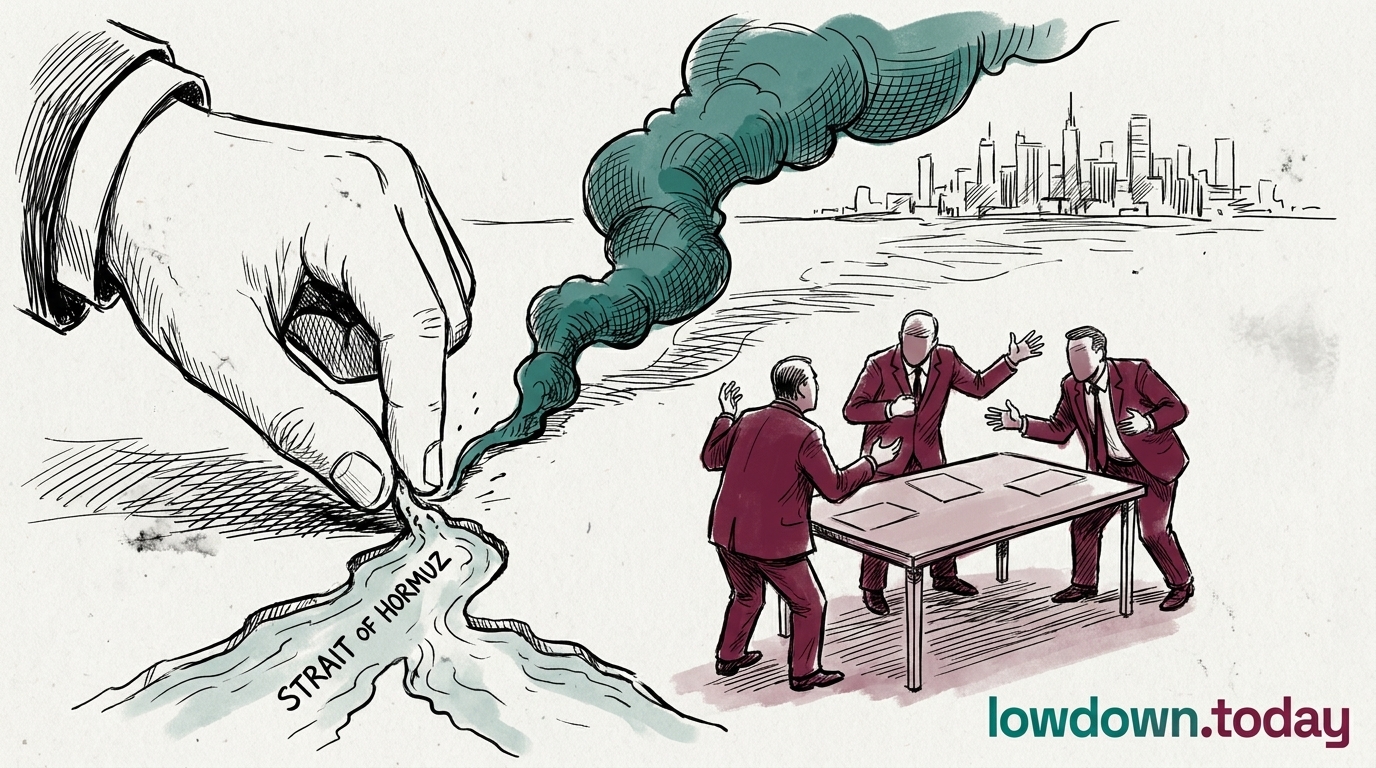
Iran fired ten ballistic missiles at Jordan's Azraq air base, which hosts US troops and aircraft, on 9 July; Jordan reported eight intercepted and no casualties.1 The same day the Islamic Revolutionary Guard Corps (IRGC) struck Bahrain's Fifth Fleet headquarters, Kuwait and Qatar with one-way attack drones and missiles, and targeted a Patriot interceptor battery, a mobile surface-to-air missile unit, on Qatari soil.2
Jordan is the first non-Gulf, no-coastline partner drawn onto the strike map, extending a retaliation that through 8 July had run as a US-Iran and Gulf-coastal exchange. Bahrain's interior ministry ordered residents to shelter and sirens sounded, while Kuwait shut its Flight Information Region (FIR), the block of airspace it controls, to all but vetted arrivals.3 The IRGC named the United Arab Emirates (UAE) as its next target if US strikes continue.4
Two systems that normally price escalation stayed still. Across 8 to 10 July The White House signed only an aircraft-tariff proclamation, unrelated to the war it was prosecuting, and nothing on Iran.5 Trump had already called the 16 June ceasefire memorandum over, but a Truth Social line is not a signed instrument.
One reading holds the flat signals correct: Jordan stopped eight of ten missiles, no one died, and the Doha channel is paused rather than dead.6 Aviation authorities lean the same way, reopening Qatar's Doha FIR to near-normal within a day and leaving Kuwait's as the only Gulf airspace still shut.7 The named Army dead and the strait's near-closure still show real cost accruing inside that bounded exchange, so "contained" reads as a market bet rather than a settled fact.


