Skip to content
Welcome, thoughtbot's Giant Robots listeners!Start here
Iran Conflict 2026
21APR

IRGC strikes container ship hours after Trump ceasefire extension

3 min read
10:51UTC

Lowdown Wire

ConflictDeveloping
Key takeaway

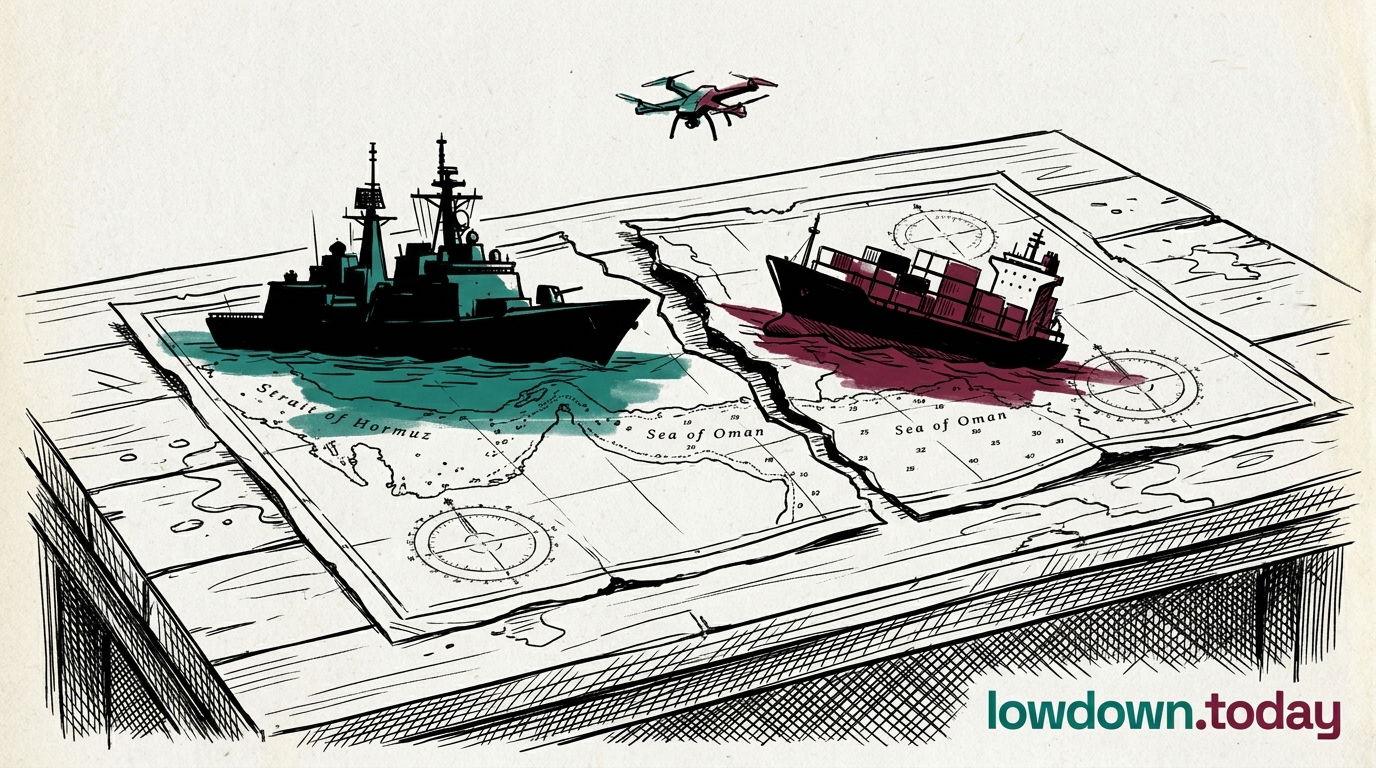
An IRGC Navy gunboat struck a container ship off Oman seven hours after Trump's indefinite ceasefire extension.

UKMTO Warning 041-26 went live at 03:55 UTC on 22 April, logging an IRGC Navy gunboat strike on a container ship roughly 15 nautical miles north-east of Oman⁠1. The master's report recorded no radio warning before fire, contradicting the framing Fars News ran hours later that the vessel had ignored Iranian warnings⁠2. UKMTO cited heavy damage to the bridge; no crew were injured, no fire broke out and no pollution was reported on either ship⁠3.

Donald Trump's indefinite extension on Truth Social had gone live seven hours earlier. A second vessel was fired on shortly afterwards in the Strait of Hormuz, unclaimed as of the alert's release and with no damage recorded⁠4. The pattern now runs to three IRGC strikes on commercial shipping in four days: the Sanmar Herald and Jag Arnav fired on despite radio clearance on 18 April, the CMA CGM Everglade damaged by an explosive device 25nm north-east of Oman the same night, and the 22 April bridge hit that followed a verbal ceasefire extension by seven hours.

Deep Analysis

In plain English

UKMTO is the Royal Navy's liaison cell for merchant shipping in the Gulf. When a warship or an armed vessel fires on a commercial ship, the master sends UKMTO a report, and UKMTO publishes a numbered warning to the shipping industry so other vessels can reroute. At 03:55 UTC on 22 April, that warning said an Iranian Revolutionary Guard gunboat had fired on a container ship about fifteen nautical miles north-east of Oman, causing heavy damage to the ship's bridge. UKMTO recorded the master's report that no radio warning preceded the gunfire. Seven hours earlier, President Trump had posted on Truth Social that the ceasefire with Iran was being extended indefinitely. The gunboats involved are fast, lightly armoured speedboats operated by Iran's Revolutionary Guard Navy, a separate force from the regular Iranian Navy and reporting to a different chain of command. A strike this soon after a ceasefire announcement raises the question of whether the announcement binds the units actually carrying out the blockade.

Deep Analysis
Root Causes

The IRGC Navy reports through The Supreme Leader's military chain, not the elected government; Ali Shamkhani's continued veto authority over negotiating concessions, combined with Ahmad Vahidi's role as IRGC intelligence interface, gives the strike decision structural independence from any Pakistani-shuttle extension delivered to the foreign ministry.

Tehran's blockade-counterpressure doctrine, updated in the 2024 maritime-law revision, frames strikes on commercial shipping as enforcement of Iranian jurisdiction over the strait rather than as escalation, so a verbal ceasefire on US blockade activity does not bind the IRGC's self-authorised enforcement operations.

The pattern of three strikes in four days, culminating hours after Trump's extension, indicates the IRGC unit-level decision loop treats the extension as irrelevant to its operating posture, consistent with an institutional reading of the Truth Social instrument as non-binding on the Iranian military track.

Escalation

The strike sits inside a four-day trajectory of three IRGC hits on commercial hulls, and the seven-hour gap from Trump's extension post to gunfire compresses the window in which the unsigned instrument can plausibly be described as functional.

CENTCOM's response envelope narrows with each unclaimed or contested incident; the 22 April case, where Fars News claimed the strike on-record while UKMTO's master report contradicted the lawful-enforcement framing, removes the deniability that constrained Washington's options in earlier Gulf crises. Short-term escalation risk tracks with whether CENTCOM reads this as a unit-level test of the extension or as a regime-level rejection of the Pakistani shuttle.

What could happen next?
  • Consequence

    London P&I Club and the Joint War Committee move war-risk additional premiums on Gulf-approach voyages 25 to 50 basis points higher within the week, reflecting the three-strikes-in-four-days sequence.

    Immediate · 0.78
  • Risk

    CENTCOM faces a forced response decision in advance of the 29 April WPR clock: either the 22 April strike is a unit-level deviation that Tehran will walk back, or the unsigned extension has already failed its operational test and a signed instrument becomes unavoidable.

    Short term · 0.74
  • Precedent

    On-record Fars News framing of the strike as lawful enforcement while UKMTO's master report contradicts the radio-warning claim removes the deniability template that constrained US response options in the 2019 Gulf of Oman limpet-mine incidents.

    Medium term · 0.8
  • Meaning

    The seven-hour gap between Trump's Truth Social post and the strike sets a baseline for how long an unsigned ceasefire instrument survives contact with IRGC Navy unit-level behaviour.

    Immediate · 0.72
First Reported In

Update #76 · Trump posts an exit Iran can't reach

UK Maritime Trade Operations· 22 Apr 2026
Read original →
Causes and effects
This Event
IRGC strikes container ship hours after Trump ceasefire extension
A third IRGC strike on commercial shipping in four days, logged seven hours after the indefinite verbal extension, tests whether Trump's Truth Social instrument binds the units executing the blockade. UKMTO's master report of no radio warning before fire contradicts Fars News's lawful-enforcement framing in real time, stripping Tehran's after-the-fact narrative of the ambiguity that earlier Gulf incidents allowed. For Washington, the gap between post and gunfire shortens the interval in which an unsigned extension can plausibly be called a functioning ceasefire, and pushes the CENTCOM response decision forward of the 29 April WPR clock.
Different Perspectives
International Energy Agency
G7 members agreed on 2 October to release up to 100 million barrels through the IEA over four months, front-loading diesel.
China
China
China signed the 15 October text reaffirming the Resolution 2216 arms embargo on the Houthis. The Wall Street Journal reported that Conflict Armament Research found Chinese parts in a Houthi copy of Iran's Kheibarshekan missile.
Russia
Russia
Russia joined the 15 October consensus condemning the Houthis, a month after vetoing a mandate for a UN panel of experts on Iran sanctions on 17 September. One Western official told Bloomberg that Moscow is providing Iran with missiles, and the White House rejected the assessment.
India
India
National Security Adviser Ajit Doval raised seafarer safety with Mohsen Rezaei on 12 October, after a drone hit the Petro Dolphin with 11 Indians aboard at Sohar. External Affairs Minister S. Jaishankar urged that attacks on commercial shipping and seafarers be avoided.
Lebanon
Lebanon
President Joseph Aoun met UN peacekeeping chief Jean-Pierre Lacroix in Beirut on 14 October as UNIFIL winds down before its mandate ends on 31 December. Two days later Qatar's prime minister pledged in Beirut to fund a solar plant for Lebanon.
Kataib Hezbollah
Kataib Hezbollah
The militia announced a halt to operations except against "hostile aircraft" and denied any disarmament deal with Prime Minister Ali al-Zaidi. A day later Quds Force chief Esmail Qaani urged eliminating "remaining traces of the US presence in other arenas".

Written with AI from Lowdown's published reporting. Not individually reviewed by an editor. Editorial standards.