Skip to content
Briefings are running a touch slower this week while we rebuild the foundations.See roadmap
Iran Conflict 2026
1MAR

Day 2: Pentagon produced no evidence for Iran war

5 min read
19:00UTC

Pentagon officials briefed Congress for 90 minutes without producing evidence that Iran posed an imminent threat, undercutting the legal basis for strikes now in their third day. Iran's retaliatory fire has set Dubai landmarks ablaze and shut Gulf airports. A 48-hour internet blackout has left 90 million Iranians in communications darkness as the IDF declared air supremacy over Iranian airspace.

Key takeaway

The campaign is militarily advanced but legally contested at home, and Iran has discovered that its years of diplomatic investment in BRICS and bilateral relationships have produced no ally willing to act when the test arrived.

This briefing mapped
Loading map…
Military
Diplomatic
Humanitarian
Economic
Legal
Domestic

More than 2,000 munitions across 24 of Iran's 31 provinces in 48 hours. An air defence network built over two decades has been functionally destroyed.

Sources profile:This story draws on centre-left-leaning sources from Qatar
Qatar

Israeli Defence Forces declared air supremacy over Iran on Saturday evening, 48 hours into the campaign, reporting more than 2,000 munitions dropped across 24 of Iran's 31 provinces, with the Israeli air force alone accounting for 1,200.

Air supremacy means the US-Israeli coalition can operate over Iran without effective resistance. Iran can no longer defend its own airspace, though it retains the ability to strike outward with ballistic missiles and drones from dispersed mobile launchers. 

Sources:Al Jazeera
Briefing analysis

The Pentagon's failure to substantiate the 'imminent threat' justification parallels the 2003 Iraq invasion, where the stated casus belli — weapons of mass destruction — was never found. A key difference: Congress authorised the 2003 war; this campaign has no congressional vote.

The 'no ground troops' pledge echoes the 2011 NATO intervention in Libya, where air power toppled the government but the absence of a stabilisation force contributed to state collapse and a civil war that persists fifteen years later. Iran's simultaneous leadership vacuum, military decapitation, and domestic unrest create conditions structurally similar to Libya's post-Gaddafi fragmentation.

Military Chief of Staff Abdul Rahim Mousavi is dead — the fifth senior figure killed since the strikes began. No tier of Iran's command architecture has a living head.

Sources profile:This story draws on centre-left-leaning sources from Qatar
Qatar

Iranian Military Chief of Staff Abdul Rahim Mousavi reportedly killed, according to Iranian state media as reported by Al Jazeera, extending the command decapitation that began with Khamenei, Shamkhani, Nasirzadeh, and Pakpour.

Five senior leaders killed in 48 hours leaves Iran fighting a foreign war, suppressing domestic unrest, and maintaining a naval blockade without a functioning command hierarchy. The interim political council has nominal authority but no military leadership left to direct. 

Sources:Al Jazeera

A US defence official concedes the conflict will last weeks. The Pentagon has not produced evidence for the 'imminent threat' that justified starting it without Congress.

Sources profile:This story draws on centre-left-leaning sources from Qatar
Qatar

A US defence official told Al Jazeera the war against Iran is expected to last 'weeks, not days.'

The acknowledgement that the campaign will last weeks, combined with the absence of evidence for the stated justification, reframes the conflict from emergency defensive action to extended war of choice. The distinction determines its political sustainability in Washington and its economic cost to every country dependent on Gulf energy. 

Sources:Al Jazeera

The president declared the Iran campaign 'ahead of schedule' on CNBC — the same day Pentagon officials reportedly failed to produce evidence of the imminent threat that justified launching it.

Sources profile:This story draws on centre-left-leaning sources from Qatar
Qatar

President Trump told CNBC the military operation against Iran was 'ahead of schedule.'

The contradiction between Trump's confident public framing and the absence of intelligence supporting the war's legal justification transforms the domestic political contest from debate over a defensive necessity to accountability for a policy choice, with war powers votes expected this week. 

Sources:Al Jazeera

Guterres condemned all sides; Russia invoked betrayal, Iran invoked war crimes, the US invoked non-proliferation. No binding resolution emerged.

Sources profile:This story draws on centre-left-leaning sources from United States
United States

At Saturday's UN Security Council emergency session, Secretary-General Guterres condemned the US-Israeli strikes as violations of international law and the UN Charter, while also condemning Iran's retaliatory strikes. Russia called it a 'real betrayal of diplomacy.' Iran's UN ambassador called it a 'war crime.' The US delegation asserted the strikes were lawful, stating 'Iran cannot have a nuclear weapon.'

The Security Council's inability to produce any binding response confirms that the institution's enforcement mechanism is structurally disabled when a permanent member is the belligerent — a design feature of the 1945 Charter, not a temporary breakdown. 

Sources:PBS

Iranian strikes killed one person and injured seven at Zayed International Airport — a civilian facility in a country that had no role in launching the war but hosts the air bases that helped enable it.

Sources profile:This story draws on centre-left-leaning sources from Qatar and United States
QatarUnited States

One person killed and seven injured at Zayed International Airport in Abu Dhabi from Iranian retaliatory strikes.

A civilian killed at Abu Dhabi's international airport exposes the structural flaw in Gulf security architecture: US military presence was designed as a shield for host nations but has in practice functioned as a target designator for Iranian retaliation. 

Iranian strikes damaged a concourse at the world's busiest international airport and grounded 70% of flights, threatening the connectivity-dependent economic model that underpins Dubai's prosperity.

Sources profile:This story draws on centre-left-leaning sources from Qatar and United States
QatarUnited States

A concourse at Dubai International Airport was damaged by Iranian strikes; 70% of flights were cancelled.

The 70% cancellation rate at the world's busiest international airport, combined with the strait of Hormuz closure, compromises both of Dubai's primary economic arteries — aviation and maritime trade — simultaneously. 

The Pentagon briefed Congress for 90 minutes on its legal basis for striking Iran. According to Newsweek, officials produced no evidence of the imminent threat cited to bypass congressional authorisation.

Sources profile:This story draws on left-leaning sources from United States
United States
LeftRight

Pentagon officials briefed congressional staff for 90 minutes in a bipartisan session and reportedly produced no evidence for the White House's 'imminent threat' claim — the stated justification for launching strikes without congressional authorisation.

The absence of evidence for the stated legal justification — imminent threat — removes the constitutional basis for launching military operations without congressional approval and exposes the campaign to challenge as an unauthorised war of executive choice. 

Sources:Newsweek

Congress will vote on war powers this week. The votes cannot override a presidential veto. What they can do is write the record of whether the legislature consented or objected — a record that outlasts the campaign.

Sources profile:This story draws on left-leaning sources from United States
United States
LeftRight

War powers votes expected in US Congress this week; will be symbolic as presidential veto cannot be overridden, but establish historical and legal record.

The expected votes are constitutionally unable to halt the campaign but will establish the formal legislative record of congressional consent or objection — a record that shaped political accountability after Iraq and will determine how this war is judged historically and legally. 

Sources:Newsweek
Sources profile:This story draws on neutral-leaning sources

Iran's internet blackout extended beyond 48 hours, with connectivity remaining at approximately 1% of normal levels (per NetBlocks), costing an estimated $35.7 million per day.

The continued blackout is the most severe in Iran's history and is imposing significant economic costs while the IRGC simultaneously fights externally, suppresses internal unrest, and reconstitutes its leadership. 

Sources:Wikipedia

Residents described the city as 'quiet' on Saturday — the first morning in 37 years without a Supreme Leader, and the first after a night of airstrikes on the capital's administrative core.

Sources profile:This story draws on centre-left-leaning sources from Qatar
Qatar

Tehran residents described a 'quiet' first morning — the first in 37 years without a Supreme Leader.

The reported quiet in Tehran reflects a population caught between the collapse of the old political order, active military bombardment, and mass civilian departure — a city suspended between the system that has ended and whatever replaces it. 

Sources:Al Jazeera

In some provinces security forces have retreated; in others, unverified reports describe them firing on crowds celebrating Khamenei's death — and the internet blackout ensures neither claim can be confirmed.

Sources profile:This story draws on centre-left-leaning sources from Qatar
Qatar

In some Iranian provinces, security forces have been overwhelmed or retreated. Unverified social media reports describe security forces firing on crowds celebrating the strikes.

The uneven security force response across Iranian provinces — retreat in some, reported lethal force in others — suggests provincial commanders may be making independent decisions in the absence of unified command, while the self-imposed communications blackout prevents verification of conditions on the ground. 

Sources:Al Jazeera

Brent crude rose 11% and gold hit a record $5,362 per ounce — but the numbers are far below what a sustained Hormuz closure would produce, revealing a market consensus that the strait will reopen.

Sources profile:This story draws on centre-left-leaning sources from United States
United States

Global markets reacted to the Iran conflict: Brent Crude opened at $82.37/barrel (+11%), gold hit a record $5,362/oz, Nikkei fell 2%, European futures dropped 2.3%, Dow futures fell 300 points.

Market pricing shows institutional investors believe the conflict will remain a contained air campaign without sustained disruption to global energy supplies — a bet that carries large downside risk if the strait of Hormuz closure holds or tanker attacks escalate. 

Sources:Bloomberg

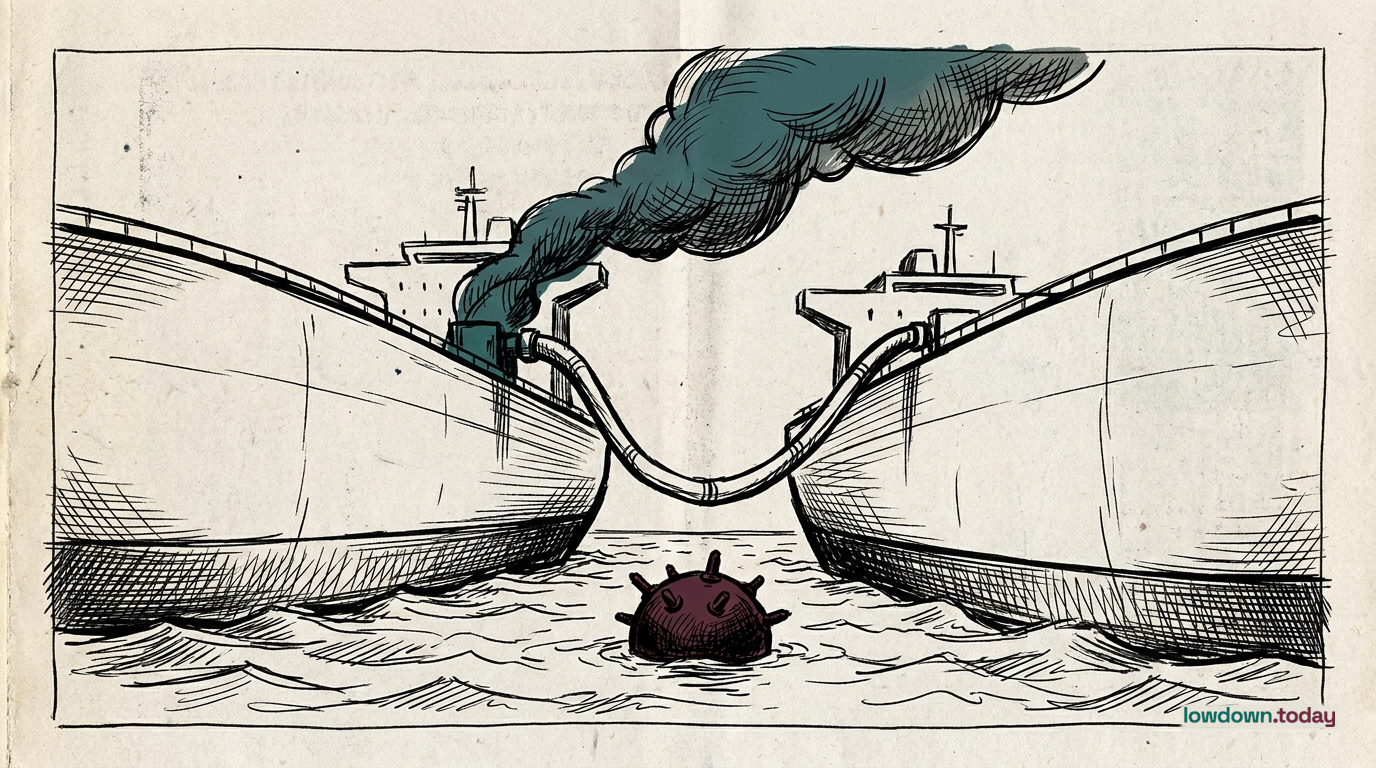
JP Morgan raised its recession probability to 35%, with one variable dominating the model: whether the Strait of Hormuz stays closed.

Sources profile:This story draws on centre-left-leaning sources from United States
United States

JP Morgan raised its recession probability estimate to 35%, with the strait of Hormuz disruption as the primary variable. Goldman Sachs and JP Morgan project $110–130 oil for a prolonged conflict.

The recession probability estimate quantifies the economic stakes of the Hormuz closure — the single factor most likely to determine whether the Iran conflict produces a manageable energy price increase or a global supply shock with food security consequences for import-dependent economies. 

Sources:Bloomberg

India's prime minister was in Israel 48 hours before the strikes began. His government has said nothing since.

Sources profile:This story draws on centre-leaning sources from Canada
Canada
LeftRight

India was conspicuously silent on the strikes. PM Modi had visited Israel on 25–26 February, 48 hours before the strikes began. The opposition Indian National Congress condemned the assassination of a head of state.

India's silence reflects an irreconcilable tension between its deepening defence relationship with Israel and its strategic and energy ties to Iran. The silence also weakens BRICS' collective response, since India's voice — as the bloc's largest democracy — would carry outsize weight. 

Ankara is building border infrastructure for mass displacement from a war it condemned but cannot stop — while still importing Iranian oil.

Sources profile:This story draws on centre-leaning sources from Canada
Canada
LeftRight

Turkey is preparing border infrastructure for up to one million refugees from the Iran conflict, while continuing to import Iranian oil.

Turkey's refugee preparation is the most operationally concrete response from any neighbouring state, acknowledging that the air campaign will produce mass displacement. It also creates future leverage over Washington, replicating how Ankara used Syrian refugee flows as a bargaining instrument with the EU. 

The country that took Israel to the ICJ over Gaza has not criticised Washington for striking Iran. The difference: the ICJ case cost nothing. Criticising the US costs billions.

Sources profile:This story draws on centre-leaning sources from Canada
Canada
LeftRight

South Africa has not criticised Washington over the Iran strikes, despite having taken Israel to the International Court of Justice over Gaza.

South Africa's restraint exposes the boundary between principled international legal action and the economic leverage that constrains it. The Global South's ability to challenge Western military operations depends on whether it can afford to. 

Closing comments

A US defence official told Al Jazeera the war will last 'weeks, not days.' Three escalation vectors remain active. First, the Strait of Hormuz: the IRGC closure broadcast has not been rescinded, and no commercial shipping is transiting; if the closure holds or tanker attacks begin, oil markets will reprice from $82 toward the $110–130 range Goldman Sachs and JP Morgan project. Second, militia activation: Kataib Hezbollah has declared it 'will not remain neutral' but has not yet struck; Hezbollah in Lebanon has not activated. Third, the Iranian domestic situation — with leadership decapitated, communications severed, and security forces overwhelmed in some provinces, the interim council faces simultaneous war, succession, and popular uprising. De-escalation paths are narrow: Iran has no single interlocutor capable of negotiating a ceasefire, the communications blackout prevents even internal coordination, and BRICS solidarity has failed to materialise as a diplomatic channel.

Emerging patterns

  • Systematic degradation of Iranian military infrastructure across nearly all provinces
  • Systematic decapitation of Iranian military and political command structure
  • US signalling extended campaign duration beyond initial air strikes
  • Political messaging framing campaign as successful
  • UNSC paralysis with no binding action despite escalating conflict
  • Critical transport infrastructure in Gulf states directly struck
  • Domestic legal challenge to war authorisation undermining stated casus belli
  • Congressional assertion of war powers authority despite inability to override veto
  • Post-Khamenei psychological shift in Iranian public life
  • State security apparatus fracturing under simultaneous foreign war and domestic unrest
Different Perspectives
South Africa
South Africa
Has not criticised Washington for the strikes on Iran, despite bringing the genocide case against Israel to the International Court of Justice over the Gaza campaign. The silence breaks from Pretoria's established position as the most vocal Global South critic of Israeli and US military operations in the region.
Senator Mark Warner
Senator Mark Warner
Following the classified Pentagon briefing, publicly stated he has 'seen no intelligence that Iran was on the verge of launching any kind of preemptive strike,' calling the conflict 'a war of choice.' Warner is the senior Democrat on the Senate Intelligence Committee — the most senior intelligence committee member to publicly challenge the campaign's legal basis.
BRICS
BRICS
Declined Iran's request for an emergency meeting — no session convened, no joint statement issued. The bloc's first real-world test of collective solidarity since Iran's January 2024 accession produced no response. The January 2026 trilateral pact among BRICS members had no operational effect.