Skip to content
Briefings are running a touch slower this week while we rebuild the foundations.See roadmap
Iran Conflict 2026
2MAR

Day 3: Hezbollah enters; tankers burn in Hormuz

5 min read
08:00UTC

The US-Israeli campaign against Iran has expanded to four fronts in 72 hours, with Hezbollah entering the war, commercial tankers under fire in the Strait of Hormuz, and a drone striking RAF Akrotiri in Cyprus — the first impact of this conflict on European soil. Iran's foreign minister says military units are acting independently of central government control.

Key takeaway

The conflict's central structural problem is that the decapitation strategy intended to disable Iran's military capacity may have instead eliminated the command authority needed to negotiate a halt. The war is expanding faster than any diplomatic mechanism can contain it, and the one traditional back-channel — Oman — has not been publicly activated.

This briefing mapped
Loading map…
Humanitarian
Military
Diplomatic
Economic

Seventeen more children have died since the first count. Iran's internet blackout means no independent body can reach Minab to determine who killed them.

Sources profile:This story draws on centre-left-leaning sources from Qatar
Qatar

The death toll at Shajareh Tayyebeh school in Minab, Iran has risen to 165, up from the previously reported 148. No independent investigation has been conducted or permitted.

The deadliest single incident involving children in this conflict has produced 17 additional deaths since the first count, and Iran's internet blackout physically prevents the independent investigation that international humanitarian law requires. Without forensic access, responsibility cannot be established — leaving the dead as instruments of competing narratives rather than subjects of legal accountability. 

Sources:Al Jazeera
Briefing analysis

The last sustained military campaign against commercial shipping in the Persian Gulf was the Tanker War phase of the Iran-Iraq conflict (1984–88), which struck 546 vessels over four years and drew direct US naval intervention under Operation Earnest Will to escort reflagged Kuwaiti tankers. Three commercial tankers have been hit in 72 hours of the current conflict.

The 2006 Israel-Hezbollah war — the last full-scale engagement on Israel's northern border — lasted 34 days and ended with UN Security Council Resolution 1701. Israel is now discussing a ground invasion of Lebanon while simultaneously conducting air operations across 24 Iranian provinces, a two-front commitment it has not previously attempted.

The Pentagon has not confirmed the figure. Iran's conventional navy may be broken, but the coastal forces attacking commercial shipping operate from shore.

Sources profile:This story draws on centre-left-leaning sources from United States
United States

President Trump claimed nine Iranian warships have been sunk by US forces.

If accurate, nine warships lost in 72 hours would represent the fastest destruction of a state navy since the 1982 Falklands War. The claim remains unverified by the Pentagon. Iran's asymmetric coastal forces — the ones attacking commercial tankers — operate independently of the conventional warships Trump claims to have destroyed. 

Sources:Axios

The last three US presidents to predict the duration of a Middle Eastern military campaign were wrong. This conflict has already reached four fronts across ten countries in 72 hours.

Sources profile:This story draws on centre-left-leaning sources from United States
United States

President Trump stated the military campaign against Iran would last 'four weeks or less.'

The four-week claim requires a defined adversary capable of conceding or collapsing on schedule. With Iran's command structure disrupted, proxy networks activating independently, and the war spanning four fronts across ten countries, the conditions for ending the conflict may not exist within any fixed timeline. 

The US air campaign against Iran has reached a scale unseen since the 2003 Iraq invasion, systematically dismantling naval, missile, and command infrastructure across a country of 80 million.

Sources profile:This story draws on centre-left-leaning sources from Qatar and United States
QatarUnited States

US forces have struck more than 1,000 targets in Iran, including naval vessels, submarine pens, missile batteries, communications infrastructure, and IRGC command centres.

The target count and breadth — naval, missile, communications, command — indicate a campaign to permanently degrade Iran's conventional military capacity, not a limited punitive action. Combined with Israel's parallel operation, this is the most intensive aerial bombardment of a single state in over two decades. 

The US-Israeli campaign has killed up to 40 senior Iranian officials — the most thorough decapitation of a state's leadership since 2003. It has also eliminated the people needed to end the war.

Sources profile:This story draws on centre-left-leaning sources from Qatar and United States
QatarUnited States

Up to 40 senior Iranian officials have been killed in the US-Israeli strikes, according to cumulative reporting.

The killing of 40 senior officials, including The Supreme Leader, has severed Iran's chain of command. The tactical success of decapitation has created a strategic paradox: there may be no authority on the Iranian side capable of ordering and enforcing a ceasefire. 

Israeli warplanes struck Hezbollah's stronghold in Beirut's southern suburbs with twelve separate explosions overnight, killing 31 and wounding 149, after the November 2024 ceasefire collapsed in under three months.

Sources profile:This story draws on centre-left-leaning sources from Qatar
Qatar

Israel struck Beirut's southern suburbs (Dahieh) in response to Hezbollah's attack, with at least 12 explosions reported, killing 31 people and wounding 149.

The strikes opened a new active front in Lebanon, killing 31 and wounding 149 in one of the most densely populated urban areas in the Levant. The November 2024 ceasefire — the instrument meant to prevent this recurrence — did not survive the assassination of Khamenei. Lebanon's hollowed-out medical system and absence of functioning government leave the civilian population without institutional protection. 

Sources:Al Jazeera

Mohammad Raad, who led Hezbollah's parliamentary bloc for over three decades, was reportedly killed in the Dahieh strikes — extending Israel's decapitation campaign from the battlefield to the legislature.

Sources profile:This story draws on centre-left-leaning sources from Qatar
Qatar

Mohammad Raad, head of Hezbollah's parliamentary bloc, was reportedly killed in the Israeli strikes on Beirut, according to Al Jazeera citing Lebanese security sources.

If confirmed, Raad's death extends Israel's systematic elimination of Hezbollah leadership from military commanders to the political wing, removing the figure who managed the organisation's interface with Lebanon's confessional parliamentary system since 1992. The sourcing — Al Jazeera citing Lebanese security sources — has not been independently confirmed. 

Sources:Al Jazeera

Within hours of Hezbollah's first strikes, Israel invoked the phrase 'official declaration of war' and senior military officials began publicly discussing a ground operation — a step that would commit the IDF to two major fronts simultaneously.

Sources profile:This story draws on centre-left-leaning sources from Qatar
Qatar

Israel characterised Hezbollah's rocket and drone attack as an 'official declaration of war by Hezbollah.' Senior Israeli military officials are openly discussing a ground invasion of Lebanon.

Israel's formal declaration and open discussion of ground invasion signal intent to commit forces to a second major theatre while simultaneously conducting air operations across 24 Iranian provinces. The 2006 precedent — a ground campaign that failed to achieve its objectives, cost 121 Israeli soldiers killed, and ended military careers — looms over the decision. Hezbollah's activation was a structural consequence of the network-state decapitation: the largest surviving node had to activate or concede that the entire deterrence architecture was dead. 

Sources:Al Jazeera

The Prime Minister confirmed American forces could use British military installations roughly one hour before a drone struck one of them, making the UK the sole European state actively supporting the campaign.

Sources profile:This story draws on centre-leaning sources from France
France
LeftRight

UK Prime Minister Keir Starmer stated the US could use British bases for operations against Iran, approximately one hour before the drone strike on RAF Akrotiri.

Britain became the first and only European power to facilitate the US military campaign against Iran, breaking with the EU's refusal to endorse Washington's action. The near-immediate strike on Akrotiri demonstrated the military cost of that alignment within the hour. 

Sources:Euronews

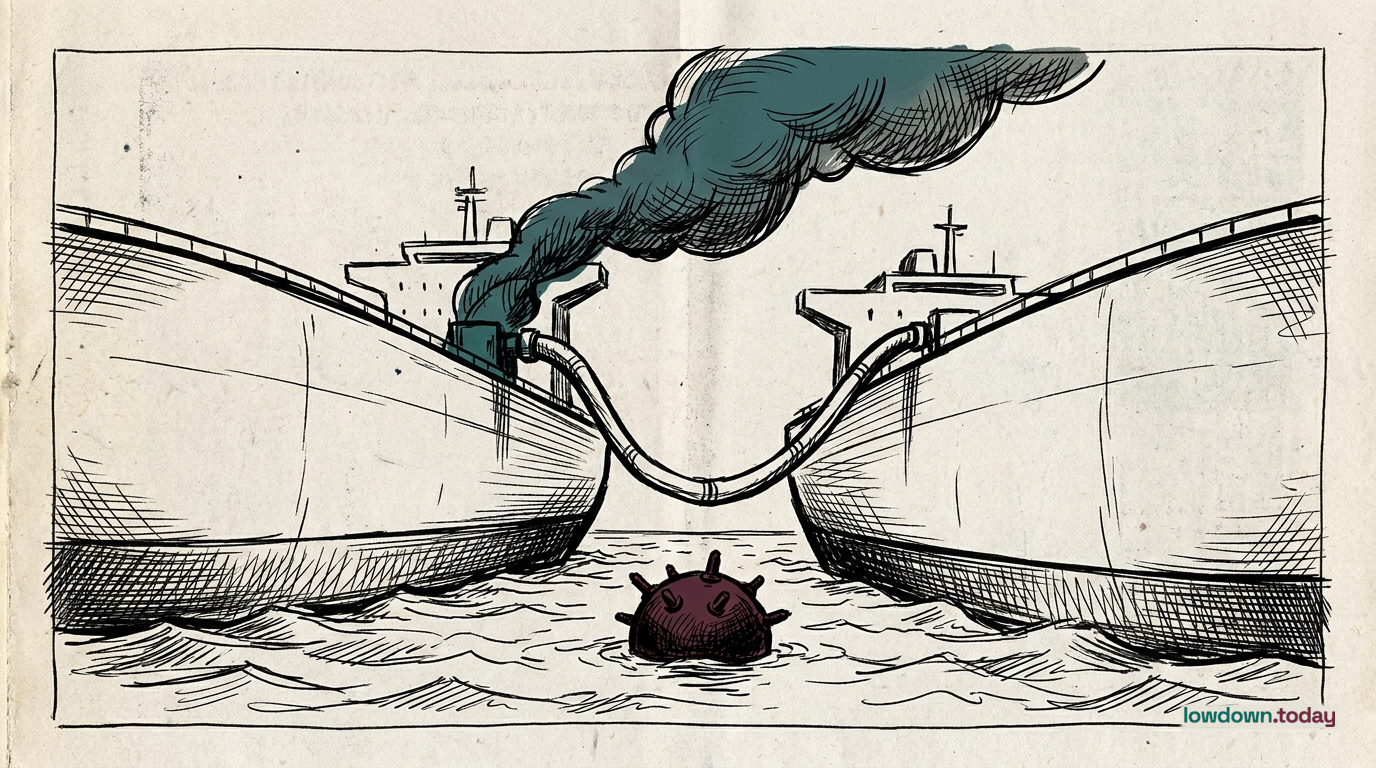
The MV Skylight is the first commercial vessel struck since the IRGC declared the strait closed, converting Iran's most powerful strategic lever from a threat into physical reality.

Sources profile:This story draws on mixed-leaning sources from United States
United States

The oil tanker MV Skylight was struck off the coast of Oman near the strait of Hormuz, injuring four crew members.

The attack on commercial shipping transforms the Hormuz crisis from a broadcast closure — which markets could treat as potentially temporary — into an active combat zone where merchant vessels face direct military attack. This converts a geopolitical risk premium into sustained physical supply disruption. 

A projectile struck the tanker MKD Vyom near the Strait of Hormuz, setting its engine room on fire — the second commercial vessel hit in 72 hours in waters that carry a fifth of the world's traded oil.

Sources profile:This story draws on neutral-leaning sources from United States
United States

The tanker MKD Vyom was hit by a projectile near the strait of Hormuz, causing an engine room fire.

The strike on MKD Vyom — the second tanker hit in 72 hours — demonstrates that the IRGC's Hormuz closure broadcast is being enforced with live weapons against commercial shipping, with an engine room fire that represents one of the most dangerous casualties a tanker can sustain. 

Sources:gCaptain

The Sea La Donna is the third commercial vessel attacked near the Strait of Hormuz in 72 hours. The strike rate already exceeds the average tempo of the four-year Tanker War of the 1980s.

Sources profile:This story draws on neutral-leaning sources from United States
United States

The tanker Sea La Donna was attacked near the strait of Hormuz; details remain pending.

Three tanker attacks in 72 hours establishes a strike rate exceeding the average tempo of the 1984–88 Tanker War — the last sustained military campaign against commercial shipping in these waters — and confirms the strait has transitioned from a threatened chokepoint to an active combat zone. 

Sources:gCaptain

Vessel traffic through the Strait of Hormuz has fallen 70%. Six of the world's largest shipping lines have halted transits. The waterway that carries a fifth of global traded oil is, for commercial purposes, closed.

Sources profile:This story draws on neutral-leaning sources from United States and France
United StatesFrance

Vessel traffic through the strait of Hormuz has fallen 70%. More than 150 tankers are anchored in open Gulf waters awaiting resolution.

A 70% collapse in Hormuz traffic converts the geopolitical risk premium in energy markets into a physical supply disruption, with oil already up 11%, container surcharges of $2,000–4,000 imposed, and direct consequences for the energy and food security of import-dependent nations across Asia, Europe, and Africa. 

Sources:gCaptain·Kpler

Six of the world's biggest shipping companies have suspended all Hormuz transits after three tankers were attacked in 72 hours — a faster escalation than the entire 1984–88 Tanker War.

Sources profile:This story draws on neutral-leaning sources from United States
United States

CMA CGM, Maersk, Nippon Yusen, Mitsui, and Kawasaki Kisen have halted all transits through the strait of Hormuz, joining Hapag-Lloyd's earlier suspension.

The suspension by CMA CGM, Maersk, Nippon Yusen, Mitsui, Kawasaki Kisen, and Hapag-Lloyd means roughly half of global container shipping capacity now refuses to transit the waterway carrying 20% of the world's traded oil. Unlike the Red Sea, where Cape of Good Hope rerouting was possible during Houthi disruptions, no viable maritime bypass exists for Gulf hydrocarbon exports. 

Sources:gCaptain

CMA CGM's emergency surcharge is the first concrete price tag on the strait's closure — the mechanism through which a military conflict in the Persian Gulf becomes a grocery bill in Hamburg and Yokohama.

Sources profile:This story draws on neutral-leaning sources from United States
United States

CMA CGM imposed an emergency surcharge of $2,000–$4,000 per container for Strait of Hormuz routes, effective immediately.

The surcharge is the economic transmission belt converting a regional military conflict into global consumer price increases. Unlike tariffs, which are debated and phased in, shipping surcharges propagate immediately through supply chains and reach retail prices within weeks. The Hormuz disruption is structurally worse than the 2024 Red Sea crisis because no rerouting option exists for the bulk of Gulf energy exports. 

Sources:gCaptain

Iran's foreign minister says military units are acting without central direction — the logical consequence of killing everyone in the chain of command, and the single largest obstacle to any ceasefire.

Sources profile:This story draws on centre-left-leaning sources from Qatar and United States
QatarUnited States

Iran's foreign minister stated that military units are operating outside central government direction, raising the possibility that the decapitation of senior leadership has severed the chain of command.

The statement reveals the central paradox of decapitation strategy: destroying an adversary's command structure eliminates the interlocutor needed to negotiate a halt. Whether the claim is genuine or diplomatic cover for escalatory strikes, the operational implication is identical — no single Iranian authority can credibly order a ceasefire and enforce compliance across the theatre. 

Closing comments

Escalation trajectory is steep and accelerating. From one front and one country under fire on Day 1, the conflict has reached four fronts and ten-plus countries by Day 3. Hezbollah's entry, the strike on RAF Akrotiri, and direct attacks on commercial tankers each represent a qualitative escalation beyond the original Iran theatre. No ceasefire mechanism exists. No mediator holds leverage over both sides. The next likely escalation vectors are: an Israeli ground invasion of Lebanon (senior officials are publicly discussing it), Iraqi militia attacks on US assets (Kataib Hezbollah has declared it 'will not remain neutral'), and sustained Hormuz closures driving oil above $100. De-escalation requires an Iranian interlocutor with both authority and credibility — and the strikes may have eliminated precisely those individuals.

Different Perspectives
Iran's foreign minister
Publicly stated that military units are operating outside central government direction — the first acknowledgement by an Iranian official that the chain of command may be severed following the decapitation of senior leadership.
Israeli military leadership
Moved from background briefings to openly discussing a ground invasion of Lebanon within hours of Hezbollah's attack — a departure from the prior posture of containing the northern front through the November 2024 ceasefire and air operations.
Senator Mark Warner
Senator Mark Warner
Stated 'Trump has started a war of choice' after the Pentagon briefing reportedly produced no intelligence that Iran had been planning to attack US forces. War powers votes are expected this week.
CMA CGM
CMA CGM
Imposed an emergency surcharge of $2,000–$4,000 per container on all Strait of Hormuz routes effective immediately, and halted all transits — reflecting the shift from theoretical risk to active combat against commercial vessels.
