Skip to content
You can now search across every topic, entity and event.What's new
Iran Conflict 2026
19MAR

Riyadh expels five Iranian diplomats

4 min read
08:52UTC

Saudi Arabia declared Iran's military attaché and four embassy staff personae non gratae, formally ending the China-brokered rapprochement that took Beijing years to build and the war three weeks to destroy.

ConflictDeveloping
Key takeaway

Beijing's signature Middle East diplomatic achievement has been dismantled in three weeks of war.

Saudi Arabia declared Iran's military attaché and four embassy staff personae non gratae on Saturday, giving them 24 hours to leave The Kingdom 1. The stated cause: "repeated Iranian attacks" on Saudi territory — attacks that have included ballistic missiles targeting Riyadh and the eastern provinces and daily drone strikes against oil infrastructure, including two consecutive days of hits on Kuwait's Mina Al-Ahmadi refinery .

The expulsion formally ends the diplomatic relationship China restored in March 2023. That rapprochement came after a seven-year freeze triggered by Saudi Arabia's execution of Shia cleric Sheikh Nimr al-Nimr in January 2016 and the subsequent storming of the Saudi embassy in Tehran. Beijing spent years building the framework; the war dismantled it in three weeks. Qatar had already expelled its Iranian military and security attachés on 17 March after the Ras Laffan strikes . Saudi Foreign Minister Prince Faisal bin Farhan had declared that trust with Tehran was "completely shattered" and warned that Iranian escalation "will be met with escalation, whether on the political level or others" . Saturday's expulsion is the first concrete action on that warning.

For Beijing, the loss is specific. The Saudi-Iran accord was President Xi's proof that China could broker outcomes Washington could not — the centrepiece of an alternative to US-led regional security. That alternative is no longer operative. US naval forces control the strait of Hormuz. US air defences protect Saudi airspace. Secretary Rubio's emergency arms sales — $8 billion to Kuwait, $8.5 billion to the UAE — bypassed congressional review to reach Gulf states within days . China's response has been humanitarian aid to Iran, Jordan, Lebanon, and Iraq and diplomatic rhetoric. No military assets. No security guarantees. Every Gulf capital is now making procurement and basing decisions on the assumption that Washington, whatever its political demands, delivers hardware and interceptors. Beijing delivers communiqués.

The diplomatic break also narrows Iran's post-war options. Riyadh and Doha were Tehran's two remaining interlocutors among The Gulf Arab states — the channels through which any future ceasefire or de-escalation would need to pass. Both are now closed. Iran's Foreign Minister Araghchi has stated "we don't believe in a ceasefire" and laid out conditions — US withdrawal from all regional bases, reparations — that no party is positioned to deliver . With The Gulf's diplomatic doors shut and China unable to reopen them, Tehran's path back to regional normalisation runs through Washington or nowhere.


Deep Analysis

In plain English

In March 2023, China brokered a historic deal restoring diplomatic relations between Saudi Arabia and Iran after seven years of hostility. It was Beijing's most significant geopolitical achievement in the Middle East and a demonstration that China could play the role of neutral power broker that Washington historically occupied. Saudi Arabia has now formally ended that arrangement by expelling Iranian diplomats. This matters far beyond the two countries: it signals to China that its regional diplomatic capital — carefully accumulated over years — can be undone within weeks when one party goes to war. It also removes one of the few remaining formal communication channels between states that are now, effectively, in opposing coalitions.

Deep Analysis
Synthesis

China's failure to leverage its 2023 mediation into any conflict-prevention capacity is the deeper strategic subtext. Beijing had no enforcement mechanism in the agreement and no tool to restrain Iran once war began. This damages China's sustained pitch as an alternative order-builder to the US security architecture — precisely when Beijing has been advancing that narrative most aggressively in the Global South. A China that cannot protect its own diplomatic achievements when they are stress-tested is a weaker broker for the post-conflict reconstruction role Beijing is reportedly already preparing to claim.

Root Causes

The 2023 rapprochement was structurally fragile because it was transactional rather than strategic. Saudi Arabia sought operational calm to protect Vision 2030 investment inflows and regional commercial normalisation; Iran sought reduced pressure and Gulf legitimacy. Neither party resolved the underlying rivalry over Gulf hegemony, Yemen, Lebanon, or the nuclear programme. Active Iranian drone attacks on Saudi territory made the transactional rationale untenable domestically — Riyadh could not maintain the fiction of normalisation while publicly intercepting Iranian ordnance.

Escalation

The expulsion removes Iran's only remaining official diplomatic presence inside the Gulf Cooperation Council's largest member state. Iran now has no formal channel to Riyadh through which to signal red lines or de-escalation intent. This communication vacuum raises the risk of miscalculation in the ongoing Iranian drone campaign against Saudi territory — particularly given the saturation volumes now being recorded.

What could happen next?
  • Consequence

    The expulsion eliminates Iran's last formal Gulf diplomatic channel, removing the only back-channel for communicating red lines without public escalation.

    Immediate · Assessed
  • Consequence

    China's role as neutral regional broker is materially damaged, reducing Beijing's leverage in any post-conflict settlement negotiations it seeks to lead.

    Medium term · Assessed
  • Risk

    Absence of Riyadh-Tehran diplomatic communication increases miscalculation risk in the ongoing Iranian drone campaign against Saudi territory.

    Short term · Suggested
  • Precedent

    Beijing's flagship regional diplomatic achievement collapsing within three weeks of active conflict signals structural limits to China's mediation model under conditions of open warfare.

    Long term · Assessed
First Reported In

Update #44 · Trump: 48 hours to destroy Iran power grid

Al Jazeera· 22 Mar 2026
Read original
Causes and effects
This Event
Riyadh expels five Iranian diplomats
Eliminates China's most prominent Middle Eastern diplomatic achievement and consolidates US-led security architecture as the sole operational framework in the Gulf. Closes one of Tehran's two remaining diplomatic channels among Gulf Arab states.
Different Perspectives
Oil market and P&I insurers
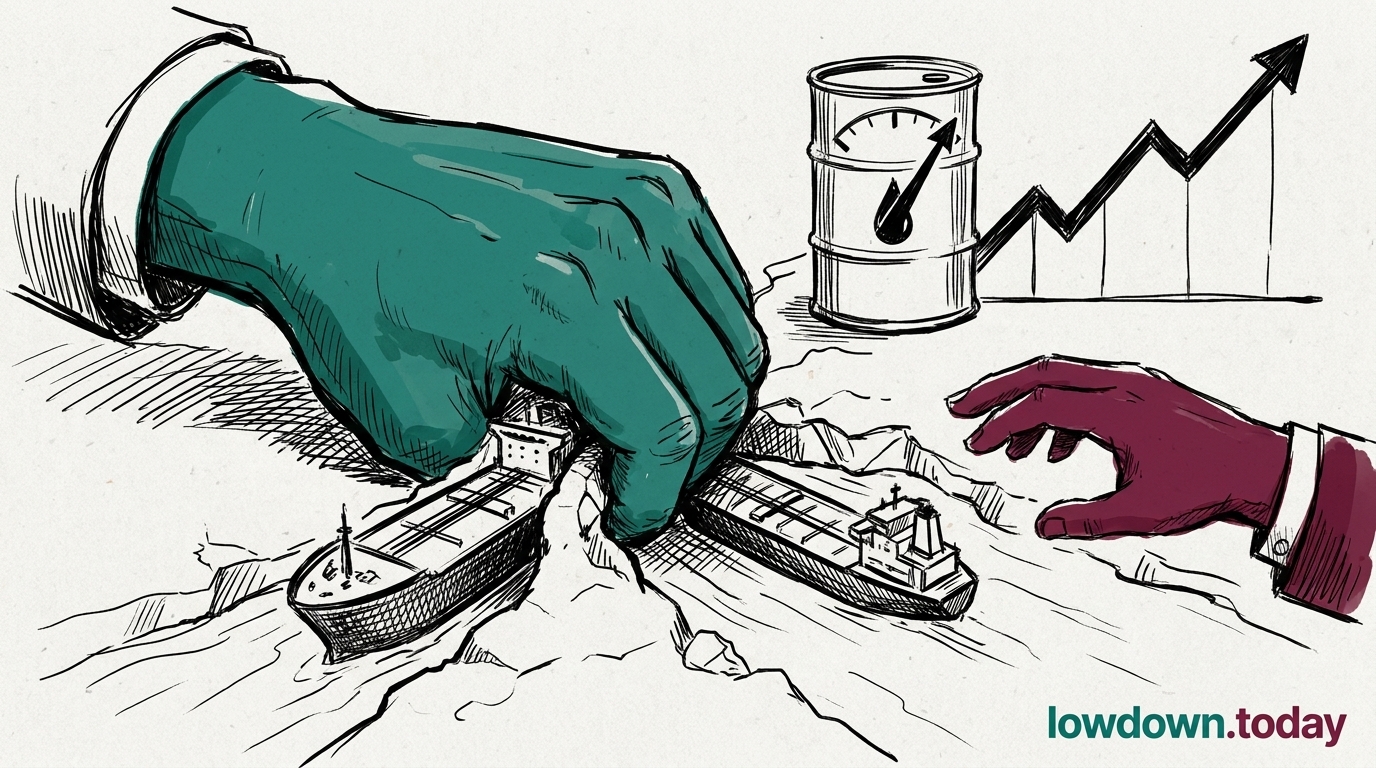
Brent cleared $87 intraday only once CENTCOM's blockade became physical rather than declared, even though P&I Clubs had already excluded Hormuz war risk a week earlier on 7 July: capital hedged ahead of enforcement, but prices moved only after it.
UAE reporting
UAE reporting
UAE reporting placed the Omani tanker deaths at one seafarer against the International Maritime Agency's count of two, the first time in this war that a Gulf state's casualty figures have diverged from an international monitor's.
Jordan
Jordan
Iranian strikes reached Jordan again on 14 July as part of the Gulf-wide retaliation for the Hormuz blockade, extending the conflict's geographic footprint to a state with no direct stake in the strait itself.
Bahrain
Bahrain
Bahrain sounded air-raid sirens on 14 July during Iran's Gulf-wide retaliation, the same day CENTCOM's blockade order and fourth night of strikes pushed the conflict's physical reach into the wider Gulf littoral.
Kuwait
Kuwait
Kuwait intercepted Iranian missiles and drones on 14 July as Tehran's blockade retaliation reached Gulf states beyond Iran's immediate shoreline, confirming Kuwaiti airspace now sits inside Iran's retaliatory envelope.
Oman
Oman
Oman absorbed the war's first tanker casualties in its own waters on 14 July, with two supertankers disabled and seafarers killed, putting the sultanate's shipping lanes directly in the path of the blockade fight for the first time.