Skip to content
You can now search across every topic, entity and event.What's new
Iran Conflict 2026
23AUG

Trump extends Lebanon ceasefire three weeks

3 min read
19:02UTC

Donald Trump extended the Israel-Lebanon ceasefire by three weeks to around 15-16 May following a second round of direct ambassador-level Washington talks. The extension is the only publicly signed Trump de-escalation instrument of the war.

ConflictDeveloping
Key takeaway

Lebanon is off the clock; Iran's WPR deadline now stands alone on 1 May.

Donald Trump on Thursday 23 April extended the Israel-Lebanon ceasefire by three weeks to approximately 15-16 May, following the second round of direct ambassador-level Washington talks 1. The extension is the only publicly signed Trump de-escalation instrument of the war; zero Iran-specific instruments remain signed across 55 days.

The extension takes Lebanon off the near-term calendar. It also isolates the War Powers Resolution clock, now dated 1 May on the 2 March congressional-notification reading, as the single paper-driven deadline Washington still has to meet on the Iran portfolio. The Lebanon track was the fallback explanation cited during the earlier buffer-zone dispute when Benjamin Netanyahu's "Yellow Line" demand threatened to bleed Israeli posture into the Iran front.

Process matters here because the Lebanon talks ran through a channel Washington has never formally opened on Iran. Ambassador-level direct discussion, mediated by the US and convened in Washington, produced a paper outcome that The White House signed. The same institutional infrastructure does not exist for Iran because the Pakistan channel carries a financial hinge through Saudi Arabia's $3 billion debt assistance and Vice President JD Vance's postponed Islamabad trip remains unscheduled.

The structural implication is that Trump's willingness to sign paper tracks the availability of a credible counterparty at his own table. For Lebanon, Hezbollah's operational weakness and Beirut's financial distress produced terms The White House could endorse. For Iran, the counterparty is distributed across Mojtaba Khamenei's handwritten courier chain, Ahmad Vahidi's IRGC and Abbas Araghchi's foreign ministry, and no single signature from Tehran would bind all three.


Deep Analysis

In plain English

The Israel-Lebanon ceasefire, which was due to expire around 26 April, has been extended by three more weeks to approximately 15 May. Trump agreed to the extension after a second round of direct, ambassador-level talks in Washington about the two countries' dispute over a 10km buffer zone along the border. The extension matters for the Iran war because Iran's Lebanese ally, Hezbollah, had been a potential wildcard: if Lebanon's ceasefire collapsed, it could have opened a second front on Israel's northern border at the same time as the Iran conflict. The extension takes that risk off the table for three weeks, but the underlying border dispute that caused the ceasefire tension is not resolved.

What could happen next?
  • Consequence

    Decoupling the Lebanon deadline from the Iran WPR 1 May clock removes Hezbollah as a potential Tehran pressure instrument for at least three weeks, narrowing Iran's available escalation options outside Hormuz.

First Reported In

Update #78 · Allies flagged, adversaries listed, nothing signed

US Congress Record· 24 Apr 2026
Read original
Different Perspectives
Hizballah
Hizballah
Has not commented on the US Treasury's 20 August designation of ten people, including named couriers, over a cash network Treasury says moved money to it from the IRGC-Qods Force. ACLED recorded a sharp rise in attacks around it the same day.
Kuwait
Kuwait
Kuwait's Chief of the General Staff, Lieutenant General Khaled al-Shriaan, co-chaired the 16th US-Kuwait Joint Military Commission at the Pentagon on 21 August. Kuwait has not published what was agreed; only a summary of the meeting's existence and attendees is sourced.
Qatar
Qatar
Has not commented publicly on the $4.5bn KC-46A tanker Foreign Military Sale notification the State Department approved on 20 August. The notification opens a sale process; Doha has not confirmed whether it will proceed to a signed transfer.
Mohammad Bagher Ghalibaf
Told a Baghdad business meeting on 20 August that Iran will not endure a hungry population regardless of its military strength, against 87.9% point-to-point inflation and 128.1% food inflation for Tir. His fellow Majlis Economic Committee member Samsami separately warned a petrol price rise would ignite unrest.
US Navy
US Navy
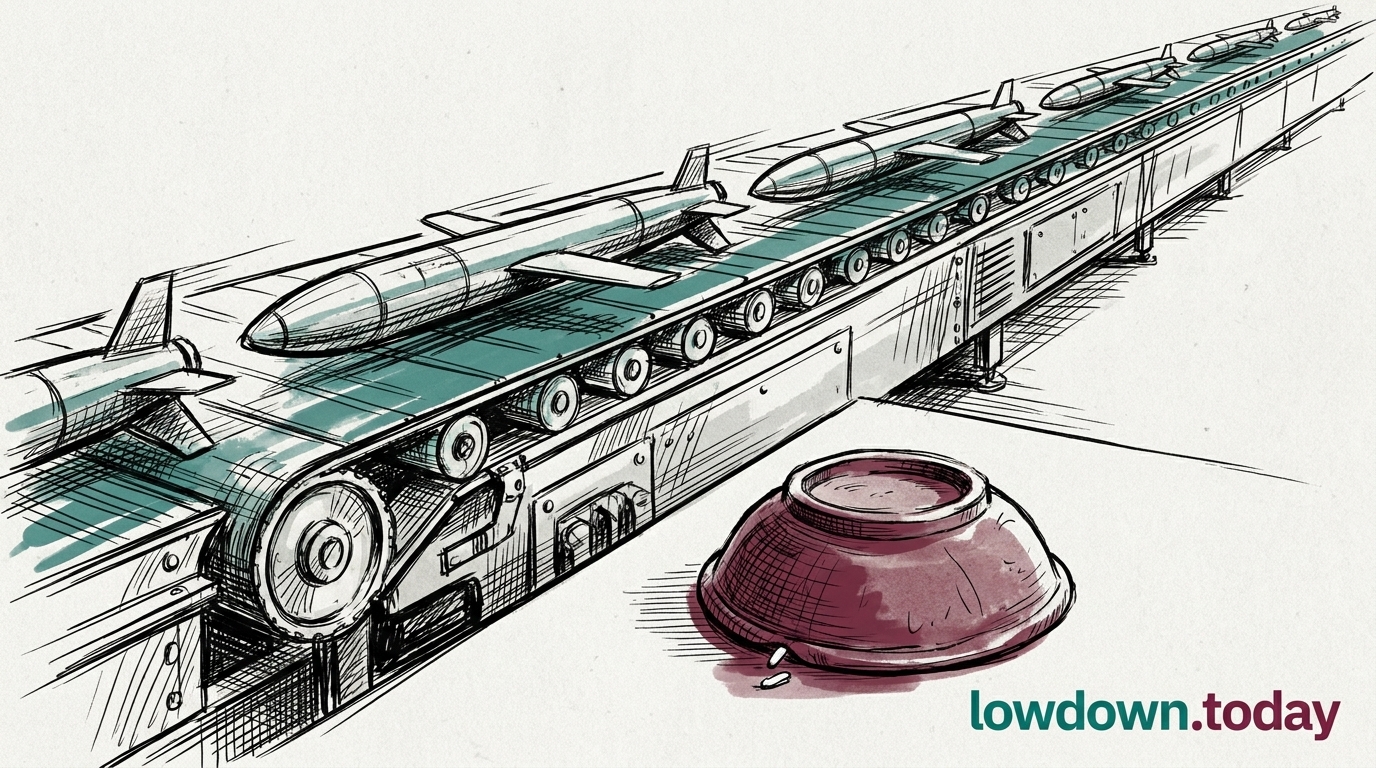
Signed a $22.9bn, seven-year contract with Raytheon on 17 August to raise Tomahawk output from about 60 a year to more than 1,000. The Acting Navy Secretary, quoted via an X post, framed it as the "Arsenal of Freedom" initiative; it replaces the 850 missiles fired by 1 April in about ten months at the new rate.
UK Maritime Trade Operations
UKMTO logged six armed men boarding a tanker 136 nautical miles east of Al Mukalla on 20 August and redirecting it toward Somalia. A vessel steered toward the Somali coast reads as an attempted seizure, a distinct hazard from the stand-off strikes the same lane has seen before.



