Skip to content
You can now search across every topic, entity and event.What's new
Iran Conflict 2026
23JUL

Aramco warns of a 17.5% shock

4 min read
19:27UTC

Brent crude settled at $104.21 on Monday, up $2.92 on Trump's verbal alone. Saudi Aramco chief executive Amin Nasser said the market is losing roughly 100 million barrels of supply each week, with prolonged disruption pushing any normalisation into 2027.

ConflictDeveloping
Key takeaway

Brent at $104 prices Trump's words; Aramco's 100 million barrels per week implies a 17.5% unpriced shock.

Brent Crude settled at $104.21 on Monday 11 May, up $2.92 (2.9%) on $101.29 the previous session 1. The move broke the $101 floor that had held through Friday's bulk-carrier strike near Doha, the Mokhber doctrine declaration and the IRGC firing-order threat . Nothing signed underwrote the spike: it came on Donald Trump's Oval Office verbal statement, with no executive order, deployment directive or CENTCOM operational order behind it. Brent traded above $94 on Tuesday morning, holding most of Monday's gain.

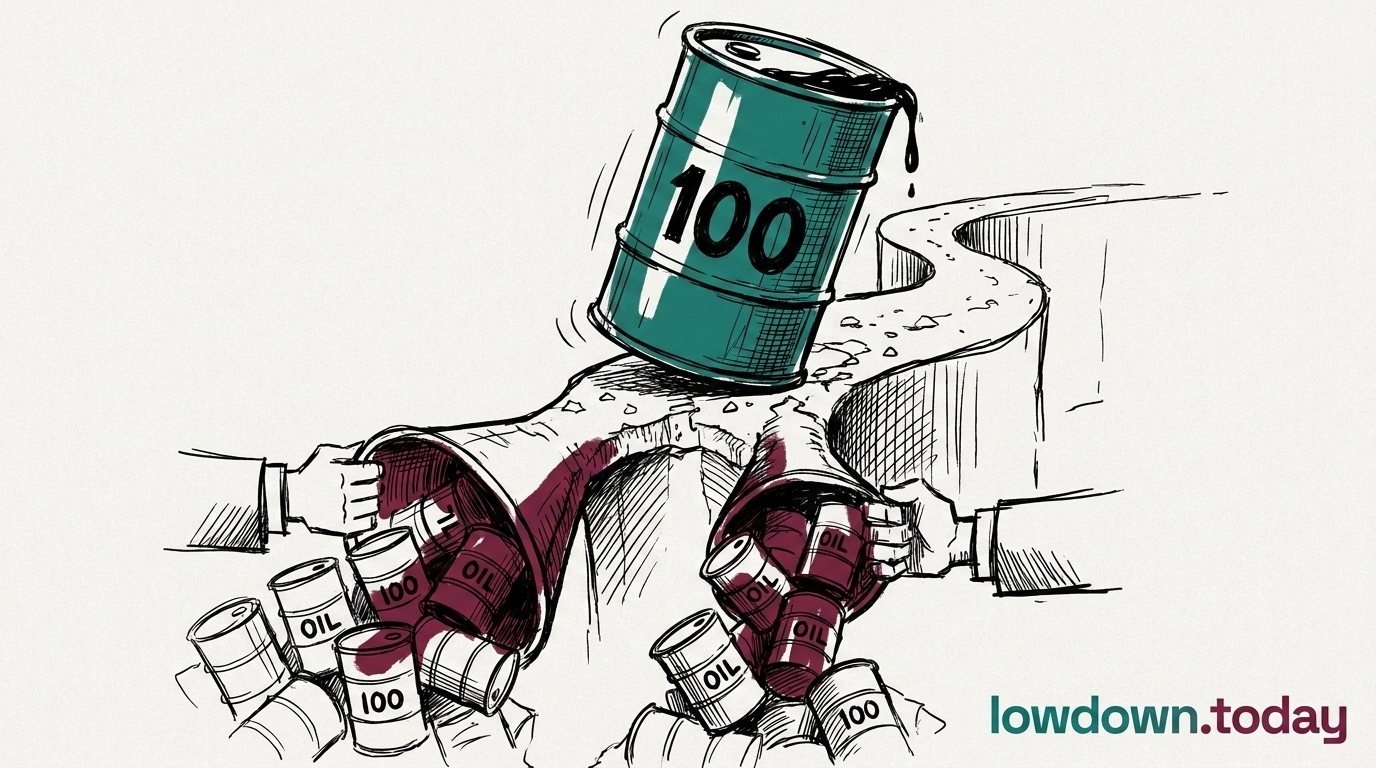
Saudi Aramco chief executive Amin Nasser said the same day that the market is losing roughly 100 million barrels of supply each week and that prolonged disruption could push any normalisation into 2027 2. That weekly loss roughly equals Saudi Arabia's full weekly output. Translated into a daily run rate against the notional 80 million barrels per day global crude base, Nasser's number implies a 17.5% supply shock against a curve that has not priced it.

Brent at $104.21 prices the market's probability-weighted average of paper outcomes, not Nasser's physical-market reading; priced literally, Nasser's number justifies materially higher Brent. The ceiling holds while Wall Street still expects a deal; it breaks upward if Trump signs a bombing order on his Friday return, or downward if he signs a written counter-text. For UK consumers the lag template is already running: the $4.54 per US gallon pump benchmark hit on 8 May is the precedent forecourts will follow within a fortnight, putting roughly £1.78 per litre on UK pumps before the Beijing trip closes.

Deep Analysis

In plain English

The price of oil went up sharply on 11 May after Trump's tough statements about Iran. It reached $104.21 per barrel, breaking through a floor of about $101 that had held for several days. The CEO of Saudi Aramco; the world's largest oil company; said the world is losing around 100 million barrels of oil supply every week because of the Hormuz disruption. He warned it could be 2027 before the situation returns to normal. For ordinary people, this means petrol and diesel prices could rise further over the coming weeks if the situation does not improve. Oil prices that stay above $100 for an extended period push up the cost of transport, heating, and most goods that need to be shipped.

Deep Analysis
Root Causes

The Strait of Hormuz carries approximately 21 million barrels of oil per day in normal conditions; roughly a quarter of global seaborne crude. Iran's Persian Gulf Strait Authority has imposed a toll and registration requirement that most Western-flagged carriers have not complied with, effectively reducing transit to a fraction of pre-war volumes.

Saudi Aramco's export routes do not depend on Hormuz for the majority of its exports via the East-West pipeline to Yanbu on the Red Sea, but Aramco ships roughly 7 million barrels per day that do transit the strait; giving Nasser's 'market is losing supply' framing a direct commercial basis, not merely geopolitical observation.

The oil market's difficulty pricing the disruption reflects genuine uncertainty about whether a deal materialises this week or in three months: two scenarios produce $75 and $120 Brent respectively, so the $104 settlement is arithmetically the probability-weighted midpoint.

What could happen next?
  • Consequence

    Sustained Brent above $100 triggers fuel surcharge reviews at major freight carriers. US, UK, and EU logistics cost indices will absorb the move within 30 days.

    Short term · 0.85
  • Risk

    A 2027 normalisation scenario; if Nasser's guidance is treated as credible; would prompt hull and cargo insurers to reprice annual premiums at Q3 2026 renewal cycles, adding $15-25 per barrel in effective delivered cost for Asian buyers.

    Medium term · 0.6
  • Opportunity

    The $101 floor breaking higher gives US negotiators a price signal they can present to Iran: a deal that reopens Hormuz produces immediate Brent compression to $85-90, saving Tehran from the inflationary oil-price feedback on its own import costs.

    Short term · 0.65
First Reported In

Update #95 · OFAC opens the Hong Kong door

CNBC· 12 May 2026
Read original
Different Perspectives
India
India
India buys more Saudi crude than any other country and has 2.5 million nationals working in the kingdom, so a $100 Brent and a live strike on Saudi tankers reach New Delhi through both fuel bills and remittance risk. Neither channel has an alternative route the way Saudi Arabia's own pipeline does.
Qatar
Qatar
Qatar co-authored the four-mediator ten-day ceasefire proposal alongside Egypt, Pakistan and Oman, centred on resuming Hormuz navigation, while separately pursuing its dated compensation claim against Iran at the UN Security Council filed on 21 July. Doha is mediating and litigating in the same week.
Israel
Israel
Israeli intelligence, reported by the Wall Street Journal, assesses Iran moved thousands of centrifuges and part of its roughly 440kg enriched-uranium stock into Pickaxe Mountain after the June 2025 strikes on its three main nuclear sites. Some of the US refuelling aircraft now deploying to the region are bound for Israeli bases and Ramon Airport.
Houthis
Houthis
Yahya Saree announced the missile and drone strikes on the Encelia and Layla on 22 July as enforcement of the embargo his forces had declared by radio warning alone two days earlier. Six vessels already turned back on the broadcast; the strike shows Houthi forces will use weapons once warnings stop working.
Saudi Arabia
Saudi Arabia
Saudi Arabia's state news agency confirmed only a fire on the Encelia's bow, with the crew safe; the Layla strike remains unconfirmed by Riyadh. The kingdom built its Petroline pipeline specifically to bypass Hormuz through the Red Sea, so the tanker fire lands on the route Riyadh had already spent billions escaping.
United States
United States
Washington is weighing both ten-day proposals but wants a longer truce than either offers, and moved F-16 and F-35 jets plus refuelling aircraft into the region while it decides. That deployment, not Trump's Pickaxe Mountain remarks, is the measurable US action, buying options for the day talks fail rather than betting on them.