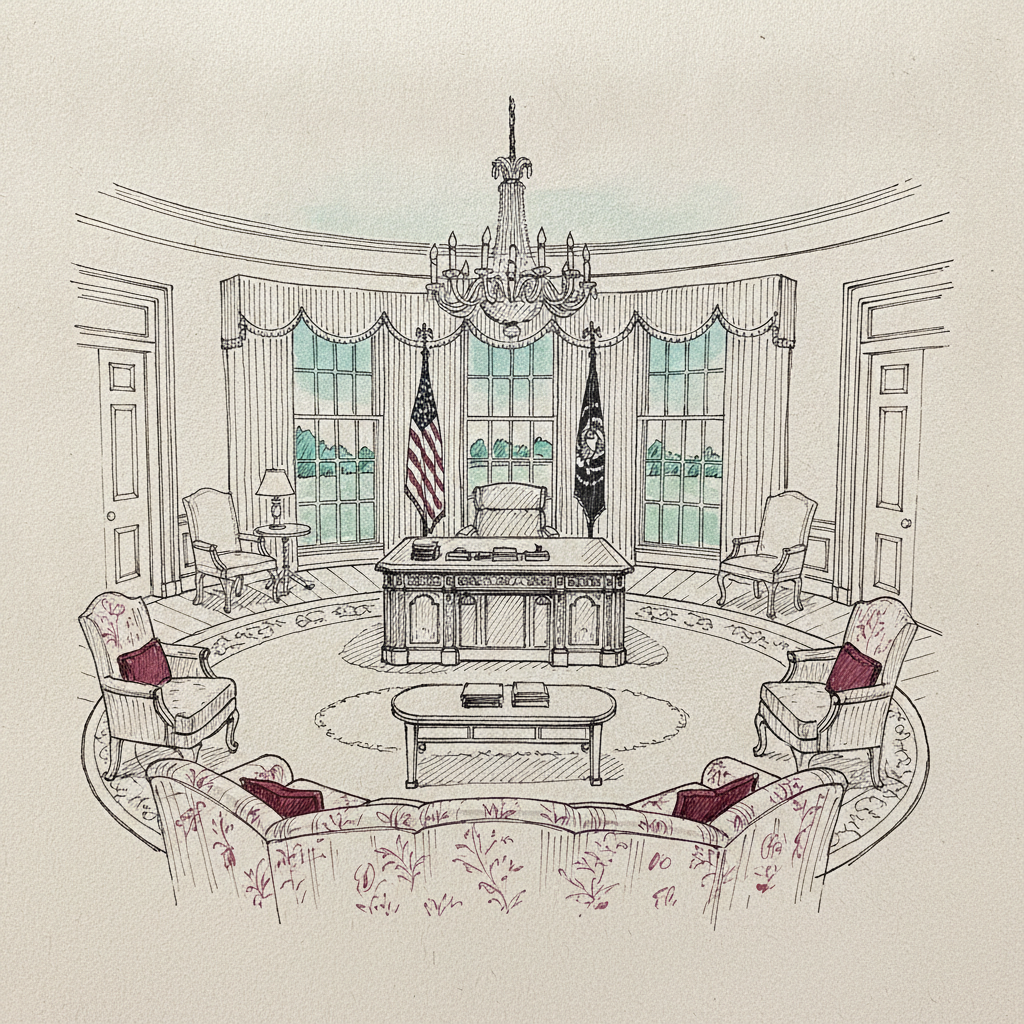
Oval Office
The official office of the President of the United States within The White House.
Donald Trump used the Oval Office on 4 June 2026 to disclose, then reject, a uranium-airlift plan and claim Iran's enriched stockpile was 'entombed', a claim the IAEA had no access to verify.
Last refreshed: 3 August 2026 · Appears in 1 active topic
Why did a presidential Oval Office endorsement not resolve Iran's visa problem?
Timeline for Oval Office
Mentioned in: Russia fires 850 drones across Ukraine
Russia-Ukraine War 2026Mentioned in: Witkoff's Miami talks end a day early
Russia-Ukraine War 2026Mentioned in: Pentagon adds a 19th name to its toll
Iran Conflict 2026Mentioned in: White House signs nothing on Iran
Iran Conflict 2026Mentioned in: CIA warned Trump before he signed
Iran Conflict 2026Background
The Oval Office is the official working office of the President of the United States, located in the West Wing of The White House in Washington DC. It is the most recognised symbol of presidential authority and the customary setting for major statements, bill signings and press encounters.
Through the Iran war, the office has functioned as the stage for The Administration's most consequential and least paper-backed claims, from a nuclear stockpile said to be 'entombed' with no verification, to a presidential endorsement of Iran's World Cup participation that visa policy did not immediately follow. Statements made here carry the full symbolic weight of the presidency, even when, as with the Iran file, no executive order or proclamation has accompanied them.
Trump's uranium claim went unverified here
In the Oval Office on 4 June, Trump disclosed a plan to airlift Iran's enriched uranium stockpile out of the country, then rejected it and claimed the material was already 'entombed'. The same day, the International Atomic Energy Agency said it had lost track of Iran's 440.9kg stockpile of 60%-enriched uranium after 97 days without inspector access, with roughly 200kg probably at Isfahan and the rest unlocated.
The office has repeatedly hosted rhetoric that outpaces the paper record: Trump's 30 April endorsement of Iran's World Cup participation, delivered here, likewise ran ahead of the State Department's continued visa holds on IRGC-linked players. No signed instrument has followed any of these Oval Office statements.
What did Trump say about Iran's World Cup participation in the Oval Office?
Why did the Oval Office endorsement not give Iran's players visas?
Did Trump order Iran strikes verbally from the Oval Office?


Written with AI from Lowdown's published reporting. Not individually reviewed by an editor. Updated 3 August 2026. Editorial standards.