Skip to content
You can now search across every topic, entity and event.What's new
Iran Conflict 2026
23JUL

Brent flat at $101.29; Hormuz floor holds

3 min read
19:27UTC

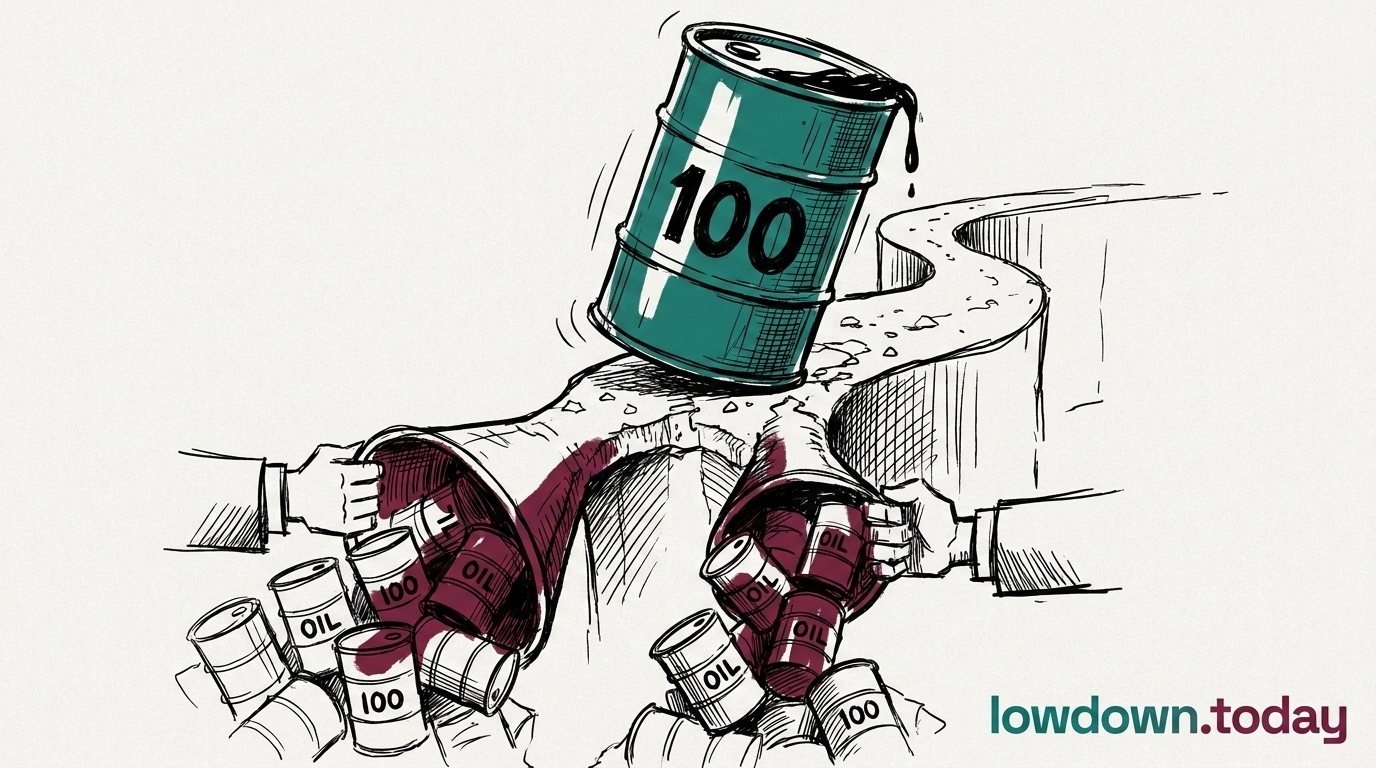
Brent crude settled at $101.29 a barrel on Sunday 10 May, a $0.09 movement across three sessions. Three weekend shocks moved the screen by less than a tenth of a dollar.

ConflictDeveloping
Key takeaway

Saudi Arabia clears its $87 fiscal breakeven without needing to lift a finger to reopen Hormuz.

Brent Crude front-month settled at $101.29 a barrel on Sunday 10 May, OilPrice.com data showed 1. The price moved $0.09 across three sessions through the doctrinal statement from Mohammad Mokhber, the bulk carrier strike off Doha, and the IRGC (Islamic Revolutionary Guard Corps) commander's statement that missiles and drones targeting US positions are awaiting authorisation. The structural Hormuz premium floor at $101 identified the previous week holds; for traders, the negotiating continuation is the dominant signal and the kinetic widening is already in the price.

Three weekend shocks that would have moved the market by $5 to $10 a year ago now move it by less than a dime. That is the signature of a repriced market, not a calm one. Traders have absorbed the blockade as a structural feature and are pricing the negotiation as a ceiling, not a reopening: $101 is the new bottom while Iran controls the strait, and any move higher would need a confirmed ceasefire trigger or an IRGC strike on US naval assets to deliver. Neither is in the December futures curve.

US gasoline at $4.54 a gallon reflects the same floor at the consumer end; UK forecourt prices land at roughly £1.50 to £1.55 a litre once duty and VAT are added; European refiners are absorbing more of the shock through compressed margins, which is why Continental pump prices have not yet moved as hard as the US ones. The structural cost is being distributed by jurisdiction rather than by barrel, with the lightest-tax jurisdictions feeling the chokepoint hardest at the till.

The macro consequence is that the floor is now self-reinforcing. With Brent stuck above $100, Saudi Arabia clears its $87 fiscal breakeven comfortably, removing the budgetary pressure that would normally push Riyadh to advocate for OPEC+ production hikes. The UAE clears its $76 breakeven by an even wider margin. The Gulf producers benefiting financially from the chokepoint they are diplomatically trying to reopen face a structural conflict of interest that the market has now priced as the base case.

Deep Analysis

In plain English

Brent crude is the global benchmark price for oil, priced in US dollars per barrel. At $101.29 it has barely moved across three trading sessions, despite a week that included Iran threatening to fire missiles at US bases and Iran's government hitting a Qatari ship. Usually major threats and attacks would send the oil price sharply higher. The fact that it barely moved tells you what the market actually thinks: traders have already factored in a prolonged blockade of the Strait of Hormuz and priced that into every barrel. The $101 level is the new normal, not a spike. For UK drivers, diesel and petrol prices at the forecourt are already reflecting this, running roughly 23p per litre higher than before the conflict began.

Deep Analysis
Root Causes

Oil markets price on probability-weighted forward scenarios, not on single-event shocks. Before the 2026 conflict, Brent's volatility floor was underpinned by OPEC+ supply discipline; after 28 February it is underpinned by Hormuz blockade continuity. The $101 floor is not a reaction to any particular event on 10 May; it reflects markets pricing an 18-30 month blockade continuation as the base case, with an MOU-induced reopening treated as an upside scenario, not an expectation.

The insurance repricing mechanism works independently of the oil price. P&I clubs and Lloyd's underwriters repriced Hormuz war-risk coverage after the first IRGC seizure in April; that repricing feeds into tanker-charter rates regardless of whether Brent is at $90 or $110. The $101 floor is where these two repricing dynamics intersect: the oil-market base-case blockade premium meets the tanker-market structural insurance cost floor.

What could happen next?
  • Meaning

    Brent's price stability at $101 through extreme doctrinal and kinetic events confirms that traders regard the MOU negotiation as the price signal, not the attacks. The market assigns higher probability to prolonged negotiation than to either rapid deal or full escalation.

  • Consequence

    The structural Hormuz premium now baked into $101 means a signed MOU would not return prices to pre-conflict levels. Analysts at Axios and LSEG assess the insurance repricing as permanent regardless of reopening.

First Reported In

Update #93 · Tanker hits Doha while Qatar mediates

OilPrice.com· 10 May 2026
Read original
Different Perspectives
India
India
India buys more Saudi crude than any other country and has 2.5 million nationals working in the kingdom, so a $100 Brent and a live strike on Saudi tankers reach New Delhi through both fuel bills and remittance risk. Neither channel has an alternative route the way Saudi Arabia's own pipeline does.
Qatar
Qatar
Qatar co-authored the four-mediator ten-day ceasefire proposal alongside Egypt, Pakistan and Oman, centred on resuming Hormuz navigation, while separately pursuing its dated compensation claim against Iran at the UN Security Council filed on 21 July. Doha is mediating and litigating in the same week.
Israel
Israel
Israeli intelligence, reported by the Wall Street Journal, assesses Iran moved thousands of centrifuges and part of its roughly 440kg enriched-uranium stock into Pickaxe Mountain after the June 2025 strikes on its three main nuclear sites. Some of the US refuelling aircraft now deploying to the region are bound for Israeli bases and Ramon Airport.
Houthis
Houthis
Yahya Saree announced the missile and drone strikes on the Encelia and Layla on 22 July as enforcement of the embargo his forces had declared by radio warning alone two days earlier. Six vessels already turned back on the broadcast; the strike shows Houthi forces will use weapons once warnings stop working.
Saudi Arabia
Saudi Arabia
Saudi Arabia's state news agency confirmed only a fire on the Encelia's bow, with the crew safe; the Layla strike remains unconfirmed by Riyadh. The kingdom built its Petroline pipeline specifically to bypass Hormuz through the Red Sea, so the tanker fire lands on the route Riyadh had already spent billions escaping.
United States
United States
Washington is weighing both ten-day proposals but wants a longer truce than either offers, and moved F-16 and F-35 jets plus refuelling aircraft into the region while it decides. That deployment, not Trump's Pickaxe Mountain remarks, is the measurable US action, buying options for the day talks fail rather than betting on them.