Skip to content
Welcome, thoughtbot's Giant Robots listeners!Start here
Iran Conflict 2026
19JUL

Four states add Hormuz coalition kit

3 min read
14:05UTC

Belgium redirected minehunter BNS Primula, Germany committed Fulda and Mosel, Australia committed an E-7A Wedgetail and France committed the carrier Charles de Gaulle to the European Hormuz coalition on 18 May; none of the new assets carries published rules of engagement.

ConflictDeveloping
Key takeaway

Coalition hardware is stacking up without rules of engagement to use it.

Four states added hardware to the European Hormuz Coalition on 18 May 2026, Breaking Defense reported. Belgium's Defence Minister Theo Francken ordered the Tripartite-class minehunter BNS (Belgian Naval Ship) Primula redirected from the Baltic to the Mediterranean. Germany committed the minehunter Fulda and the replenishment ship Mosel. Australia committed a Boeing E-7A Wedgetail, an airborne early warning and control aircraft with phased-array radar that lets a single platform manage a Hormuz-wide air picture. France committed the nuclear-powered aircraft carrier Charles de Gaulle, the heaviest surface combatant the coalition now fields⁠1.

The deployments slot into a posture Italy began with two Lerici-class minehunters forward-deployed earlier in the month, and pick up the 80% frigate-availability target the French Navy set on 18 May. Breaking Defense also reported the European Union is considering extending Operation Aspides, its Red Sea anti-Houthi mission, into Hormuz, which would pull 21 contributing nations into the same mission frame.

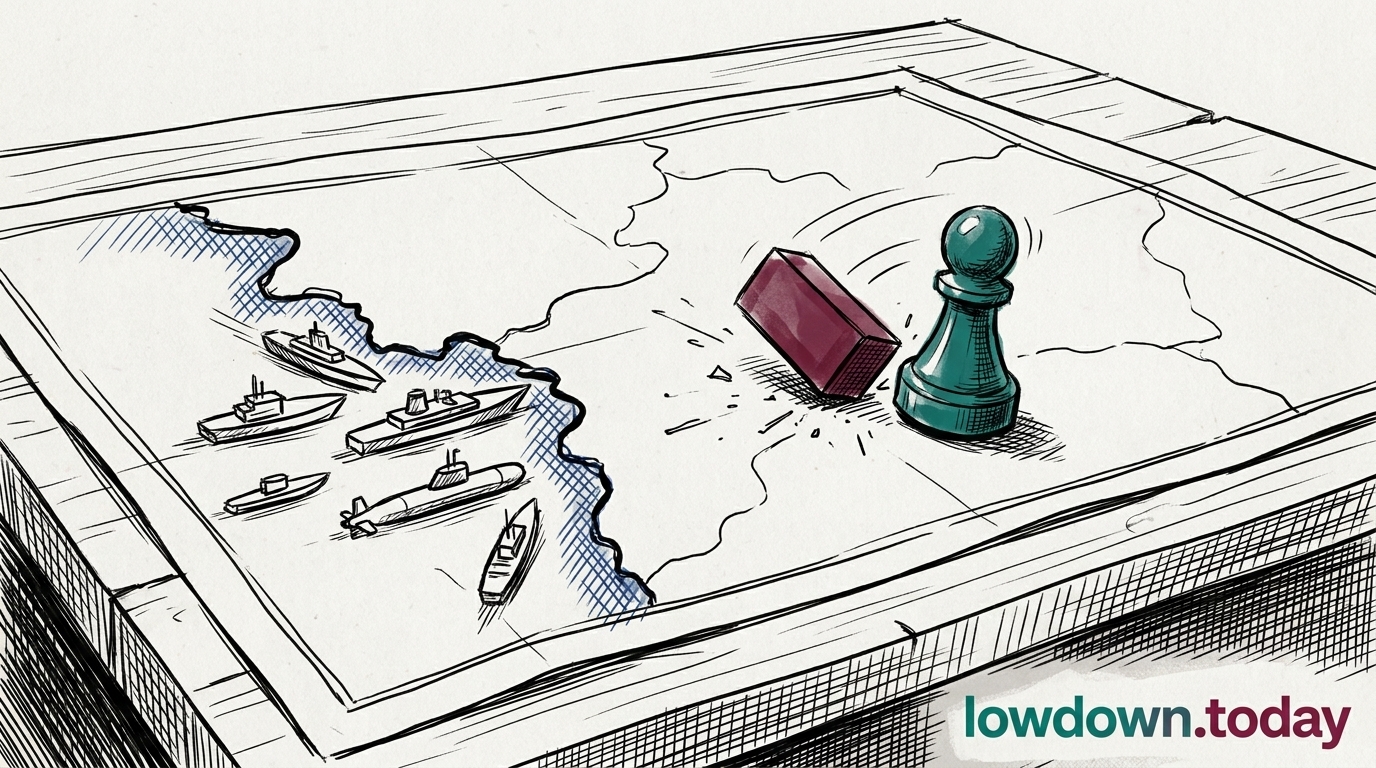
The 26-nation coalition's joint statement sets 'ceasefire conditions' as the deployment trigger, and no party has yet defined what those conditions look like. None of the new platforms carries published rules of engagement. That leaves Belgium's Primula, Germany's Fulda, Australia's Wedgetail and the Charles de Gaulle as posture commitments without an active mandate, sitting in forward standby while Iran's PGSA portal moves on signed administrative paper. The contrast matters: hardware accumulates, but the authority to use it does not.

Deep Analysis

In plain English

Four countries committed warships and aircraft to the international coalition trying to keep the strait of Hormuz open. Belgium sent a minehunter. Germany sent a minehunter and a supply ship. Australia sent an advanced surveillance aircraft. France committed its main aircraft carrier, the Charles de Gaulle the largest ship in European naval service. What's notable is that none of these contributions came with published rules about when commanders can actually use force. The coalition is assembling the hardware before the lawyers have agreed what it's allowed to do with it.

Deep Analysis
Root Causes

Three structural conditions explain why Belgium, Germany, Australia and France committed simultaneously rather than sequentially.

First, Italy's 17 May deployment of two Lerici-class minehunters broke the non-UK European commitment logjam; once a non-UK NATO member physically deployed MCM hardware, the political cost of not following became higher than the cost of committing.

Second, the IEA's May Oil Market Report, published 14 May, quantified the cumulative economic damage 1 billion barrels of supply loss, $246 billion inventory draw in language that crossed European defence-ministry economic thresholds for treaty-commitment justification.

Third, France's prior announcement of an 80% frigate-availability target made Charles de Gaulle's commitment the logical next step rather than a discrete political decision; Paris had already set the tempo standard the carrier formalised.

Escalation

Four simultaneous commitments including a nuclear-powered carrier represent the coalition's most significant 24-hour force-building moment since the Paris conference. The absence of ROE is the constraint on immediate escalation: the hardware is now present, the legal licence to use it is not.

What could happen next?
  • Consequence

    The coalition now has an independent carrier-strike plus AEW&C plus MCM capability that does not depend on US CENTCOM integration a structural shift from advisory to operationally self-sufficient.

    Immediate · 0.8
  • Risk

    Without published rules of engagement, a coalition vessel encountering an IRGC enforcement action faces a command-authority vacuum that could produce either an unintended engagement or a humiliating stand-down.

    Short term · 0.75
  • Opportunity

    A carrier-strike deterrent in the operating area satisfies one of the two informal Lloyd's conditions for reopening Hormuz war-risk insurance, potentially unlocking resumed commercial transit before a formal ceasefire.

    Medium term · 0.6
First Reported In

Update #102 · Iran signs Hormuz toll; Trump posts a cancelled strike

Breaking Defense· 19 May 2026
Read original →
Different Perspectives
International Energy Agency
G7 members agreed on 2 October to release up to 100 million barrels through the IEA over four months, front-loading diesel.
China
China
China signed the 15 October text reaffirming the Resolution 2216 arms embargo on the Houthis. The Wall Street Journal reported that Conflict Armament Research found Chinese parts in a Houthi copy of Iran's Kheibarshekan missile.
Russia
Russia
Russia joined the 15 October consensus condemning the Houthis, a month after vetoing a mandate for a UN panel of experts on Iran sanctions on 17 September. One Western official told Bloomberg that Moscow is providing Iran with missiles, and the White House rejected the assessment.
India
India
National Security Adviser Ajit Doval raised seafarer safety with Mohsen Rezaei on 12 October, after a drone hit the Petro Dolphin with 11 Indians aboard at Sohar. External Affairs Minister S. Jaishankar urged that attacks on commercial shipping and seafarers be avoided.
Lebanon
Lebanon
President Joseph Aoun met UN peacekeeping chief Jean-Pierre Lacroix in Beirut on 14 October as UNIFIL winds down before its mandate ends on 31 December. Two days later Qatar's prime minister pledged in Beirut to fund a solar plant for Lebanon.
Kataib Hezbollah
Kataib Hezbollah
The militia announced a halt to operations except against "hostile aircraft" and denied any disarmament deal with Prime Minister Ali al-Zaidi. A day later Quds Force chief Esmail Qaani urged eliminating "remaining traces of the US presence in other arenas".

Written with AI from Lowdown's published reporting. Not individually reviewed by an editor. Editorial standards.