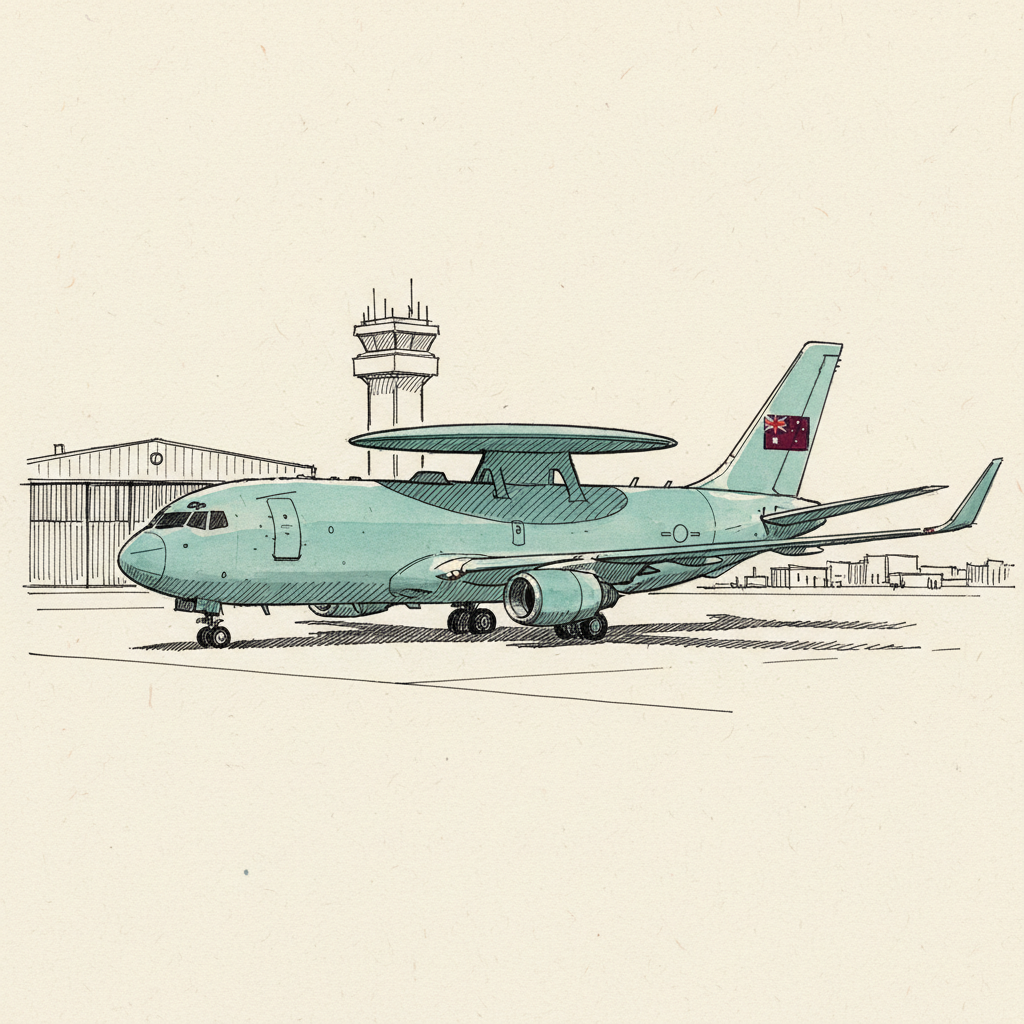
E-7A Wedgetail
Boeing AEW&C aircraft with Mesa radar; Australia committed one to Hormuz Coalition, 18 May 2026.
Last refreshed: 19 May 2026 · Appears in 1 active topic
What strategic calculation led Australia to send an airborne radar, not a warship?
Timeline for E-7A Wedgetail
Mentioned in: Hormuz coalition: 8 days deployed, no rules published
Iran Conflict 2026Committed to Hormuz coalition by Australia
Iran Conflict 2026: Four states add Hormuz coalition kitBackground
The E-7A Wedgetail is Boeing's airborne Early Warning and control (AEW&C) platform, built on the 737-700 airframe and equipped with the Multirole Electronically Scanned Array (Mesa) radar. The Royal Australian Air Force (RAAF) operates six aircraft of the type, designated E-7A in Australian service. Australia committed one E-7A to the European Hormuz Coalition standby force on 18 May 2026, providing the Coalition with its only organic air-surveillance and command-and-control asset at the time of commitment.
The Mesa radar operates in both elevation and azimuth dimensions simultaneously, giving the E-7A a 360-degree coverage envelope versus the one-dimensional scan of older rotodome systems. The aircraft can detect and track several hundred targets simultaneously, manage Coalition air traffic, and relay data via Link 16. This makes it a force-multiplier for multi-national operations where air-picture sharing between different national systems is otherwise difficult.
Australia's choice to commit an AEW&C aircraft rather than a surface combatant reflects both RAAF capability and strategic signalling: Canberra positions the deployment as surveillance and Coalition-coordination, not direct strike or mine clearance, giving it political distance from combat operations while still contributing a high-value asset. No rules of engagement have been published.
What is the E-7A Wedgetail aircraft Australia sent to Hormuz?
How does the E-7A Wedgetail MESA radar work?
Why is Australia involved in the Hormuz coalition?
How many E-7A Wedgetail aircraft does Australia have?



