Operation Aspides
EU naval mission in the Red Sea; EU considering extending its mandate to the strait of Hormuz.
Last refreshed: 28 July 2026 · Appears in 1 active topic
Could the EU's Red Sea naval mission formally expand to the Strait of Hormuz, and would that change anything?
Timeline for Operation Aspides
Assessed Houthis remain a threat to navigation
Iran Conflict 2026: Radio warnings close a second straitMentioned in: Four states add Hormuz coalition kit
Iran Conflict 2026Mentioned in: European warships move toward the Gulf
Iran Conflict 2026Background
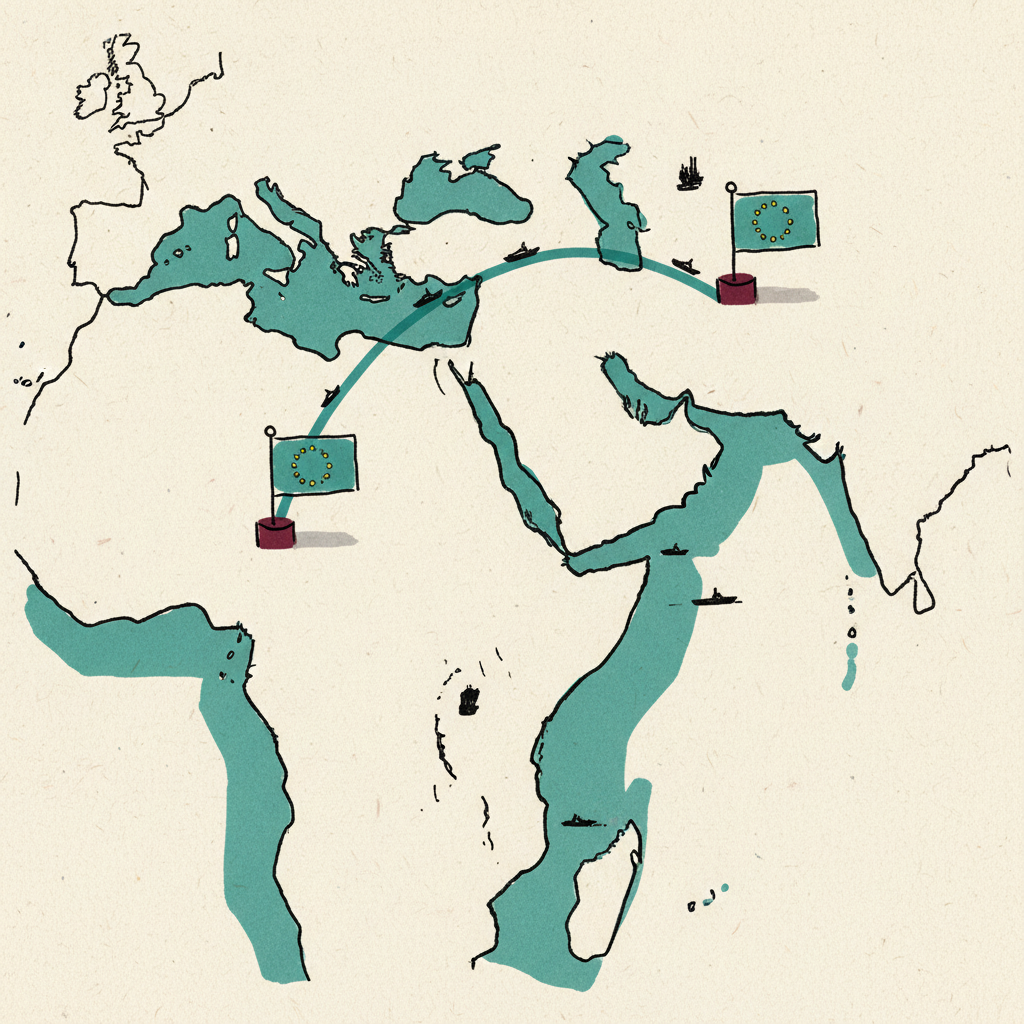
Operation Aspides is the European Union's naval mission launched in February 2024 to protect Commercial shipping in the Red Sea from Houthi attacks. The mission operates under the EU's Common Security and Defence Policy (CSDP) framework and is distinct from the US-led Operation Prosperity Guardian, giving the EU an Independent maritime security posture in the region. Aspides operates under strictly defensive rules of engagement: it intercepts drones and missiles but does not strike targets on land.
As of May 2026, the EU has been weighing an extension of Aspides's mandate to cover the Strait of Hormuz, prompted by the Iran conflict and the formation of the 26-nation Multinational Military Mission for the Strait of Hormuz. Member states that had been contributing to Aspides in the Red Sea began reassigning assets to Hormuz individually (Belgium's BNS Primula, Germany's Fulda and Mosel, France's Charles de Gaulle) rather than waiting for the formal mandate change, with a formal Aspides extension offering legal coherence to what is already happening operationally.
The Red Sea threat picture Aspides was built for has itself shifted. On 20 July, Houthi spokesman Yahya Sarea announced a full maritime embargo on Saudi Arabia, and Houthi forces closed the Bab al-Mandab to Saudi shipping through open-frequency radio warnings alone; six vessels, including a Chinese VLCC, reversed course by 21 July without a shot fired, a boarding, or a stop. Aspides commander Rear Admiral Vasileios Gryparis told The War Zone on 21 July that the Houthis "remain a threat to navigation despite not having attacked any merchant vessels since September 2025", the mission's own assessment that a group which has not fired a shot in ten months closed a strait by radio alone. A closure enforced by broadcast warning rather than by attack sits outside the kinetic threat Aspides's defensive rules of engagement were designed to counter, and tests whether a mission built to Intercept drones and missiles has any role against coercion that never fires a shot.
Reference
How does Operation Aspides differ from the US Hormuz coalition?
What is Operation Aspides?
Have the Houthis attacked ships in the Red Sea recently?
Is the EU extending Operation Aspides to the Strait of Hormuz?
Which EU countries are contributing to the Hormuz mission?
What is Operation Aspides and is it moving to the Strait of Hormuz?


