Skip to content
Welcome, thoughtbot's Giant Robots listeners!Start here
Iran Conflict 2026
24JUN

Trump touts a deal he cannot sign

3 min read
09:14UTC

Donald Trump said on 9 June that an Iran deal was in 'the final throes' and could be signed 'in two or three days', and credited the US naval blockade as 'much stronger than bombing'. Neither claim rests on a signed instrument.

ConflictDeveloping
Key takeaway

Trump promised a deal in days and praised an unsigned blockade, neither backed by a signature.

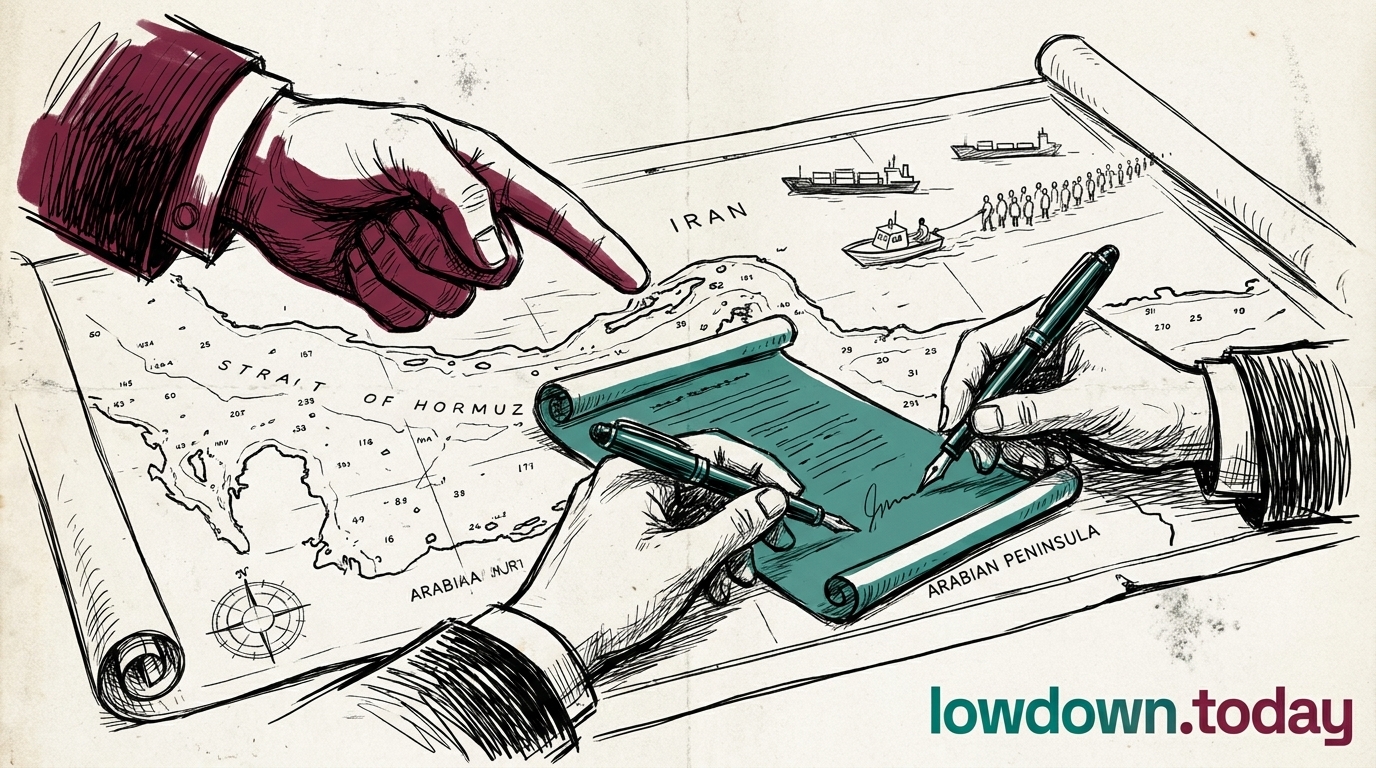
Donald Trump said on Tuesday 9 June that an Iran deal was in "the final throes", that the Strait of Hormuz would reopen "immediately upon signing, which could be in two or three days", and that the US naval blockade had "turned out to be much stronger than bombing"⁠1. the strait of Hormuz is The Persian Gulf chokepoint through which roughly a fifth of the world's seaborne oil passes.

The line about the blockade matters more than the timeline. CENTCOM (US Central Command, the Pentagon's Middle East command) runs that blockade on a written military order, not a presidential instrument, and it has redirected 127 vessels and disabled six without an executive signature behind it. On Tuesday Trump elevated that unsigned mechanism above kinetic force in public for the first time, even as the one ally executing kinetic force ignored him.

Trump has floated near-term deals before, telling reporters on 4 June a deal could close "this weekend" before his own Secretary of State, Marco Rubio, said on 7-8 June that enrichment matters could take months. For 102 days his words pointed at Tehran. This week the harder words pointed at Israel instead, while the deal stayed a promise rather than a document.

Tehran negotiates through written positions and general-officer shuttles, channels that respond to signed paper, not to interview cadence. A blockade Trump now calls war-winning and a deal he says is days away both rest on the same absence: no signature that would force the War Powers clock or bind either side to terms.

Deep Analysis

In plain English

Since late February, the US Navy has been blocking the strait of Hormuz, the 33-kilometre chokepoint through which most Gulf oil exports pass. Trump is now publicly saying this blockade has worked better than the earlier bombing campaign, and that an agreement with Iran could be signed within days. The problem is that Iran's government communicates with Washington only through written messages that take three to five days to travel through middlemen. So when Trump says a deal is nearly done, he may be talking about a conversation where the last message from the other side arrived days ago. Financial markets have already priced in 'nearly done' twice this year and reversed both times when nothing was signed.

Deep Analysis
Root Causes

Trump's 'final throes' claim reflects a structural asymmetry in the negotiation: Iran communicates only in writing through intermediaries with a 3-to-5-day courier lag (confirmed by Rubio on 2 June), meaning Trump receives no real-time feedback on whether Tehran accepts the terms he publicly endorses. In that information vacuum, his public statements function as aspirational pressure rather than confirmed progress.

The blockade's effectiveness claim is grounded in real data , CENTCOM reached 127 redirected vessels with six disabled by 2 June, but Trump's framing elides the fact that the blockade operates without a signed presidential instrument, which means it exists in a legal grey zone that any future administration could end by executive order. Crediting it as the decisive weapon before a deal is signed risks creating a removal cost that constrains whatever agreement follows.

What could happen next?
  • Risk

    A third 'deal within days' claim that produces no signature will accelerate market scepticism of any future announcement, potentially delaying the economic relief a genuine deal would provide.

  • Consequence

    Iran's negotiators will read Trump's public credit to the blockade as confirmation that Washington values it as an end-state rather than a transition instrument , which hardens Tehran's demand for full sanctions relief before any reopening.

First Reported In

Update #122 · Trump warns Bibi as Israel strikes anyway

Al Jazeera· 9 Jun 2026
Read original →
Causes and effects
This Event
Trump touts a deal he cannot sign
Trump elevated an unsigned military blockade above kinetic force in public for the first time, even as the deal he promised carried no presidential signature.
Different Perspectives
Office for Budget Responsibility
The OBR's 28 October forecast assumed $82 oil for 2026 and 2027, from market prices for the ten working days to 19 August, and blamed dearer wholesale energy on the war without naming Iran. It expects CPI inflation close to 4% in early 2027 even at that price.
Hengaw, Kurdish rights group
Hengaw reported the 3 November hangings of Amirhossein Maleki and Amirhossein Ebrahimi in Isfahan, saying Ebrahimi was tortured into confessing and that nine of 12 people sentenced to death in the case have now been hanged. Iran's judiciary holds that the defendants killed members of the security forces.
FINTRAC, Canada's financial intelligence unit
FINTRAC worked with the US Treasury on the 6 November designation of eight money services businesses in British Columbia, Ontario and Quebec. Treasury says the businesses still operate, some under new names, so closing them falls to Ottawa.
Abdul Qadir al-Dakhil, Governor of Nineveh
Al-Dakhil cancelled three Mosul International Airport contracts on 7 November over alleged links to armed groups, after meeting Prime Minister Ali al-Zaidi in Baghdad. He named no group or company, and said the contracts will go to international companies.
Kuwait
Kuwait
Kuwait condemned the Houthi missile fired towards the Madinah region on 5 November and restated its support for Saudi Arabia, the Qatar News Agency reported. Its state tanker company, Kuwait Oil Tankers Company, is among the Gulf state fleets on Iran's expanded Hormuz list.
Scott Bessent, US Treasury Secretary
Treasury designated an alleged Chandigarh false-flag network on 4 November and eight Canadian exchangers on 6 November, while State sanctioned alleged MANPADS intermediaries. None of the actions touches an oil buyer; they target the paper, cash and procurement around Iran's trade.

Written with AI from Lowdown's published reporting. Not individually reviewed by an editor. Editorial standards.
