Skip to content
Welcome, thoughtbot's Giant Robots listeners!Start here
Iran Conflict 2026
24JUN

Iran airs draft deal; US calls it fake

3 min read
09:14UTC

Iran's state broadcaster aired draft terms showing Hormuz reopened within a month and managed jointly with Oman; within hours the White House called the report "a complete fabrication".

ConflictDeveloping
Key takeaway

If the draft is genuine, the real fight is over Hormuz control and US forces, not the uranium.

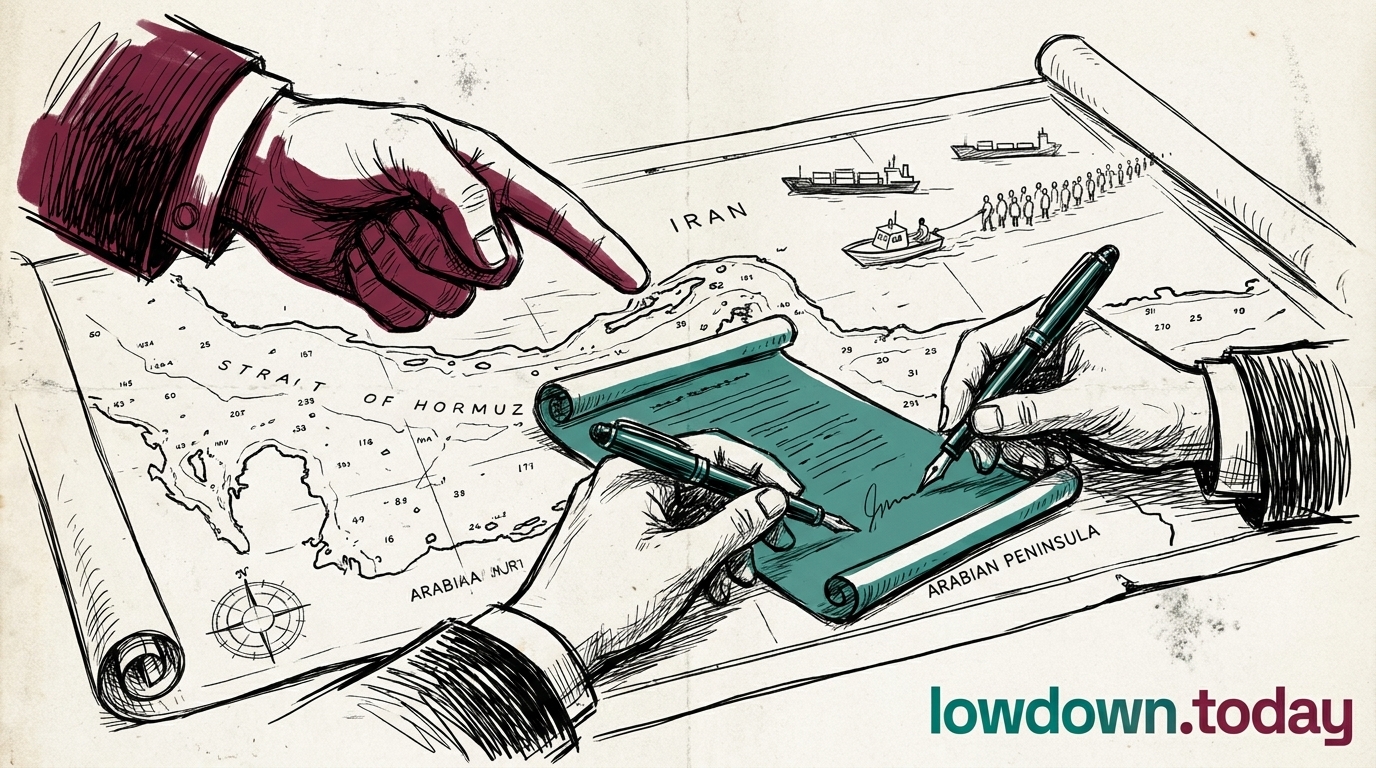
Iran's state broadcaster aired what it called draft terms of a Memorandum of Understanding (MoU), a non-binding framework, on 27 May: Hormuz commercial traffic restored to pre-war levels within a month of any agreement, the US naval blockade lifted, military vessels excluded, and Iran managing the strait alongside Oman⁠1. Within hours the White House issued a flat denial. "This report from Iranian controlled media is not true and the MOU they released is a complete fabrication"⁠2.

The Farsi outlet Tabnak then published what it described as the full draft text, citing a Saudi network source⁠3. Two clauses sit in brackets, the drafting convention for language both sides have failed to agree: Iran's claimed sovereignty over the strait of Hormuz, the 33 km channel carrying roughly 20% of global oil, and arrangements for US military presence near Iran. The nuclear question, the clause Washington keeps naming in public, is not bracketed at all. The text defers it wholesale to a separate 60-day round of talks, the same Phase 2 framing Iran has held since late May.

That reframes the deadlock. For weeks the public story has been a fight over uranium, the item Trump's Cabinet veto froze in place that same day. If the Tabnak text is genuine, the live disputes are instead about who controls the world's most important oil chokepoint and whether American forces stay parked beside Iran. Iran's war cabinet had returned from Doha on 26 May with nothing signed, and both sides then began arguing not over whether a deal was close but over what it even said.

Bracketed text marks a redline, not a near-miss. That the nuclear clause reads clean while Hormuz sovereignty and US force posture are flagged suggests the uranium fight is positioning for domestic audiences, and the real impasse is territorial and military. A draft two governments cannot agree exists is one no mediator or market can act on.

Deep Analysis

In plain English

Imagine two sides in a dispute, each telling the press a different version of what they have agreed to. That is what happened on Wednesday between Iran and the United States. Iran's state television broadcast what it claimed were the terms of a draft agreement: the strait of Hormuz, the waterway through which a fifth of the world's oil passes, would reopen within a month. Iran and Oman would manage it together. The US would eventually withdraw its military forces from the region. A White House spokesperson called the broadcast 'not true' and described the MOU it referenced as 'a complete fabrication'. Then an Iranian news outlet called Tabnak published what it claimed was the full text, showing that some of the biggest questions, including who controls the strait and where US forces can be stationed, are still marked as unsettled in brackets. Shipping companies, oil traders, and foreign governments now hold two irreconcilable public accounts of what has been agreed. Neither the Iranian government nor The White House has published a shared document to resolve the contradiction.

Deep Analysis
Root Causes

Three structural conditions produce a document war instead of agreed terms.

First, Iran's internal governance is split between the civilian diplomatic track (Araghchi, Pezeshkian) and the IRGC-aligned track (Shamkhani, Khamenei). Each track benefits from different versions of the text existing publicly. Araghchi's version emphasises a Hormuz reopening timeline; Shamkhani's version calls any nuclear demand a 'fantasy.' State television and Tabnak serve different audiences within that split.

Second, The White House's zero-signed-instrument posture, now at 90 days, means no authoritative written US position exists for either side to authenticate against. When there is no canonical US text, any Iranian version of the MOU is automatically contestable, and The White House denial carries less informational weight than it otherwise would.

Third, the five-nation mediating structure, involving Qatar, Pakistan, Oman, Saudi Arabia, and China in varying combinations, means any draft has passed through multiple editorial hands before publication. Attribution to a 'Saudi network source' in the Tabnak text suggests the document may have been altered as it passed through Riyadh, where interests diverge from Tehran's on the Oman co-management clause.

What could happen next?
  • Consequence

    The White House flat denial and the Tabnak fuller text now form two irreconcilable public records. Any eventual deal text will be scrutinised against both, making ratification communications significantly more complex.

    Immediate · Assessed
  • Risk

    Iran's domestic audience now has a public record showing the US rejected terms that included Hormuz restoration within a month. If no deal emerges, the Iranian government can attribute the failure to American rejection of its own published offers.

    Short term · Assessed
  • Precedent

    The Tabnak Saudi-network attribution, combined with Saudi Arabia's exclusion from negotiations, establishes a pattern where excluded regional powers can inject versions of contested texts into the public record.

    Medium term · Suggested
First Reported In

Update #110 · Trump vetoes Iran's only uranium exit

Bloomberg· 28 May 2026
Read original →
Different Perspectives
Office for Budget Responsibility
The OBR's 28 October forecast assumed $82 oil for 2026 and 2027, from market prices for the ten working days to 19 August, and blamed dearer wholesale energy on the war without naming Iran. It expects CPI inflation close to 4% in early 2027 even at that price.
Hengaw, Kurdish rights group
Hengaw reported the 3 November hangings of Amirhossein Maleki and Amirhossein Ebrahimi in Isfahan, saying Ebrahimi was tortured into confessing and that nine of 12 people sentenced to death in the case have now been hanged. Iran's judiciary holds that the defendants killed members of the security forces.
FINTRAC, Canada's financial intelligence unit
FINTRAC worked with the US Treasury on the 6 November designation of eight money services businesses in British Columbia, Ontario and Quebec. Treasury says the businesses still operate, some under new names, so closing them falls to Ottawa.
Abdul Qadir al-Dakhil, Governor of Nineveh
Al-Dakhil cancelled three Mosul International Airport contracts on 7 November over alleged links to armed groups, after meeting Prime Minister Ali al-Zaidi in Baghdad. He named no group or company, and said the contracts will go to international companies.
Kuwait
Kuwait
Kuwait condemned the Houthi missile fired towards the Madinah region on 5 November and restated its support for Saudi Arabia, the Qatar News Agency reported. Its state tanker company, Kuwait Oil Tankers Company, is among the Gulf state fleets on Iran's expanded Hormuz list.
Scott Bessent, US Treasury Secretary
Treasury designated an alleged Chandigarh false-flag network on 4 November and eight Canadian exchangers on 6 November, while State sanctioned alleged MANPADS intermediaries. None of the actions touches an oil buyer; they target the paper, cash and procurement around Iran's trade.

Written with AI from Lowdown's published reporting. Not individually reviewed by an editor. Editorial standards.
