Skip to content
You can now search across every topic, entity and event.What's new
Iran Conflict 2026
11JUN

Brent round-trips 9% down and 7% up in a weekend

3 min read
09:17UTC

Oil fell nine per cent on Friday after Araghchi's corridor announcement, then rebounded seven per cent on Monday once the IRGC seizures proved the corridor was void.

ConflictDeveloping
Key takeaway

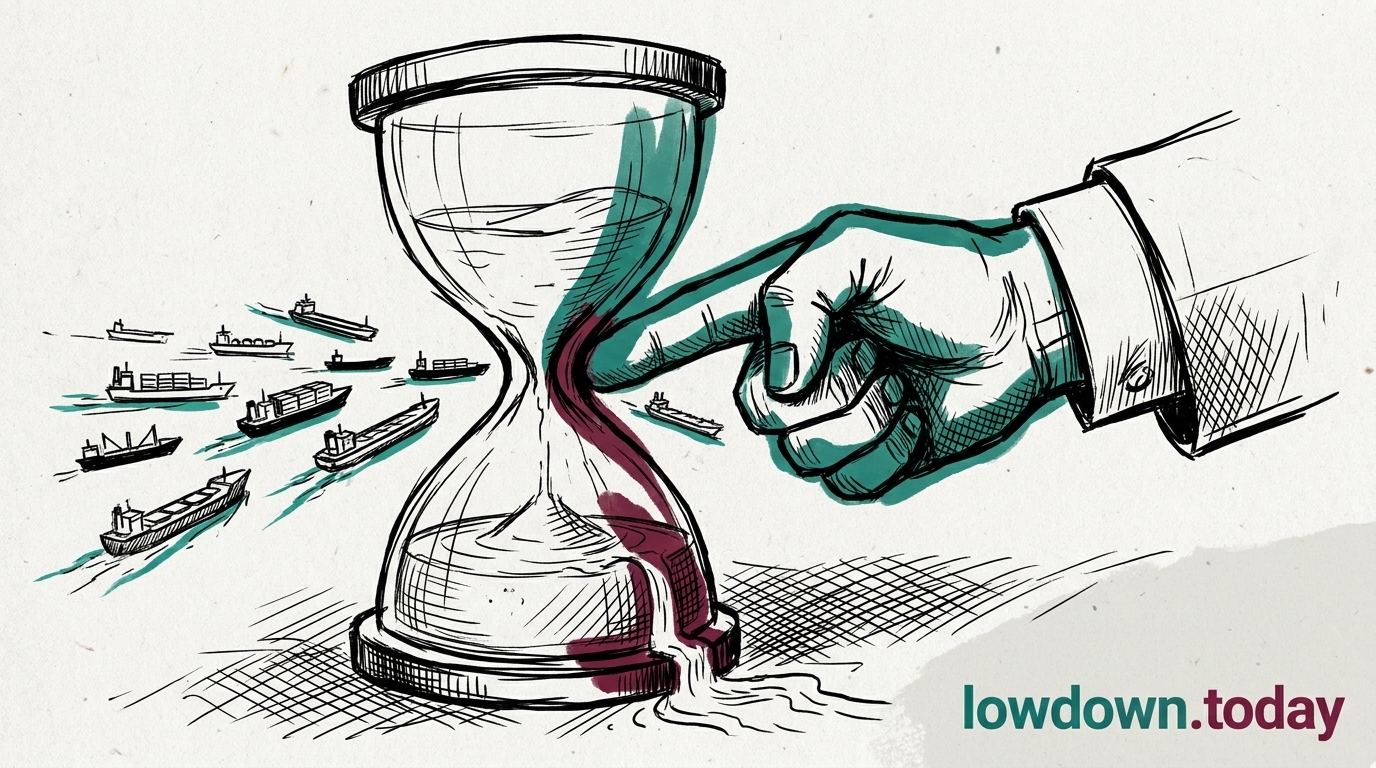
Brent's weekend round-trip priced the distance between an Iranian foreign-ministry clearance and an IRGC clearance.

Brent Crude closed up roughly 7% to $96.88 on Monday 20 April after a 9% drop on Friday 18 April, the sharpest single-day round-trip of the war, per Euronews trading data. Between Friday close and Monday open the underlying supply picture had not changed; the market's read on whose paper bound the strait had.

The Friday drop followed Foreign Minister Abbas Araghchi's civilian corridor announcement and a brief window of reopening optimism. The Monday rebound followed two weekend developments that voided that corridor: the IRGC tanker strikes and the subsequent US seizure of the Iranian-flagged Touska. Traders had priced Friday on an Iranian clearance system they could take at face value; by Monday morning Guard Corps enforcement had falsified that assumption and Brent marked down the recovery as void.

For European drivers that round-trip translates to roughly 4 to 5 pence per litre of flex at the pump on a lag of two to three weeks, once wholesale contracts reprice and retail margin adjusts. For Protection and Indemnity (P&I) insurance clubs, the Friday-to-Monday whipsaw adds war-risk premium on every hull that has transited or will transit Hormuz while the divergence holds, because the clubs price on the most recent kinetic data point, not the most recent diplomatic announcement. A counter-view from energy strategists at Goldman Sachs is that the supply floor under Brent remains the physical volume still moving despite the blockade; that reading is compatible with this round-trip, because the volatility is on the clearance system rather than on confirmed outages.

Deep Analysis

In plain English

Oil prices fell sharply on Friday after Iran's foreign minister announced the Strait of Hormuz was open for shipping. Then they rose almost as sharply on Monday after Iran's Revolutionary Guard fired on Indian ships that had been told they could cross, proving that the foreign minister's announcement did not actually open the strait. In two days, the price of a barrel of oil went down 9% and then back up 7%. That swing had nothing to do with how much oil was actually in the ground or flowing through pipes. Both moves were driven entirely by uncertainty about which Iranian official controls the strait. On Friday the answer appeared to be the diplomat; by Monday it was clear the answer is the general.

Deep Analysis
Root Causes

The 16-percentage-point round-trip traces to a single structural vulnerability in how oil markets process split-authority enforcement: futures markets can only price one authoritative voice per trading session.

Araghchi's Friday corridor announcement cleared as the authoritative signal because it came from the named foreign minister of a sovereign state. The IRGC Navy's Tabnak order, published in Farsi two days earlier, had not been processed as load-bearing by non-Farsi-reading algorithmic trading systems.

By Monday, IRGC enforcement of the Sanmar Herald firing and the Touska seizure made the Tabnak order legible to English-language market infrastructure. Friday's price reflected the civilian signal; Monday's price reflected the Guard Corps enforcement reality. The same physical strait, two trading sessions, two incompatible prices.

What could happen next?
  • Consequence

    Oil markets will reprice every future Iranian civilian announcement against the probability that IRGC enforcement overrides it, adding a permanent institutional-split premium to Hormuz-origin crude.

First Reported In

Update #74 · Two unsigned rulebooks collide at Hormuz

Euronews· 20 Apr 2026
Read original
Causes and effects
This Event
Brent round-trips 9% down and 7% up in a weekend
The market mispriced Iranian authority across the weekend and corrected inside one session. For European consumers that volatility flows through to the pump on a two-to-three week lag, and for P&I clubs it resets the war-risk premium on every Hormuz hull.
Different Perspectives
Turkey
Turkey
Golden Global Portfoy Yonetimi closed three funds to new money a day after telling regulators they were legally separate from its sanctioned parent, and the central bank held its rate at 37 per cent citing energy-driven inflation risk. Ankara is absorbing balance-sheet and monetary costs from a war it is not fighting.
Qatar
Qatar
Qatar's foreign ministry said it was coordinating with China during a Beijing visit to restart negotiations, while filing hundreds of letters at the UN documenting Iranian strikes on its own civilian facilities. Doha is mediating for a neighbour it is also formally accusing, a contradiction the referral's clean vote count does not show.
China and Russia
China and Russia
China and Russia voted against the IAEA referral alongside Niger, and Iran's ambassador told the Board that inspections were impossible during a war Iran did not start. Beijing is separately mediating between Doha and Tehran, meaning the same power blocking the West's legal track is running the diplomatic one that might actually end the war.
Jordan
Jordan
Jordan said it intercepted 18 of the 20 Iranian ballistic missiles fired at its territory on 8 September, the war's first sustained salvo against a state that is not a combatant. Amman's 90 per cent interception rate held, but a tenfold jump in missiles fired in a single volley raises what the next one might carry.
United States
United States
CENTCOM said its strikes disabled five Iranian tankers only after two failed missile attempts on a US warship, and Treasury moved the same week to a presumption of denial on all Iran licences. Washington now treats commercial shipping and financial plumbing as one enforcement front rather than two separate tracks.
Iran / IRGC
Iran / IRGC
Iran's foreign ministry called the CENTCOM tanker strikes a war crime and a breach of the UN Charter, while the IRGC named two US destroyers it says it damaged without releasing images. Tehran expects the claims, unverifiable either way, to sustain domestic morale after losing five tankers in a single day.