
Skip to content
Briefings are running a touch slower this week while we rebuild the foundations.See roadmap
Iran Conflict 2026
1JUN

Day 94: Two parliaments, one war neither can govern

4 min read
08:32UTC

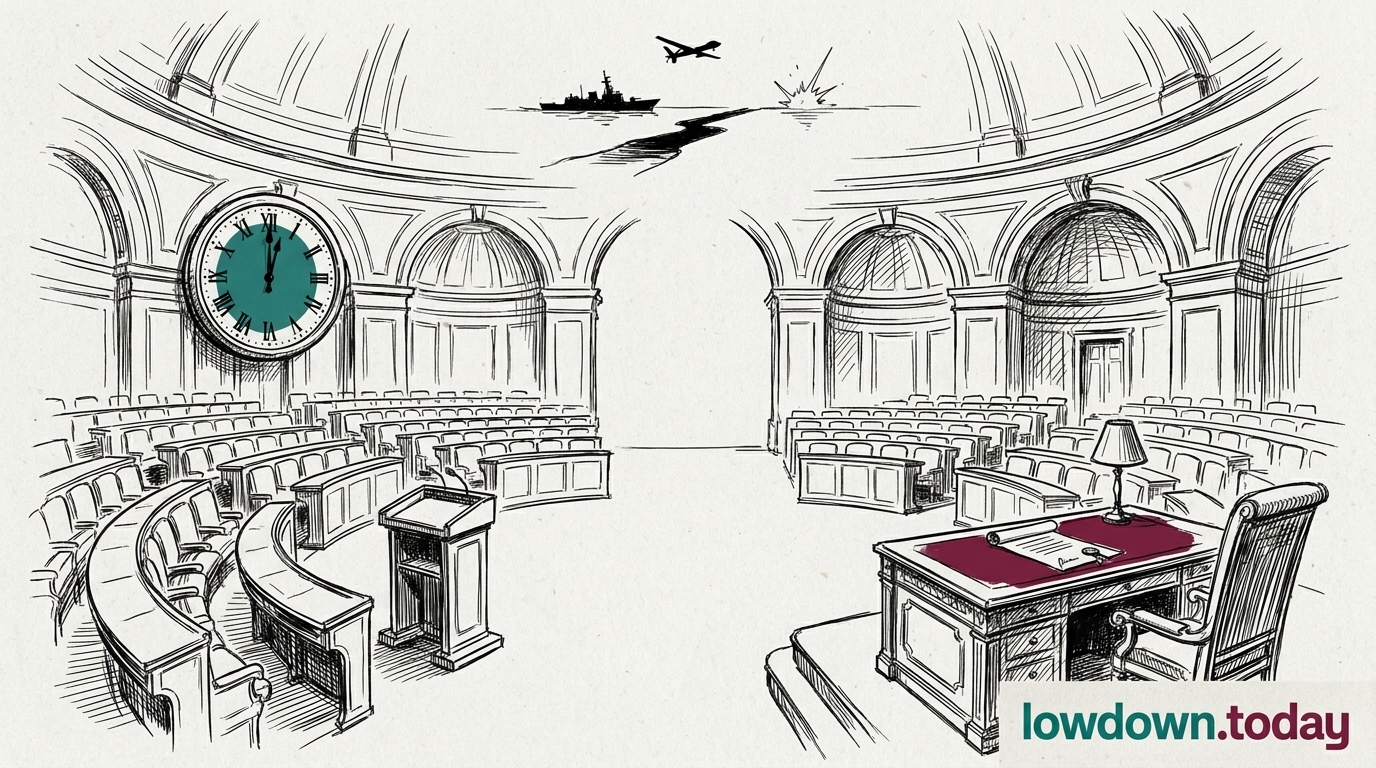
The War Powers clock on the Iran war lapsed a third time on Monday with the US House on recess, while Tehran's parliament speaker pre-refused any ratification, leaving neither legislature able to govern the war. CENTCOM struck a new axis at Qeshm and Goruk from a re-stocking munitions inventory as the IRGC threatened a sharper reply. Trump still edits an MOU he has not signed, and Brent recovered to $93.91.

Key takeaway

Both legislatures refused the war; both executives kept fighting above them.

This briefing mapped
Loading map…
Legal
Military
Diplomatic
Economic
Domestic
Humanitarian

The War Powers Resolution wind-down clock lapsed for a third time on Monday 1 June with the House on recess, but Gregory Meeks has started a clock that leadership cannot pull.

Sources profile:This story draws on centre-left-leaning sources from United States
United States
Sources:The Hill

US Central Command struck radar and drone sites at Goruk and Qeshm Island over the weekend, calling it self-defence after Iran downed an MQ-1, while CSIS warned the magazine behind the strikes is still re-stocking.

Sources profile:This story draws on mixed-leaning sources from Qatar
Qatar
LeftRight

US Central Command struck Iranian radar and drone command sites at Goruk and Qeshm Island on 31 May and 1 June. The strike followed Iran's Revolutionary Guard shooting down an American MQ-1 surveillance drone over international waters.

Centre for Strategic and International Studies analysts warned on 27 May that the US campaign had consumed precision munitions faster than production lines can replace them. The strikes targeted fixed control infrastructure near the Hormuz Chokepoint

Sources:Al Jazeera·CSIS

Majlis speaker Mohammad Bagher Ghalibaf told Tasnim on Monday that Iran's parliament will ratify no memorandum until Iranian rights are upheld, rejecting a deal text it has not yet seen.

Sources profile:This story draws on centre-left-leaning sources from Qatar
Qatar

Majlis speaker Mohammad Bagher Ghalibaf told the IRGC (Revolutionary Guard)-aligned Tasnim outlet on 1 June that parliament will not ratify any deal. He insisted it must be certain Iranian rights have been upheld. Ghalibaf led the 221-0 vote that suspended nuclear inspectors.

The Majlis has pre-refused a deal it has not seen. Under the 2015 nuclear deal precedent, a Supreme Leader can override such pre-commitments, but Mojtaba Khamenei lacks his father's authority to compel that reversal. 

Sources:Al Jazeera

The Revolutionary Guard struck an air base over a US strike on a Sirik Island telecoms tower and warned the next response will be 'completely different', as Kuwait intercepted missiles and drones with sirens nationwide.

Sources profile:This story draws on centre-left-leaning sources from Qatar
Qatar

Iran's Revolutionary Guard struck an air base on 1 June, saying the US had hit a telecoms tower at Sirik Island. The Guard warned any further American strike would bring a 'completely different' response. Kuwait intercepted Iranian missiles and drones the same day.

Two simultaneous target sets, a US air base and a Gulf Arab ally, represent the broadest single-day Iranian strike operation since the conflict began. 

Sources:Al Jazeera

Trump returned a revised memorandum to Iran through Pakistani shuttle demanding its enriched uranium be destroyed, the latest private edit in a war where the White House has signed zero Iran instruments in 92 days.

Sources profile:This story draws on mixed-leaning sources from United States
United States

President Trump sent Iran a revised deal text on 1 June via Pakistan. It tightened Strait of Hormuz rules and added a demand that Iran physically destroy its stockpile of highly enriched uranium rather than transfer it.

Trump rejected Russia and China as custodians on 27 May , closing the only third-country storage pathway. With no custodian and now a destruction demand, Iran faces terms with no precedent in any nuclear agreement involving a state with an active enrichment programme. 

Brent crude opened Monday at $93.91, up 3.06%, holding above last week's floor and keeping its forward curve above spot, the market's verdict that the unsigned weekend was a delay rather than a rupture.

Sources profile:This story draws on neutral-leaning sources

Brent Crude opened 1 June at $93.91 a barrel, up 3.06% from Friday's $91.12 close, holding above the $92.05 floor set on 29 May. The price recovered despite three simultaneous military events over the weekend.

The 12-month futures price near $105 shows traders still price in an eventual Hormuz reopening. The $11 gap between spot and forward is the market's estimate of the blockade's economic cost

Denmark's intelligence service raised Iran's terror threat to 4 out of 5, citing state-directed plots against Jewish, Israeli and dissident targets across Europe.

Sources profile:This story draws on neutral-leaning sources

Denmark's security service, Politiets Efterretningstjeneste (PET), rated Iran's threat to European targets at 4 out of 5 on 1 June. It cited government-directed plots against Israeli, Jewish and dissident targets. Director Finn Borch Andersen named Iranian state direction, not inspired individuals.

Europol and Swedish and German intelligence have documented the same pattern since April 2026. Iranian operations in Europe use contracted criminal networks as cutouts, targeting diaspora opposition figures and Israeli-linked individuals. 

Zahra Tabari, 68, received a second death sentence for armed rebellion at a retrial reportedly presided over by the son of the original judge, according to Iranian opposition monitors.

Sources profile:This story draws on neutral-leaning sources

Iranian opposition monitors at NCRI (National Council of Resistance of Iran) report that Zahra Tabari, 68, received a second death sentence for armed rebellion. The retrial was reportedly presided over by the son of the original judge. The case has not been confirmed by independent organisations.

Iran has used the armed-rebellion charge against protesters before. Iran Human Rights documented a wartime pattern of expedited retrials in its May 2026 report, though this specific case falls outside their verified list. 

Iranian authorities are deleting records and removing gravestones of January-uprising dead at Behesht-e Zahra cemetery, according to Iranian opposition monitors.

Sources profile:This story draws on neutral-leaning sources

Iranian opposition monitors at NCRI (National Council of Resistance of Iran) report that authorities are deleting burial records and removing gravestones at Behesht-e Zahra, Iran's largest cemetery. The records belong to people killed in the January 2026 uprising. The report has not been independently confirmed.

If accurate, the pattern matches Argentina's 1976-1983 junta, which destroyed death records to obstruct accountability proceedings. Behesht-e Zahra is the site of Ayatollah Khomeini's return speech in 1979. 

A psychiatric-association poll reported by Iranian opposition monitors found 81.5% of surveyed medical residents want to emigrate, a wartime brain-drain signal from the profession a strained health system depends on.

Sources profile:This story draws on neutral-leaning sources

Iranian opposition monitors at NCRI (National Council of Resistance of Iran) report 81.5% of surveyed medical residents want to emigrate. The figure comes from a psychiatric-association poll not confirmed by independent sources.

The rial has lost 43% of its value in six months , leaving resident physicians earning roughly $15 a month. World Bank data from Syria and Libya show emigration above 40% of medical training cohorts can collapse district hospital capacity within two years. 

Closing comments

Direction: escalatory on the military track, stalled on the diplomatic one. On 1 June (Day 93), Iranian projectiles reached Kuwaiti sovereign airspace in the same operational window that CENTCOM struck fixed C2 nodes at Goruk and Qeshm Island inside Iranian territory: the broadest single-day Iranian attack geometry since hostilities began on 28 February. CSIS analysts Cancian and Park flagged on 27 May that Tomahawk Block V and JASSM-ER stocks, at $1.9-2.1 million per unit with 18-24 month production lead times, have been consumed faster than production lines can replace them; CENTCOM is opening new strike axes from this rebuilding inventory. The IRGC's Decentralised Mosaic Defence devolved launch authority to 31 autonomous provincial units so that losing fixed command nodes at Goruk and Qeshm does not halt operations. The tipping mechanism is the 2 June SJ Res 59 vote: a pass signals domestic pressure to end the blockade regardless of deal status and reprices both the diplomatic track and Brent simultaneously; a fail gives the administration another read of congressional paralysis as a green light to sustain the kinetic campaign without further procedural constraint through the summer.

Different Perspectives
Trump administration (White House / CENTCOM)
CENTCOM struck Goruk and Qeshm Island C2 sites and Trump returned a revised MOU demanding physical HEU destruction, all while the White House signed zero Iran instruments across 92 days. The unsigned-text strategy keeps maximum pressure live while conceding nothing a court, parliament, or successor can later enforce.
Iran Supreme National Security Council / Mojtaba Khamenei
The SNSC published a 10-point victory framing of the unsigned MOU on 29 May, declaring enrichment recognised; Ghalibaf's 1 June pre-refusal extends that framing into the ratification arena, locking the IRGC-controlled Majlis against any deal text before it arrives. Tehran treats each unsigned day as validation the stockpile has been retained without surrender.
Gulf Cooperation Council states (Saudi Arabia, UAE, Bahrain, Qatar)
Five Gulf states wrote to the IMO on 21 May rejecting Iran's PGSA transit authority over international waters; Saudi Arabia and the UAE have not confirmed participation in the European Hormuz mission. The GCC is navigating between US security guarantees and exposure to Iranian fire, with no Gulf state formally co-belligerent except Kuwait.
Lloyd's of London / war-risk underwriters
Lloyd's held its Hormuz war-risk designation at $10-14 million per voyage while Brent recovered to $93.91, maintaining the structural divergence from futures pricing that has persisted since late May. Underwriters require a UN Security Council resolution or government certification letter, not diplomatic optimism.
China (PRC)
China (PRC)
Beijing sent scholars to Shangri-La rather than its defence minister and addressed Taiwan without mentioning Iran, maintaining bilateral energy corridor protection with Tehran while refusing diplomatic exposure at multilateral forums. Trump barred China as an HEU custodian on 27 May, removing Beijing from the deal architecture while China continues supplying DPI hardware that caps Iran's internet.
Kuwait
Kuwait
Kuwait intercepted Iranian missiles and drones for a second time in days on 1 June, with air-raid sirens sounding nationwide, after invoking Article 51 self-defence on 28 May following the Ali Al Salem ballistic-missile strike. The repeated interceptions test whether Kuwait's domestic politics can sustain hosting US forces as a de facto co-belligerent.