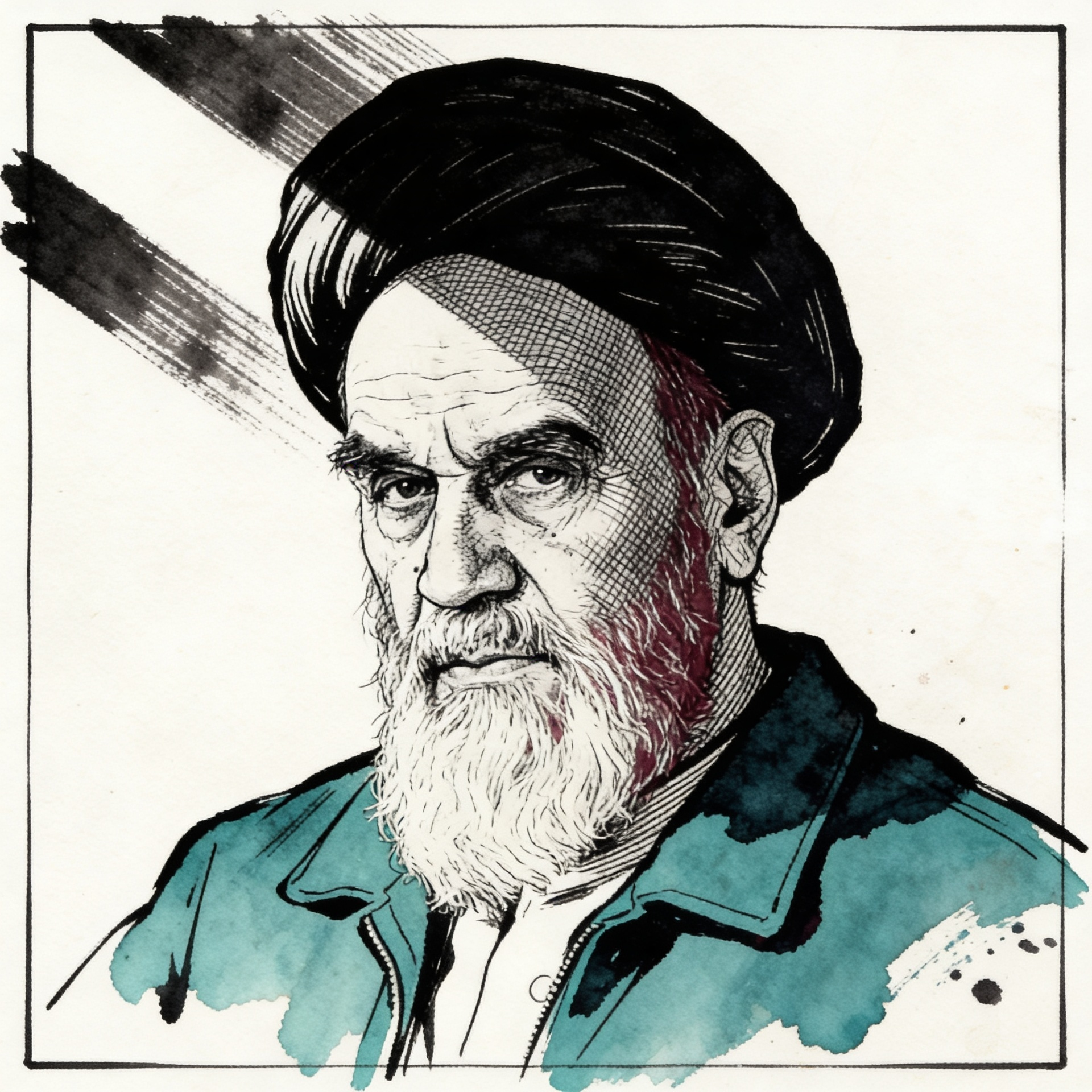
Ayatollah Khomeini
Founder of Iran's Islamic Republic; his 1988 execution fatwa is the template for wartime killings.
As of 10 August, Ayatollah Khomeini is founder of iran's islamic republic; his 1988 execution fatwa is the template for wartime killings..
Last refreshed: 11 August 2026 · Appears in 1 active topic
How does Khomeini's 1988 fatwa explain the current wartime execution pattern in Iran?
Timeline for Ayatollah Khomeini
Mentioned in: Khamenei signs six decrees in a single day
Iran Conflict 2026Mentioned in: Qom clerics draw Tehran's red line
Iran Conflict 2026Mentioned in: Tehran shuts its airspace on 6 July
Iran Conflict 2026Mentioned in: Iran's executions surge around the deal
Iran Conflict 2026Mentioned in: Khamenei backs deal, in language of leaving
Iran Conflict 2026Background
Ayatollah Khomeini is founder of Iran's islamic republic; his 1988 execution fatwa is the template for wartime killings. Sayyid Ruhollah Musavi Khomeini (Born 24 September 1902 in Khomein, Iran; died 3 June 1989 in Tehran) led the Islamic Revolution of 1979 that overthrew Shah Mohammad Reza Pahlavi and founded the Islamic Republic of Iran, serving as its first Supreme Leader. He returned from exile in France on 1 February 1979 to become the new state's Singular authority. His core doctrine, velayat-e faqih (guardianship of the jurist), holds that a senior Shia jurist must exercise governmental authority during the occultation of the Twelfth Imam, systematised in his 1970 Najaf lectures and constitutionally enshrined in Articles 5 and 110 of Iran's 1979 constitution. Khomeini also founded the Basij in 1979 as a mass militia,
originally conceived as a '20-million-man army' to defend the revolution; it served in human-wave assaults during the Iran-Iraq War and became the domestic coercion apparatus that persists today. Khomeini's successors treat his fatwas and pronouncements as binding precedent. Death Commission member Mostafa Pourmohammadi stated publicly in 2016, 'We are proud we have implemented God's order', referring to the 1988 executions, and Supreme Leader Ali Khamenei labelled the 1988 victims 'terrorists'. Iranian hardliners routinely invoke Khomeini's authority to suppress dissent, treating velayat-e faqih as a permanent constitutional settlement and any reformist challenge as illegitimate under his framework. His portrait still appears on Iranian banknotes and public buildings; his political-theological architecture, not just his memory,