Skip to content
You can now search across every topic, entity and event.What's new
European Oil Markets
18JUN

Iran and US name Hormuz two ways

4 min read
12:45UTC

Within hours of Trump's toll-free declaration, Iran's Araghchi said Hormuz passage would carry service costs under Iranian and Omani sovereignty and would no longer be free.

EconomicDeveloping
Key takeaway

Markets priced Trump's toll-free reopening while Iran announced paid passage it says it controls with Oman.

Iran's foreign minister Abbas Araghchi told Persian-language media on 14 June 2026 the Strait of Hormuz sits "under the sovereignty of Iran and Oman", that "collecting tolls is not acceptable, but why not service costs", and that passage "will no longer be free." 1 That is the direct opposite of the "toll free" reopening Donald Trump had authorised on Truth Social the same day . Fars News, aligned with the Islamic Revolutionary Guard Corps (IRGC), the branch of Iran's military that controls the strait's traffic, went further, reporting that passage "will be regulated by Iran in coordination with Oman." 2

Two labels, one charge: a toll is what Washington says it has abolished, while a service cost is the same fee under a name Tehran can defend as sovereign administration with Oman. Whoever names the charge sets the terms of passage, which is why the language, not the headline, decides who holds the chokepoint. The IRGC had declared the strait closed to all shipping on 11 June , so the open question is whether the corps reopens a waterway it spent the war monetising, and on whose terms.

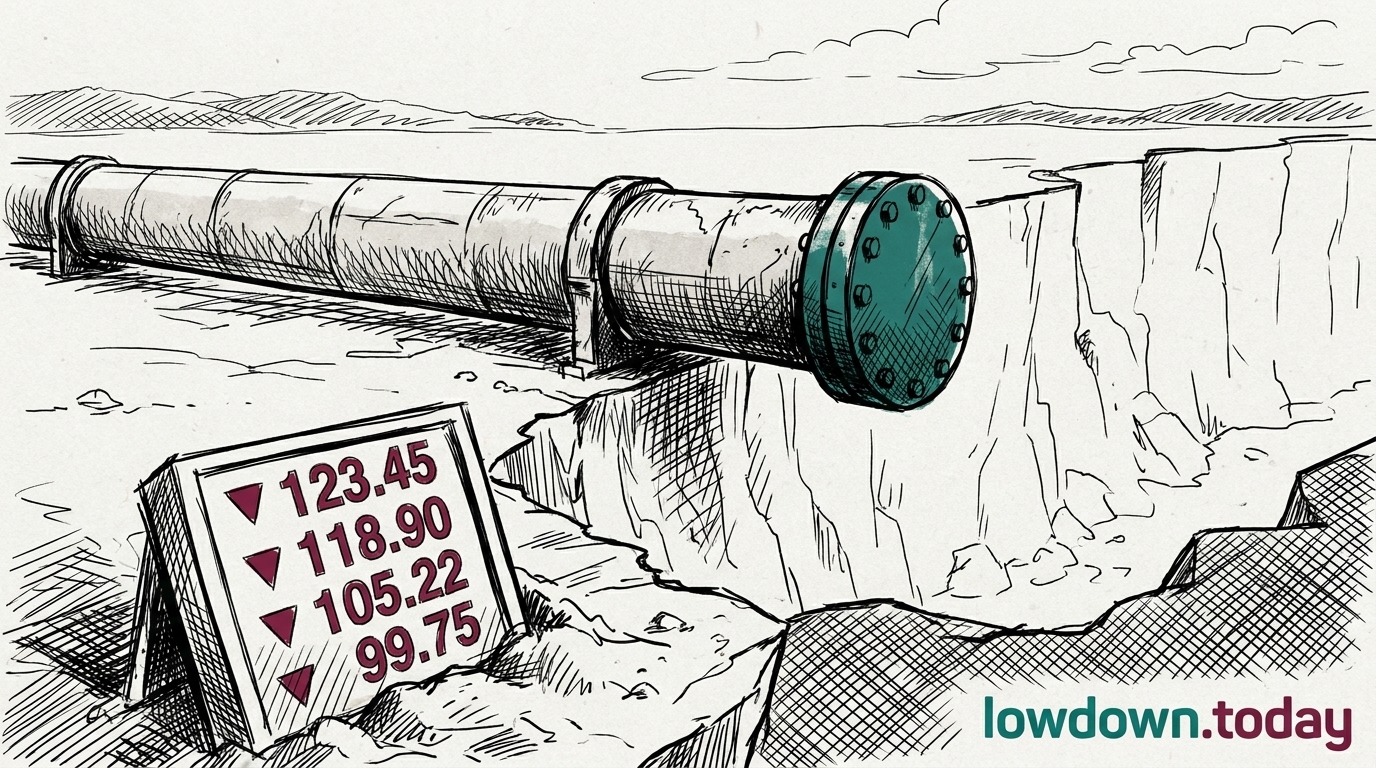
Markets bought the President's version. Brent Crude fell to about $82.98 on 15 June, down roughly 5% and through the $87 floor that had held the prior band; it had touched $87.33 two days earlier and traded above $96 a week before that . 3 West Texas Intermediate (WTI), the US benchmark, fell about 4.7% to $80.89. 4 A 5% fall feeds through to cheaper petrol and heating if the truce holds, which is the bet traders are making before a single barrel has moved. Asian equities rallied, with Japan's Nikkei up 5% and South Korea's KOSPI up 5.5%. 5

The fall prices a reopening, not restored supply. Mines still sit in the Larak-Qeshm channel, Iranian production fields stand idle, and the UAE state oil company assessed that full flows will not resume before 2027 even with a fast deal . Stephen Innes of SPI Asset Management called it "a first-step deal, not a final peace settlement" and said the market "will now trade verification." 6 A single mine incident in the Larak-Qeshm channel would reprice the deal-probability bet overnight.


Deep Analysis

In plain English

The Strait of Hormuz is a narrow waterway, about 33 kilometres wide at its tightest point, through which roughly one in five barrels of the world's oil passes. Think of it as the world's most important shipping lane. Trump said ships can pass through for free. Iran's Foreign Minister said passage will carry 'service costs' under Iranian and Omani authority. Both statements refer to the same announcement. The result is that whoever a shipping company listens to determines whether they owe money to pass, and to whom. Until one version wins, shipping companies face legal risk either way: pay Iran's costs and potentially violate US sanctions; refuse and risk Iranian interference with their vessel. Markets reacted positively because a deal of any kind is better than a shooting war, but the practical navigation question remains unanswered.

Deep Analysis
Root Causes

The two-description problem traces to a specific gap in maritime law over the Larak-Qeshm channel. Iran never ratified UNCLOS, so the convention's guarantee of toll-free transit passage does not bind Tehran inside what it treats as sovereign territorial water.

The IRGC built revenue machinery into that gap on 5 May 2026 by standing up the Persian Gulf Strait Authority, which levied up to $2 million per very large crude carrier in yuan or stablecoins until OFAC designated the PGSA under Executive Order 13224.

The sanctions designation, not any change in Iranian intent, forced the 15 June relabel. The IRGC has run Hormuz passage as an operational income stream since April, so any reopening must preserve the per-carrier charge.

Re-describing the frozen PGSA toll as a navigation 'service cost' keeps the cash flowing under a name OFAC has not yet listed. The Larak-Qeshm minefield supplies the pilotage and escort the fee ostensibly buys, which lets Tehran cite UNCLOS Article 26 as cover for a charge the convention would otherwise forbid.

What could happen next?
  • Risk

    Shipping companies face legal exposure transacting with any Hormuz 'service cost' mechanism that may constitute business with a US-sanctioned counterparty (PGSA, designated under Executive Order 13224 in May 2026).

    Immediate · Assessed
  • Consequence

    Lloyd's of London war-risk surcharges remain in place until a UN Security Council resolution or government certification; tanker insurance costs stay elevated regardless of political announcements.

    Short term · Assessed
  • Meaning

    The Oman-Iran transit protocol (ID:2835) drafted in April is now the operative legal framework Tehran will use to legitimise per-passage fees; the semantics of 'service cost versus toll' are the deal's load-bearing ambiguity.

    Medium term · Reported
First Reported In

Update #128 · Trump declares Iran war over

RFE/RL· 15 Jun 2026
Read original
Different Perspectives
Gulf oil producer
Gulf oil producer
Secured OPEC's confirmed 188,000 b/d September increment with the next meeting set for 6 September, but the Secretariat's own 2 August release says nothing about the fourth quarter. Output guidance beyond September remains undisclosed even as delegate sourcing keeps filling that gap.
Money manager positioned in WTI
Added 21,402 lots to a 108,307 net long in NYMEX WTI in the week to 28 July, against just 1,485 added to Brent's 15,740, a roughly fourteen-to-one split. Conviction sits in the American benchmark even as the European diesel story sets the record.
Indian refiner buying Urals
Bought Russian crude at a discount that narrowed to $1-2 a barrel in the week to 29 July from over $10, as Hormuz risk pushed it toward Urals. If that risk eases with the strike now called off, the discount it is currently enjoying could re-widen just as fast.
Russian diesel exporter
Novak tied any lifting of the diesel export ban, due to lapse 31 July, to an unspecified market recovery with no date, and pushed the gasoline ban to end-2026. An open-ended constraint suits an exporter benefiting from the record European crack it feeds.
War-risk underwriter
Withdrew war-risk cover for Saudi-linked hulls on 24 July and has not reinstated it, holding Bab el-Mandeb tanker transits near 7.5 a day. A cancelled strike does not by itself trigger the committee review needed to re-accept the class.
Northwest European refiner
Sources only 17% of diesel imports from Saudi Red Sea ports against the Mediterranean's 24%, so the ARA crack at $85.86 trails the Med print by $5.81. Lower Red Sea exposure is cushioning it against the rerouting cost, not eliminating it.



