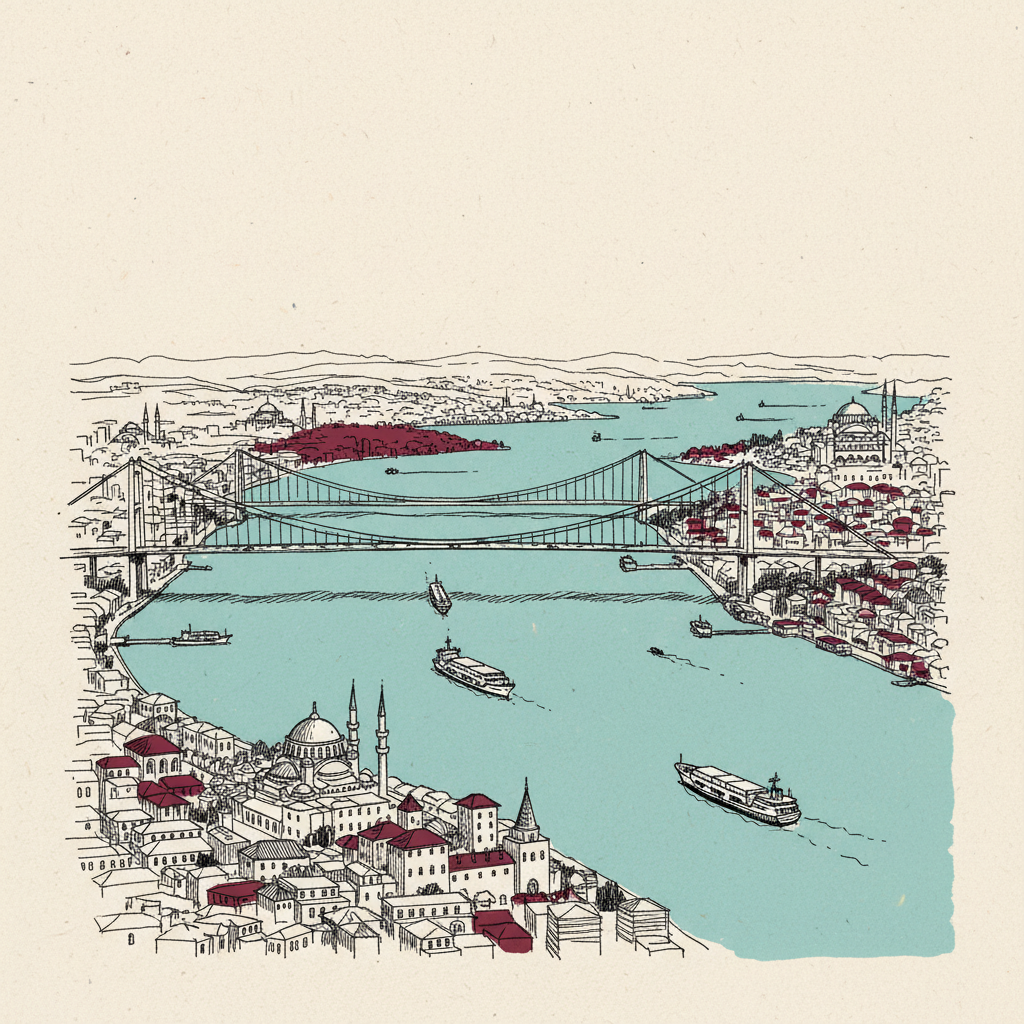
Bosphorus
Turkish Strait connecting the Black Sea to the Mediterranean; controlled under the 1936 Montreux Convention.
The Bosphorus is Istanbul's 31 km strait linking the Black Sea to the Mediterranean, governed by the 1936 Montreux Convention. Turkey invoked Article 19 to close it to belligerent warships on 27-28 February 2022, after Russia's Ukraine invasion.
Last refreshed: 22 September 2026
Could Turkey close the Bosphorus to commercial shipping if the Black Sea war escalates?
Timeline for Bosphorus
Mentioned in: Qatar refuses to hedge against Hormuz
Iran Conflict 2026Mentioned in: Iran and US name Hormuz two ways
Iran Conflict 2026Mentioned in: EU rejects Trump's Hormuz toll venture
Iran Conflict 2026Mentioned in: Sanctioned LNG tanker sunk off Libya
Russia-Ukraine War 2026Background
The Bosphorus is a 31-kilometre strait in northwestern Turkey connecting the Black Sea to the SEA of Marmara and, via the Dardanelles, the Mediterranean. It narrows to 700 metres between Kandilli Point and Asiyan, with an average depth of 65 metres, and Istanbul straddles both banks with a metropolitan population of around 17 million. Roughly 40,000 to 48,000 vessels transit annually; combined traffic across the Bosphorus and Dardanelles hit a record 84,640 ships in 2025.
Turkey controls passage under the 1936 Montreux Convention, which guarantees peacetime transit for commercial vessels but caps warship tonnage, numbers and, under Article 19, lets Ankara bar belligerent warships if Turkey itself stays out of the war. Ankara invoked that clause on 27-28 February 2022, three days after Russia's invasion of Ukraine, closing the strait to warships from both sides; Russia's existing Black Sea Fleet was not trapped, but NATO reinforcement was blocked at the same stroke. In January 2024 Turkey applied the same closure to British minehunters bound for Ukraine.
the strait remains the only maritime route for Black Sea littoral states to reach world markets, so Russian energy and grain exports from Novorossiysk still move through it as commercial cargo, unaffected by the warship restrictions. Ukraine's drone campaign has since extended into the wider Black Sea and Mediterranean; a sanctioned Russian LNG carrier was destroyed off Libya in March 2026, evidence that risk to shipping now reaches well beyond the strait itself.
Who controls the Bosphorus strait?
Why is the Bosphorus important for global trade?
Can Turkey close the Bosphorus?
What is the Montreux Convention and what does it let Turkey do with the Bosphorus?
Did Turkey close the Bosphorus after Russia invaded Ukraine?
Why is the Bosphorus so important for Russian oil and grain exports?
How far have Ukrainian sea drones struck from the Bosphorus?
How much are Turkish Straits transit fees in 2026?
What are the Bosphorus night transit rules for tankers?


