Skip to content
You can now search across every topic, entity and event.What's new
European Oil Markets
18JUN

Brent settles $105.30 with no fresh seizure

3 min read
12:45UTC

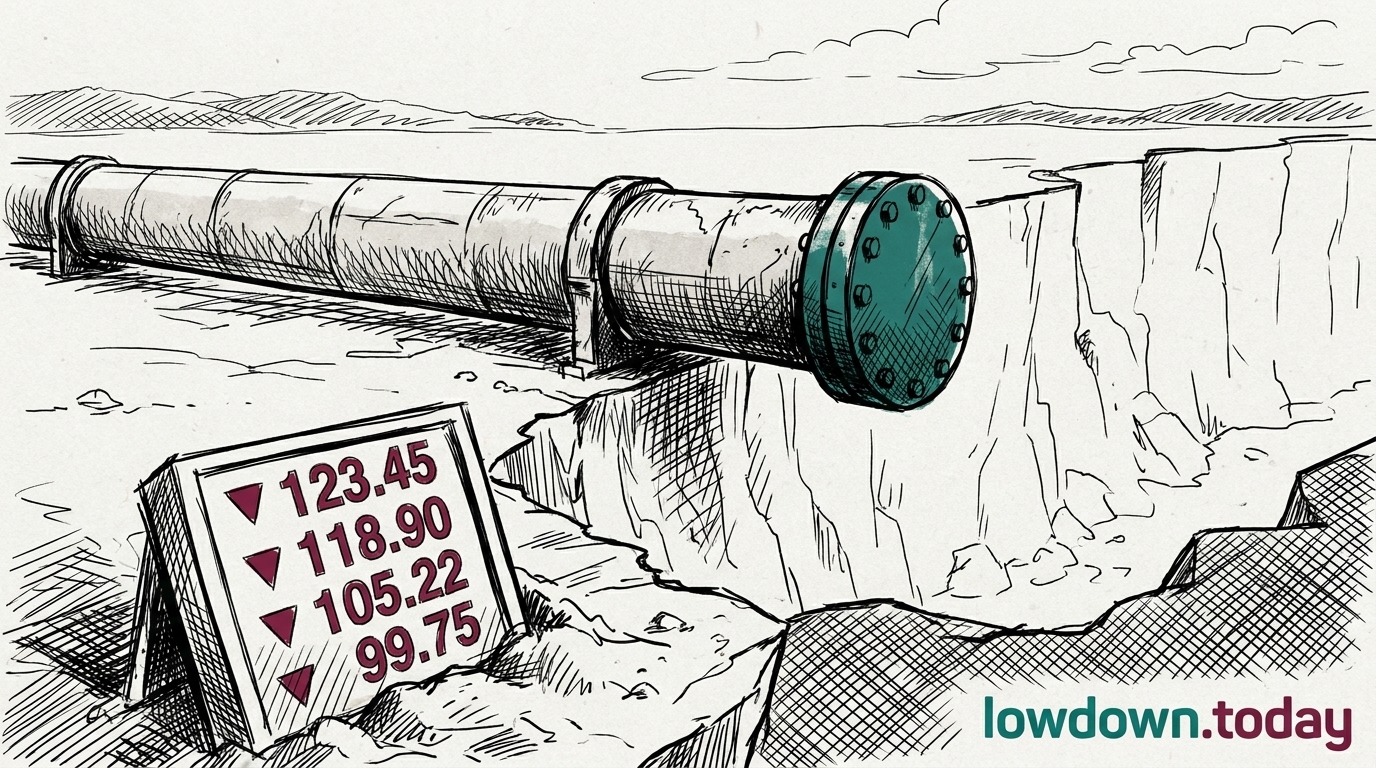
Brent crude settled at $105.30 on 25 April with intraday prints above $106 and a weekly gain of roughly 18%. The talks collapse alone is now the bullish driver, not fresh kinetics.

EconomicDeveloping
Key takeaway

Brent at $105 has been repriced as the baseline; future incidents push from there, not from $67.

Brent crude settled at $105.30 on 25 April with intraday prints above $106 and a weekly gain of roughly 18% per The National 1. This is the second consecutive session above $105, 57% above the $67.41 pre-war baseline and a continuation from the $105.73 close on 24 April . No new IRGC seizure occurred on 25 April, and the dark-shipping picture from the Larak-Qeshm carve-out was unchanged.

The price moved on the absence of a diplomatic resolution rather than on a fresh provocation. That is a structural shift: the market has stopped treating each diplomatic failure as a temporary setback and is pricing the absence of a resolution track as the default scenario. The repricing matters because future seizures will now push the price from $105 rather than from $67, amplifying the economic shock of any tactical escalation. UK and European pump prices follow Brent with a one-to-two-week lag.

The options curve confirms the shift. With the baseline reset, any de-escalation announcement becomes disproportionately bearish rather than merely corrective, which makes the political incentive structure for Tehran and Washington asymmetric: Iran loses revenue floor on a deal, and US consumer pump prices ease only after a deal is concrete enough to clear forwards. Brent at $105 is the new floor, not a ceiling.


Deep Analysis

In plain English

The price of oil affects almost everything: petrol at the pump, heating bills, the cost of goods moved by truck or ship. The benchmark price for much of the world's oil is called 'Brent crude', named after a North Sea oil field. Before the Iran war began, Brent was around $67 a barrel. On 25 April it closed at $105.30. That is a rise of nearly 57%, and it happened in under two months. Oil markets usually react strongly to specific events (a ship seized, a factory bombed). What is significant about Saturday's price is that nothing new happened: no IRGC boarding, no strike, no military escalation. The price stayed above $105 purely because traders stopped believing the war would end soon. When the diplomacy collapses and traders update their expectations, prices move even without a physical event.

Deep Analysis
Root Causes

Each Islamabad channel failure narrows the oil market's probability distribution around a near-term diplomatic resolution. When Islamabad 3 collapsed via Trump's Truth Social post, traders priced the event harder than a formal diplomatic postponement would have warranted, because a social-media cancellation carries no institutional machinery for reversal.

The ceasefire is nominally in force, but CENTCOM's interdiction count reached 33 on 25 April while the naval blockade continues. Traders have concluded that a nominal ceasefire does not translate to resumed Hormuz commercial transit. Until a deal explicitly addresses the blockade, the $38/bbl structural premium over the pre-war baseline persists regardless of individual daily incident counts.

What could happen next?
  • Consequence

    European and Asian central banks running quarterly inflation assessments in May will incorporate $105+ Brent into their forecasts, likely deferring planned interest rate cuts by one to two quarters.

  • Risk

    Goldman Sachs's $120 Q3 severe scenario becomes the base case rather than the tail risk if both the Islamabad diplomatic track and the AUMF congressional track fail before 1 May.

First Reported In

Update #79 · Islamabad 3 collapses; Witkoff grounded, talks stall

Al Jazeera· 25 Apr 2026
Read original
Different Perspectives
Gulf oil producer
Gulf oil producer
Secured OPEC's confirmed 188,000 b/d September increment with the next meeting set for 6 September, but the Secretariat's own 2 August release says nothing about the fourth quarter. Output guidance beyond September remains undisclosed even as delegate sourcing keeps filling that gap.
Money manager positioned in WTI
Added 21,402 lots to a 108,307 net long in NYMEX WTI in the week to 28 July, against just 1,485 added to Brent's 15,740, a roughly fourteen-to-one split. Conviction sits in the American benchmark even as the European diesel story sets the record.
Indian refiner buying Urals
Bought Russian crude at a discount that narrowed to $1-2 a barrel in the week to 29 July from over $10, as Hormuz risk pushed it toward Urals. If that risk eases with the strike now called off, the discount it is currently enjoying could re-widen just as fast.
Russian diesel exporter
Novak tied any lifting of the diesel export ban, due to lapse 31 July, to an unspecified market recovery with no date, and pushed the gasoline ban to end-2026. An open-ended constraint suits an exporter benefiting from the record European crack it feeds.
War-risk underwriter
Withdrew war-risk cover for Saudi-linked hulls on 24 July and has not reinstated it, holding Bab el-Mandeb tanker transits near 7.5 a day. A cancelled strike does not by itself trigger the committee review needed to re-accept the class.
Northwest European refiner
Sources only 17% of diesel imports from Saudi Red Sea ports against the Mediterranean's 24%, so the ARA crack at $85.86 trails the Med print by $5.81. Lower Red Sea exposure is cushioning it against the rerouting cost, not eliminating it.



