Skip to content
You can now search across every topic, entity and event.What's new
European Oil Markets
31JUL

IRGC strikes GFS Galaxy, shuts Hormuz

3 min read
09:33UTC

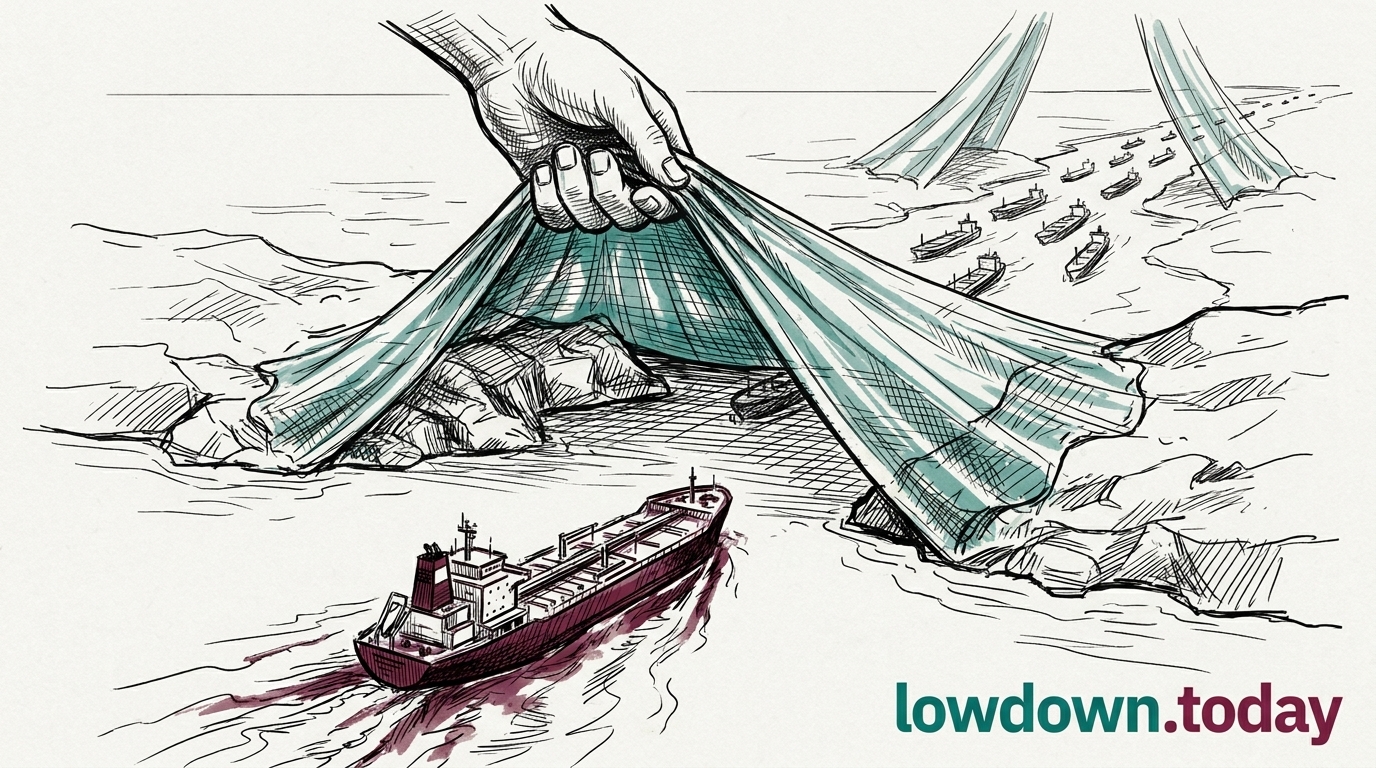
The IRGC Navy struck the container ship GFS Galaxy in the Strait of Hormuz early on 12 July, left one of eleven Indian crew missing and declared the waterway closed until further notice.

EconomicDeveloping
Key takeaway

Iran declared Hormuz closed after striking the GFS Galaxy; insurers, not warships, keep the lane empty.

Early on 12 July the Islamic Revolutionary Guard Corps (IRGC) Navy, the naval arm of Iran's ideological military force, attacked the Cyprus-flagged container ship GFS Galaxy in the Strait of Hormuz and left its engine room heavily damaged, according to Gulf wire coverage 1. Ten of the eleven Indian crew were rescued; one remains missing 2. The IRGC Navy then declared the strait, the 33km channel carrying about a fifth of the world's seaborne oil, closed until further notice.

The Persian Gulf Strait Authority (PGSA), the Iranian body that asserts control over Hormuz passage, posted on X that transit was currently not possible, blaming recent illegal movements of US forces 3. Both statements reached us through Iranian state media relayed by English aggregators, not direct Farsi primary sources.

Nine days earlier Muscat and Tehran had agreed to jointly steward Hormuz traffic as daily transits fell to two ; the 12 July closure overrides that quiet accommodation and operationalises the Hormuz leverage Russia's Dmitry Medvedev likened to a nuclear weapon at Ali Khamenei's funeral . It also hardens the corridor's first live strike, the IRGC hit on the Qatari carrier Al Rekayyat a week earlier , from a one-off punishment into a standing prohibition. What empties the lane is the insurance market, not the Iranian navy: war-risk underwriters and the International Group of P&I Clubs, which held their Hormuz war-risk exclusion through that earlier strike , price a contested legal status as harshly as a lawful blockade, so a declaration Tehran cannot lawfully impose still keeps cargoes off the water.

English-language wires name one struck vessel, the GFS Galaxy; Al Jazeera Arabic's readout of the CENTCOM response counts three commercial vessels attacked in the strait 4. Neither outlet has reconciled the two counts, and a translation difference does not explain the gap. No English-language primary source has confirmed the higher figure.


Deep Analysis

In plain English

The IRGC (Islamic Revolutionary Guard Corps, an elite branch of Iran's military separate from its regular navy) attacked a commercial container ship called the GFS Galaxy, which flies the flag of Cyprus, as it passed through the Strait of Hormuz, the narrow waterway between Iran and Oman that a large share of the world's seaborne oil and gas passes through. The attack badly damaged the ship's engine room. Iran then declared the whole strait closed until further notice, on 12 July. Of the 11 Indian crew members aboard, ten were rescued but one remains missing. Iran's own maritime authority, the Persian Gulf Strait Authority, publicly confirmed that ships could not currently get through, a rare case of Iran's government stating outright that it was blocking a major international shipping route.

Deep Analysis
Root Causes

Iran signed the 1982 UN Convention on the Law of the Sea but never ratified it, so the convention's Part III guarantee of transit passage through international straits does not bind Tehran as treaty law. Iran instead applies its own maritime security statute, which reserves the right to inspect or exclude vessels it links to hostile states.

That gap between the customary practice most flag states still observe and Iran's domestic statute is what turns a closure declaration into something more than rhetoric: there is no binding instrument Iran is violating by making the claim, only a customary norm it is choosing to disregard.

First Reported In

Update #153 · Iran declares Hormuz closed; US says open

Gulf News· 13 Jul 2026
Read original
Different Perspectives
Sanctions compliance officer reviewing a Lukoil International GmbH bid
OFAC's amended FAQ 1224 gives a compliance desk its first published standard: full severance from Lukoil and a US-jurisdiction blocked account for sale proceeds. The conditions name neither ISAB nor Italy, so a Priolo Gargallo-linked bid answers a different question than a Neftochim Burgas or Petrotel Ploiesti one.
Managed-money funds on Brent Last Day
CFTC data for the week to 21 July showed managed money flipping 74,400 contracts to a net long of 15,665 against 1,410 short on the Brent Last Day contract, code 06765T. A fund that held that short through July has now covered it, and the spent short base raises the bar for the next leg higher.
Saudi crude exporters
Saudi-linked tanker transits through Bab el-Mandeb fell to about 7.5 a day after the 24 July underwriting withdrawal, pushing more barrels onto the longer route round the Cape or through the Yanbu terminal. Every diverted barrel ties up a ship for longer, and a fleet that turns slower charges more.
Tanker owners on the Bab el-Mandeb route
Lloyd's-market syndicates withdrew war-risk cover from Saudi-linked hulls on 24 July, leaving owners of that class of vessel to sail Bab el-Mandeb uninsured or not at all. Tanker transits on the route fell to roughly 7.5 a day, and cover, once withdrawn, does not return on a shipowner's timetable.
Eni
Eni
Eni's board approved second-quarter results on 29 July, swinging refining EBIT to a EUR0.08bn profit from a year-earlier loss even as group profit doubled, and named Red Sea freight cost as a cap on that improvement. A refiner absorbing higher shipping costs on Saudi-linked crude while its numbers improve treats the freight line as a drag, not a crisis.
Asian buyers (India, Japan, China, South Korea)
Asian refiners are absorbing 62% of Yanbu's 3.75m b/d flow, the bulk of Saudi Arabia's rerouted crude now clearing east rather than into the Atlantic basin. That destination split leaves Asian buyers more exposed to any single Yanbu-specific disruption than under the kingdom's normal multi-terminal export pattern.



