Skip to content
You can now search across every topic, entity and event.What's new
European Oil Markets
23JUL

Kyiv moves the oil war to the Black Sea

2 min read
19:27UTC

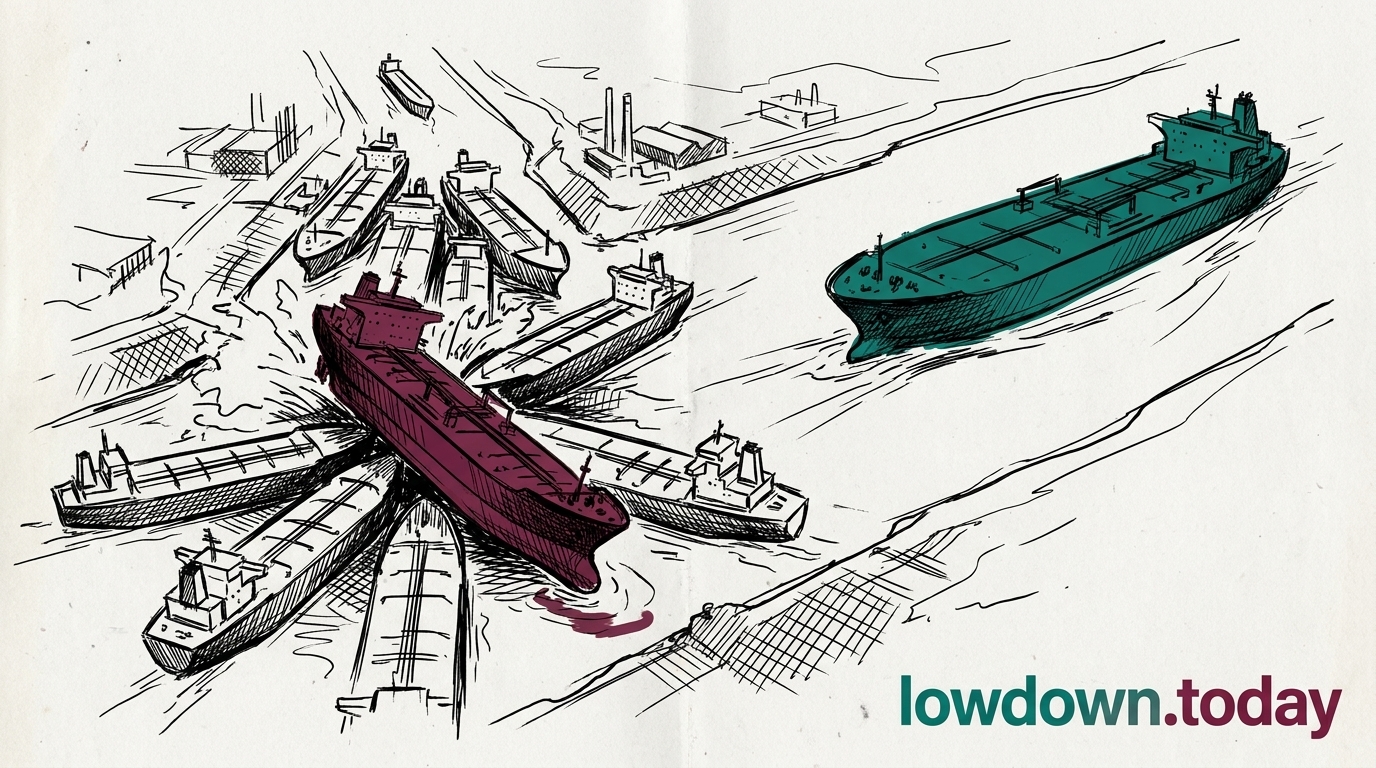
Ukrainian drones struck the Caspian Pipeline Consortium terminal at Novorossiysk on 6 April, extending an anti-oil campaign that had worked the Baltic ports to year-low throughput.

EconomicDeveloping
Key takeaway

Kyiv accepted a diplomatic cost to extend the oil strike map past the Baltic.

Ukrainian drones struck the Caspian Pipeline Consortium terminal at Novorossiysk on 6 April, followed by a hit at Taman 1. The strikes carry the anti-oil fight into terminals that Ukraine's earlier Baltic campaign had left alone. Moscow scrambled to reroute crude through Vysotsk and Taman after Ust-Luga and Primorsk lost capacity in late March.

The Baltic ports are partially back on line. Ust-Luga resumed crude loading on 5 April, but Primorsk berths dropped from ten to four, and combined daily throughput fell to about 115,000 tonnes, a year-low 2. That partial recovery is exactly the dynamic the Iran war already complicated: the Russia-Iran corridor still runs, and Urals hit $123 a barrel earlier in April , offsetting the 43% Baltic volume drop with a price lift Ukraine cannot influence.

The southern expansion carries a different diplomatic risk than the Baltic strikes did. The CPC terminal's Chevron and ExxonMobil shareholders triggered a State Department demarche addressed separately elsewhere in this briefing. Kyiv continued striking after receiving the warning, accepting a commercial-channel diplomatic cost to keep the strike map expanding rather than retreat to Baltic assets with no American interest register.


Deep Analysis

In plain English

Ukraine has been attacking Russia's oil export infrastructure to cut revenue that funds the war. The 6 April strike at Novorossiysk on the Black Sea expanded that campaign beyond the Baltic coast, where Ukraine has been hitting terminals for months. The Baltic terminals have partially recovered: Ust-Luga resumed loading on 5 April, but at year-low throughput. The Black Sea expansion brought the campaign to a terminal partly owned by Chevron and ExxonMobil, which prompted the US State Department to warn Ukraine to stop. This created a direct conflict between Ukraine's military strategy and US energy company interests.

What could happen next?
  • Risk

    Continued Novorossiysk strikes risk triggering US suspension of other forms of military support, creating a forced choice between the oil campaign and broader US assistance.

  • Consequence

    Baltic oil throughput at 115,000 tonnes per day, a year-low, represents a real constraint on Russian export volumes but is partially offset by the Urals price surge driven by the Iran war (ID:2016).

First Reported In

Update #12 · Three narrowings of US support for Kyiv

Kyiv Independent· 11 Apr 2026
Read original
Different Perspectives
US money managers (CFTC-tracked)
US money managers had trimmed WTI net long positioning into July's rally, doubting the Hormuz premium would hold without freight or war-risk confirmation, and the crude stock build reported for the week to 17 July gives that scepticism a fundamentals basis. The 25 July CFTC data will show whether Brent's move above $100 changed their calculus.
Asian distillate buyers (Singapore)
Singapore's distillate holders kept retaining middle-distillate barrels as the East-West arbitrage window narrowed further this week, a pattern that sharpened as Fujairah light distillates hit a record low. Cargoes are being held rather than released west into the tightening Mediterranean market.
Bulgaria
Bulgaria
Bulgaria secured the removal of Lukoil founder Vagit Alekperov and Patriarch Kirill from the 21st package, with President Rumen Radev calling a personal listing 'shooting ourselves in the foot'. Sofia is protecting its position in Lukoil's EUR 3bn compensation claim over the 2023 Neftohim Burgas nationalisation.
Russia
Russia
Russia loses the roughly $14 a barrel of legal headroom the price-cap formula would have released toward $58, even as Urals continues trading below Moscow's $59 budget floor. The shadow-fleet insurance workaround that lets sanctioned crude clear above $44 in practice remains untouched by the freeze itself.
European Union
European Union
The EU adopted its 21st sanctions package on 23 July, freezing the $44 Russia oil cap for 12 months rather than letting the formula drift it toward $58, and listed shadow-fleet support vessels for the first time. The package cleared only after three failed Coreper votes.
Marine war-risk underwriters (Lloyd's-linked syndicates)
War-risk syndicates lifted southern Red Sea hull premiums 150% to about 0.75% of hull value after the 20 July blockade declaration, still a seventh of the roughly 5% Hormuz band. Underwriters reset on realised loss, not declared threat, so the 23 July Encelia and Layla strikes set up the next re-mark.