Skip to content
You can now search across every topic, entity and event.What's new
European Oil Markets
23JUL

Iran walks out of talks at 09:56

3 min read
19:27UTC

Iran formally suspended all mediated talks with the United States at 09:56 on 1 June, citing Israel's Lebanon strikes; foreign minister Abbas Araghchi called a violation on one front a violation on all.

EconomicDeveloping
Key takeaway

Iran's formal walkout moved Washington in four hours; the Bab el-Mandeb threat stays a threat for now.

Iran formally suspended all negotiations through mediators with the United States at 09:56 on Monday 1 June, citing Israel's continuing strikes in Lebanon as a ceasefire breach. Foreign Minister Abbas Araghchi posted that "a violation on one front is a violation of the ceasefire on all fronts", the Foreign Ministry line relayed through the IRGC-affiliated Tasnim news agency, an outlet tied to the Islamic Revolutionary Guard Corps (IRGC), Iran's ideological military branch 1. Tehran acted through a formal diplomatic channel rather than a statement, and that act forced Trump to phone Netanyahu and halt Israel's Beirut strikes four hours later .

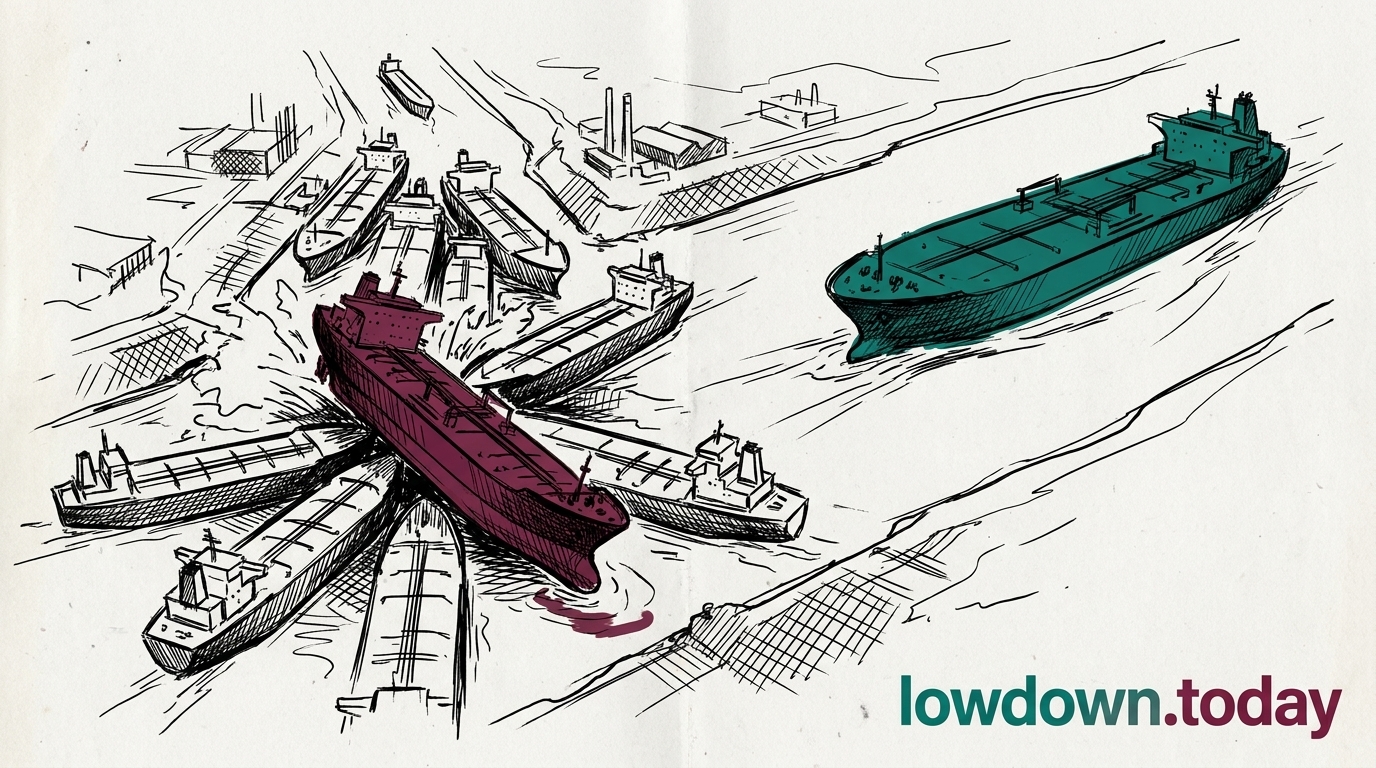
Speaker Mohammad Bagher Ghalibaf accused Washington of breaching the MOU, the unsigned Iran-US memorandum of understanding, through its naval blockade, hardening a pre-refusal of ratification he had issued the same morning . IRGC Major General Mohsen Rezaei went further: "the strait of Hormuz is under Iran's control. We will not allow the naval blockade to continue" 2. At 10:04 Tasnim authorised activating "other fronts including the Bab el-Mandeb strait", the Red Sea chokepoint between Yemen and the Horn of Africa through which roughly 6% of global oil trade passes.

Tehran authorised the second front but has not yet acted on it. No vessel has been interdicted at Bab el-Mandeb in this wave, and the Yemen-based Houthis have not formally moved 3. Khamenei's office, not parliament, controls the IRGC and the nuclear file, which is why a Tasnim release carries the weight a ministry podium would not, and why the suspension could be ordered and reversed inside a day without institutional friction.


Deep Analysis

In plain English

Iran and the United States have been trying to negotiate through intermediary countries, primarily Pakistan. On 1 June, Iran's Foreign Minister Abbas Araghchi announced Iran was stopping all those intermediary talks, blaming Israel's continued military operations in Lebanon. At the same time, Iran's military wing, the Islamic Revolutionary Guard Corps (IRGC), signalled it could activate a second shipping bottleneck: the Bab el-Mandeb strait, a narrow passage between Yemen and Djibouti that connects the Red Sea to the Gulf of Aden. About 6% of global oil and a large portion of container shipping passes through it. The Houthis, a Yemen-based armed group backed by Iran, previously blocked this strait in 2023-24 during the Gaza war. As of 2 June, no formal Houthi blockade had started, but the threat had been issued.

Deep Analysis
Root Causes

Iran's suspension mechanism has a specific structural basis in its 2026 ceasefire architecture. Araghchi's 1 June statement, 'a violation on one front is a violation of the ceasefire on all fronts', draws directly on Iran's three-phase ceasefire proposal submitted on 27 April, which explicitly demanded Lebanon be included in Phase 1 guarantees.

When Israel excluded Lebanon from the Iran-US ceasefire on day one, Tehran reserved the right to treat multi-front violations as a single breach. The 1 June suspension therefore rests on a legal position Iran had publicly stated, not improvised.

The second structural driver is the IRGC's decentralised launch authority, established after the February 2026 strikes. With 31 autonomous provincial units holding independent activation capacity, the IRGC can threaten Bab el-Mandeb without transmitting an order through channels that Araghchi's diplomatic reversal could intercept. The Houthis were placed on standby via an authorisation already delegated down the chain before talks began.

What could happen next?
  • Risk

    A Houthi activation of Bab el-Mandeb would add a second simultaneous chokepoint closure to the Strait of Hormuz blockade, compressing roughly 26% of global seaborne oil through the Cape of Good Hope route and adding 10-14 days to Asian-bound cargo transit times.

  • Consequence

    Ghalibaf's simultaneous pre-refusal of MOU ratification eliminates the possibility of a back-channel Araghchi compromise that the parliament later endorses, which was the mechanism that produced the 2015 JCPOA.

First Reported In

Update #115 · Iran moves first, Trump moves by phone

Euronews· 2 Jun 2026
Read original
Different Perspectives
US money managers (CFTC-tracked)
US money managers had trimmed WTI net long positioning into July's rally, doubting the Hormuz premium would hold without freight or war-risk confirmation, and the crude stock build reported for the week to 17 July gives that scepticism a fundamentals basis. The 25 July CFTC data will show whether Brent's move above $100 changed their calculus.
Asian distillate buyers (Singapore)
Singapore's distillate holders kept retaining middle-distillate barrels as the East-West arbitrage window narrowed further this week, a pattern that sharpened as Fujairah light distillates hit a record low. Cargoes are being held rather than released west into the tightening Mediterranean market.
Bulgaria
Bulgaria
Bulgaria secured the removal of Lukoil founder Vagit Alekperov and Patriarch Kirill from the 21st package, with President Rumen Radev calling a personal listing 'shooting ourselves in the foot'. Sofia is protecting its position in Lukoil's EUR 3bn compensation claim over the 2023 Neftohim Burgas nationalisation.
Russia
Russia
Russia loses the roughly $14 a barrel of legal headroom the price-cap formula would have released toward $58, even as Urals continues trading below Moscow's $59 budget floor. The shadow-fleet insurance workaround that lets sanctioned crude clear above $44 in practice remains untouched by the freeze itself.
European Union
European Union
The EU adopted its 21st sanctions package on 23 July, freezing the $44 Russia oil cap for 12 months rather than letting the formula drift it toward $58, and listed shadow-fleet support vessels for the first time. The package cleared only after three failed Coreper votes.
Marine war-risk underwriters (Lloyd's-linked syndicates)
War-risk syndicates lifted southern Red Sea hull premiums 150% to about 0.75% of hull value after the 20 July blockade declaration, still a seventh of the roughly 5% Hormuz band. Underwriters reset on realised loss, not declared threat, so the 23 July Encelia and Layla strikes set up the next re-mark.