Skip to content
You can now search across every topic, entity and event.What's new
European Oil Markets
16JUL

UAE says Hormuz oil waits to 2027

4 min read
09:39UTC

The UAE state oil company assessed that full flows through Hormuz will not resume until 2027 even if a deal is signed quickly, contradicting the price markets have already paid.

EconomicDeveloping
Key takeaway

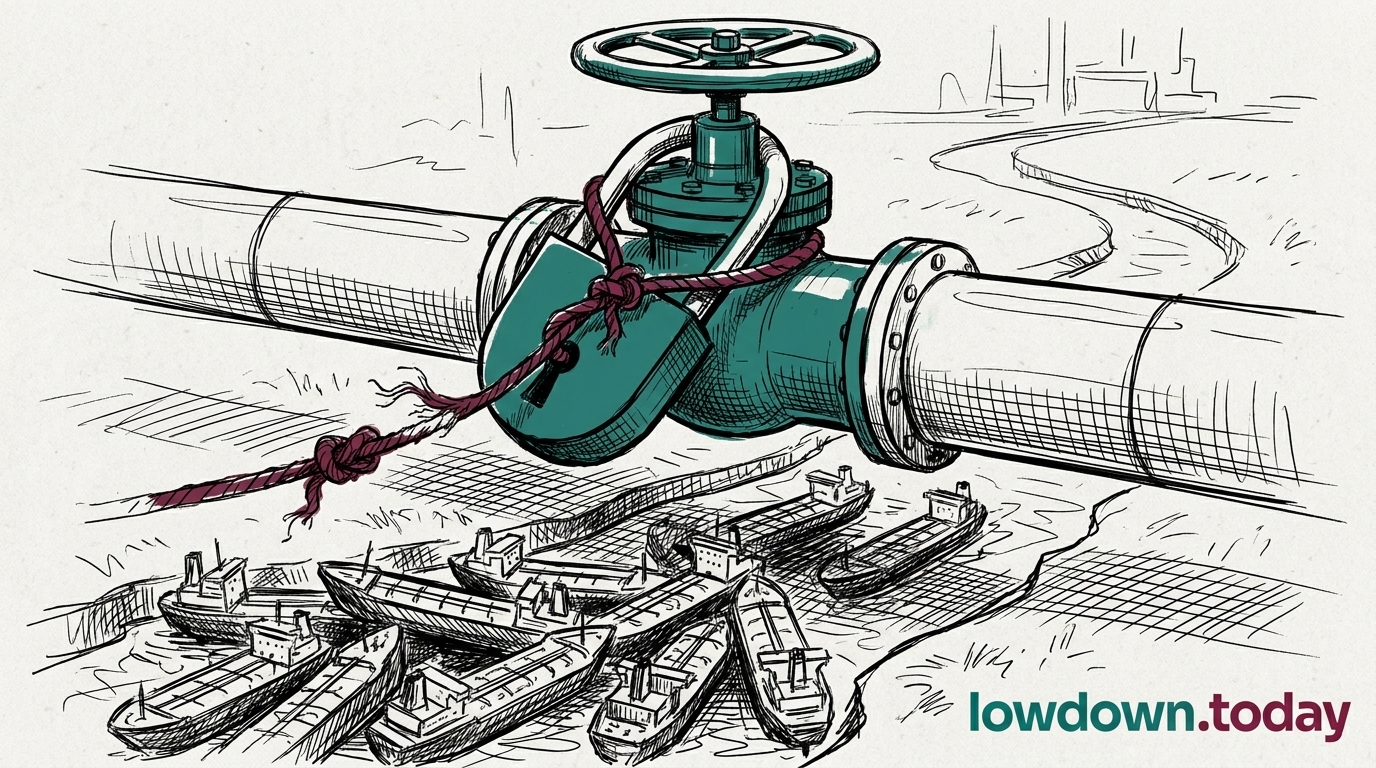
Mines, inspections and Lloyd's war-risk cover keep Hormuz oil stranded to 2027 whatever the negotiators sign.

The United Arab Emirates (UAE) state oil company assessed that full flows through the Strait of Hormuz will not resume until 2027, even if a deal is signed quickly 1. Reopening the strait means clearing mines, restoring inspection systems and repricing the war-risk insurance that underwrites every tanker movement. The UAE ambassador to Washington put it plainly: "a simple ceasefire isn't enough." In practice a signed deal reopens Hormuz on paper while the barrels stay stranded for eighteen months.

The market has already spent the optimism. Brent Crude settled near $86.80 on Friday, a three-month low, after falling more than 10 per cent from its early-June level as traders priced a deal as probable . The region's own producer now says the barrels behind that price are eighteen months out. Oil futures do not trade at weekends, so Monday's open is the next genuine test of whether that gap holds.

The insurance, not the spot price, runs the strait. Lloyd's of London, the London market whose war-risk register governs whether tankers can obtain cover, has not de-listed Hormuz. The trigger for de-listing is a United Nations Security Council resolution or a government certification, neither of which exists. Until the underwriters move, a signed memorandum reopens the strait on paper while premiums keep the barrels where they are. That is the mechanism the headline hides: the document the negotiators are chasing in Geneva does not touch the register in London that actually decides when oil sails.


Deep Analysis

In plain English

Even if the US and Iran sign a deal today, the world's biggest shipping insurance market (based in London) will not immediately say it is safe to take oil tankers through the Strait of Hormuz. Lloyd's of London maintains a list of dangerous waterways. Removing Hormuz from that list requires either a United Nations Security Council decision or a formal government certification. Neither exists yet. The UAE state oil company, one of the largest energy producers in the Gulf, assessed that full oil flows through Hormuz will not restart until 2027 because of this insurance gap. Tanker owners will not sail through a strait listed as a war zone without paying enormous extra insurance premiums, and those costs get passed through to fuel prices worldwide.

Deep Analysis
Root Causes

Lloyd's war-risk register operates on the principle of insurable interest: underwriters at Lloyd's syndicates cannot price risk on a waterway the UK government or UNSC has certified as unsafe. The trigger for de-listing is not a political statement but a legal certification changing underwriting liability. The IRGC closure declaration on 11 June created exactly the formal record that Lloyd's underwriters must account for, regardless of whether ships are physically transiting.

P&I (protection and indemnity) clubs pool catastrophic liability across member fleets under a mutual structure. A total loss of a VLCC (very large crude carrier) at $150 million hull value plus cargo indemnification exceeds the reserves of any single club; the International Group of P&I Clubs shares reinsurance.

The IG's reinsurance stack with London market excess-of-loss layers will not price Hormuz out of enhanced terms until underwriters see an independently verified safe-passage record of 30 to 90 days, a timeline consistent with ADNOC's 2027 assessment.

What could happen next?
  • Consequence

    Lloyd's de-listing Hormuz requires a UNSC resolution or government certification that does not exist; even a signed MoU does not automatically trigger the de-listing, extending the Brent crude war-risk premium into 2027.

    Medium term · Assessed
  • Risk

    Markets have priced an 80 per cent deal probability into Brent at approximately $87, but the physical resumption timeline is 12 or more months post-signing. A correction back towards $95 to $100 is structurally likely as the insurance and certification gap becomes widely understood.

    Short term · Assessed
  • Opportunity

    ADNOC's Fujairah bypass pipeline (1.5 million barrels per day capacity) and Saudi Arabia's East-West pipeline position both UAE and Saudi Aramco to capture premium transit fees during the Hormuz re-normalisation period.

    Medium term · Assessed
First Reported In

Update #127 · US drops red line; signature still slips

Al Jazeera· 14 Jun 2026
Read original
Different Perspectives
Indian refiners
Indian refiners
Indian refiners kept lifting discounted Urals as the India/Baltic price split widened past $9-10 a barrel, a gap that only grows as GL X1's Iranian wind-down cuts an alternative discounted grade off the market by 17 July. Cheaper Russian feedstock is being locked in while it lasts.
Chinese refiners
Chinese refiners
Chinese refiners gain leverage as the Urals-Brent discount widens, since Beijing's state buyers already source discounted Russian barrels near the fiscal floor unaffected by Western insurance costs. A wider discount, if it holds past 23 July, lets them lock in cheaper term contracts regardless of the cap's outcome.
US money managers (CFTC-tracked)
Managed money trimmed WTI net length into the rally, positioning that reflects doubt the Hormuz premium survives without freight or war-risk confirmation. The Brent-WTI spread widening almost entirely on the Brent leg supports that scepticism about a broad-based repricing.
OPEC+ (Saudi-led subgroup)
Saudi Arabia is defending market share through a fourth straight 188kbd August hike even as OPEC's own July MOMR cut 2026 demand growth for the fourth consecutive month. At a $108-111 fiscal breakeven, every added barrel costs Riyadh revenue it cannot recoup, so the hike reads as a positioning signal, not a demand bet.
Greek shipping registries
Greece, backed by Cyprus and Malta, is pushing a three-month cap-freeze compromise against the Commission's freeze to January 2027 ahead of the 23 July vote. Athens' and Valletta's combined tanker registrations mean a shorter review gives their insurers more frequent chances to reprice risk on Russian cargoes.
Russia (Deputy PM Alexander Novak)
Novak extended the diesel export restriction to producers on 8 July, the first producer-binding curb of the war, protecting the domestic pump price ahead of any refinery repair timeline. Urals still trades below Russia's $59 budget floor even as Brent gained, so the ban trades export revenue for fiscal stability at home.