Skip to content
You can now search across every topic, entity and event.What's new
European Oil Markets
18MAY

Trump floats leaving NATO after rebuff

3 min read
17:30UTC

After every ally he named for a Strait of Hormuz escort coalition formally refused, Trump said leaving NATO is 'something to think about.' Germany's foreign minister answered for the continent: 'We will not participate in this conflict.'

EconomicDeveloping
Key takeaway

Trump has exhausted both the NATO lever and the China lever without producing compliance, leaving no visible diplomatic middle option.

Trump said leaving NATO is "something to think about" after Australia, Japan, the United Kingdom, Germany, and France — every country he named for a Strait of Hormuz escort coalition — formally declined to send warships 1. He warned the Alliance faces a "very bad future." Germany's foreign minister responded: "We will not participate in this conflict" 2.

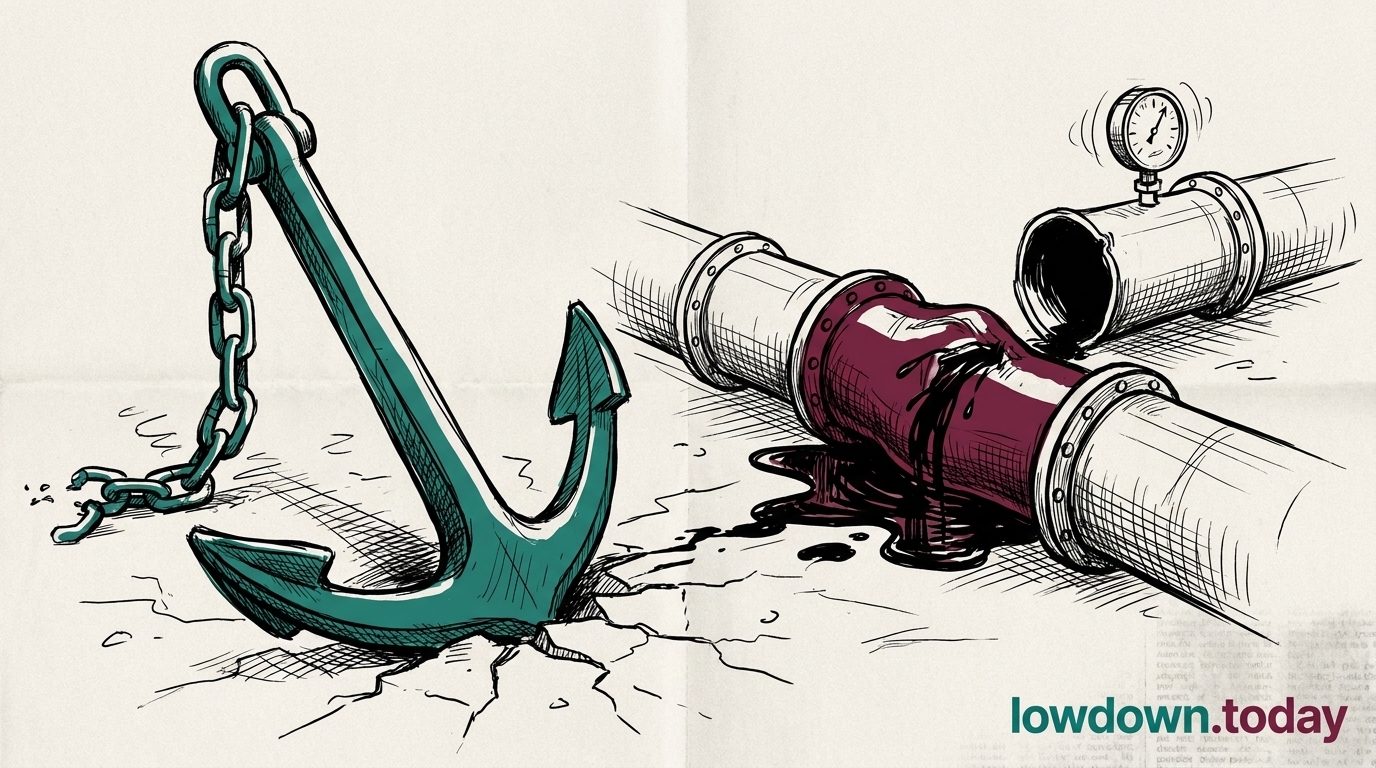
The threat came one day after Trump warned he might delay his summit with Xi Jinping over Hormuz , and three days after all five named allies formally refused his escort call . Three leverage attempts — against European allies, against China, against NATO as an institution — have produced zero warship commitments.

Trump questioned NATO's value during his first term, but those threats concerned burden-sharing within a shared strategic framework. Allied capitals are refusing Hormuz duty not out of free-riding but because they regard the campaign against Iran as an American choice they had no part in making. Five of them said as much when they jointly opposed Israel's ground offensive in Lebanon — the sharpest Western diplomatic break with Israel since the war began.

The practical consequence: the strait of Hormuz stays closed. US Navy officials described it as an Iranian "kill box" with more than 300 ships stranded . Energy Secretary Wright acknowledged the US is "simply not ready" for escorts . Without allied warships, Washington must degrade Iran's maritime threat enough to escort tankers alone — on no stated timeline — or accept that 20% of the world's seaborne oil stays blocked. Threatening to leave NATO does not produce frigates.


Deep Analysis

In plain English

The US asked its European NATO allies to join a naval patrol protecting oil tankers in the Strait of Hormuz — a critical chokepoint for global energy supplies. Every ally refused. Trump responded by suggesting the US might leave NATO entirely. NATO is the 75-year military pact that guarantees European security. The threat is partly frustration, partly negotiating tactic. But even an idle threat reshapes how European governments plan: they now have to build defences assuming US backing may not be permanent, which costs money and changes how the whole Western security system works.

Deep Analysis
Synthesis

The simultaneous failures of the NATO lever and the Xi/China lever — Trump has now publicly threatened both relationships without extracting compliance — suggests the administration has exhausted its primary coercive diplomatic tools. Having made both threats publicly, the next move is either concession or further unilateral action; there is no face-saving middle diplomatic option remaining without one of the threatened parties reversing course.

Root Causes

The structural divergence is rooted in treaty scope: European economies depend on Gulf energy stability but face no Article 5 obligation to support offensive operations in third-party conflicts. Allies calculate that participation exposes them to Iranian retaliation — port closures, cyber attacks, energy disruption — with no binding legal requirement to follow the US into an elective war it launched without NATO consultation.

What could happen next?
1 precedent1 consequence2 risk1 opportunity
  • Precedent

    First explicit presidential threat to leave NATO during an active military operation the alliance formally declined to join.

    Immediate · Assessed
  • Consequence

    European governments will accelerate autonomous defence planning regardless of whether Trump follows through, as the threat itself demonstrates the credibility gap.

    Short term · Assessed
  • Risk

    NATO credibility erosion may create a window for Russian opportunism in Eastern Europe while Western political and military attention is concentrated on the Gulf theatre.

    Medium term · Suggested
  • Risk

    China may calculate that a US-NATO fracture reduces the cost of pressure on Taiwan, particularly if the US military is simultaneously engaged in the Gulf.

    Medium term · Suggested
  • Opportunity

    European defence industrial base expansion accelerates, potentially reducing long-term dependence on US systems and creating a more autonomous European security capacity.

    Long term · Suggested
First Reported In

Update #40 · Larijani dead; Israel hunts the new leader

PBS· 18 Mar 2026
Read original
Different Perspectives
Indian refiners
Indian refiners
Indian refiners kept lifting discounted Urals as the India/Baltic price split widened past $9-10 a barrel, a gap that only grows as GL X1's Iranian wind-down cuts an alternative discounted grade off the market by 17 July. Cheaper Russian feedstock is being locked in while it lasts.
Chinese refiners
Chinese refiners
Chinese refiners gain leverage as the Urals-Brent discount widens, since Beijing's state buyers already source discounted Russian barrels near the fiscal floor unaffected by Western insurance costs. A wider discount, if it holds past 23 July, lets them lock in cheaper term contracts regardless of the cap's outcome.
US money managers (CFTC-tracked)
Managed money trimmed WTI net length into the rally, positioning that reflects doubt the Hormuz premium survives without freight or war-risk confirmation. The Brent-WTI spread widening almost entirely on the Brent leg supports that scepticism about a broad-based repricing.
OPEC+ (Saudi-led subgroup)
Saudi Arabia is defending market share through a fourth straight 188kbd August hike even as OPEC's own July MOMR cut 2026 demand growth for the fourth consecutive month. At a $108-111 fiscal breakeven, every added barrel costs Riyadh revenue it cannot recoup, so the hike reads as a positioning signal, not a demand bet.
Greek shipping registries
Greece, backed by Cyprus and Malta, is pushing a three-month cap-freeze compromise against the Commission's freeze to January 2027 ahead of the 23 July vote. Athens' and Valletta's combined tanker registrations mean a shorter review gives their insurers more frequent chances to reprice risk on Russian cargoes.
Russia (Deputy PM Alexander Novak)
Novak extended the diesel export restriction to producers on 8 July, the first producer-binding curb of the war, protecting the domestic pump price ahead of any refinery repair timeline. Urals still trades below Russia's $59 budget floor even as Brent gained, so the ban trades export revenue for fiscal stability at home.