Skip to content
You can now search across every topic, entity and event.What's new
European Energy Markets
31JUL

US strikes reach Tehran on day two, ordered by phone

4 min read
09:44UTC

CENTCOM struck surveillance, communications and air-defence sites at western Tehran, Sirik and Minab on 10-11 June, widening the war inland from the coast as Trump ordered a second day verbally from the Oval Office.

EconomicDeveloping
Key takeaway

The campaign reached the capital on its second day, ordered again by phone, with Washington calling the bombing the negotiation.

CENTCOM completed a second consecutive day of strikes on Iran across 10-11 June, hitting military surveillance, communications and air-defence sites at western Tehran, Sirik and Minab. The geography is the news: the 9-10 June strikes had stayed on the Hormuz coast at Qeshm, Bandar Abbas and Jask , and this round reached the capital. US Marine, Air Force and Navy assets ran the operation, which CENTCOM framed as self-defence against continued aggression and reported complete with no American casualties.

Donald Trump ordered it the way he ordered the first round, verbally from the Oval Office, with no AUMF, no Article 51 notice to the United Nations and no signed instrument, repeating the method even as a second day of ordnance landed . Pete Hegseth said the strikes were designed to set the terms for a deal and that Iran would be wise to take it; pressed on method, he said, "If we need to negotiate with bombs, we'll negotiate with bombs." Trump told reporters Iran "had a chance to sign a deal and survive" and should "start signing a paper."

Reading the two days together, the bombing is being run as the diplomacy rather than alongside it. The word from Washington each day has been "sign," delivered with a second strike order and an amended draft returned to Tehran. That collapses the distinction between coercion and negotiation, and it leaves Iran answering ordnance rather than a written offer.


Deep Analysis

In plain English

The United States carried out air strikes on military sites in Iran for the second day running on 10-11 June. On the first day, strikes had stayed near the coast. This second round hit sites close to Tehran, Iran's capital, a significant escalation in how far into the country the bombing was reaching. President Trump ordered the strikes in a verbal conversation at the White House. Unlike most military operations, there was no formal written authorisation from Congress and no legal notification to the United Nations. Defence Secretary Pete Hegseth told journalists the strikes were designed to force Iran to sign a deal, saying 'if we need to negotiate with bombs, we'll negotiate with bombs.'

Deep Analysis
Root Causes

The legal gap driving the no-AUMF pattern predates this conflict. The 2001 and 2002 AUMFs authorised force against al-Qaeda and Iraqi state actors respectively. Congress never passed an Iran-specific authorisation, and the Trump administration has relied on Article II inherent presidential war powers for every kinetic action since 28 February 2026.

The House's 215-208 War Powers Resolution on 3 June passed with the narrowest possible majority and Trump is expected to veto it. Senate cloture on a war-powers resolution fell ten votes short of the 60 required. The structural condition enabling verbal-order strikes is therefore not presidential preference alone but a Congress too closely divided to force an AUMF requirement.

Escalation

Upward and widening. The target set moved from the Hormuz coast to the capital in 24 hours. A second verbal strike order with no AUMF and no Article 51 notice hardens the pattern of force by spoken word. Hegseth's 'negotiate with bombs' framing means Washington has no threshold at which it would pause strikes to allow a negotiating response.

What could happen next?
  • Precedent

    Two consecutive days of presidential verbal strike orders on a foreign capital without AUMF or Article 51 notice establish the pattern as a standing doctrine, not a one-off emergency measure. Any future administration would cite this as precedent for Article II air campaigns.

    Long term · Assessed
  • Risk

    Iran's strikes on Azraq, Bahrain, and Kuwait bases (ID:4075) showed the IRGC is willing to hit third-country US facilities. A third day of US strikes on Tehran-area targets raises the probability of IRGC targeting of UAE-based US assets, which would draw UAE into the conflict.

    Immediate · Assessed
  • Consequence

    Damage to communications and air-defence infrastructure at Sirik and Minab degrades the physical capacity of Bandar Abbas export operations even after any ceasefire, adding weeks to any post-deal oil supply recovery.

    Short term · Assessed
First Reported In

Update #124 · IRGC declares Hormuz shut; US strikes again

CENTCOM / Jerusalem Post· 11 Jun 2026
Read original
Different Perspectives
Spain's LNG terminal operators
Spain's 9,145 GWh terminal inventory is the largest single stock in the EU LNG network, an option value that can reroute cargoes wherever the winter strip pays best rather than a cavern gas obligation tied to a fixed date. That flexibility matters more as Germany's cavern shortfall pushes more of the winter security question onto import infrastructure.
European Commission
European Commission
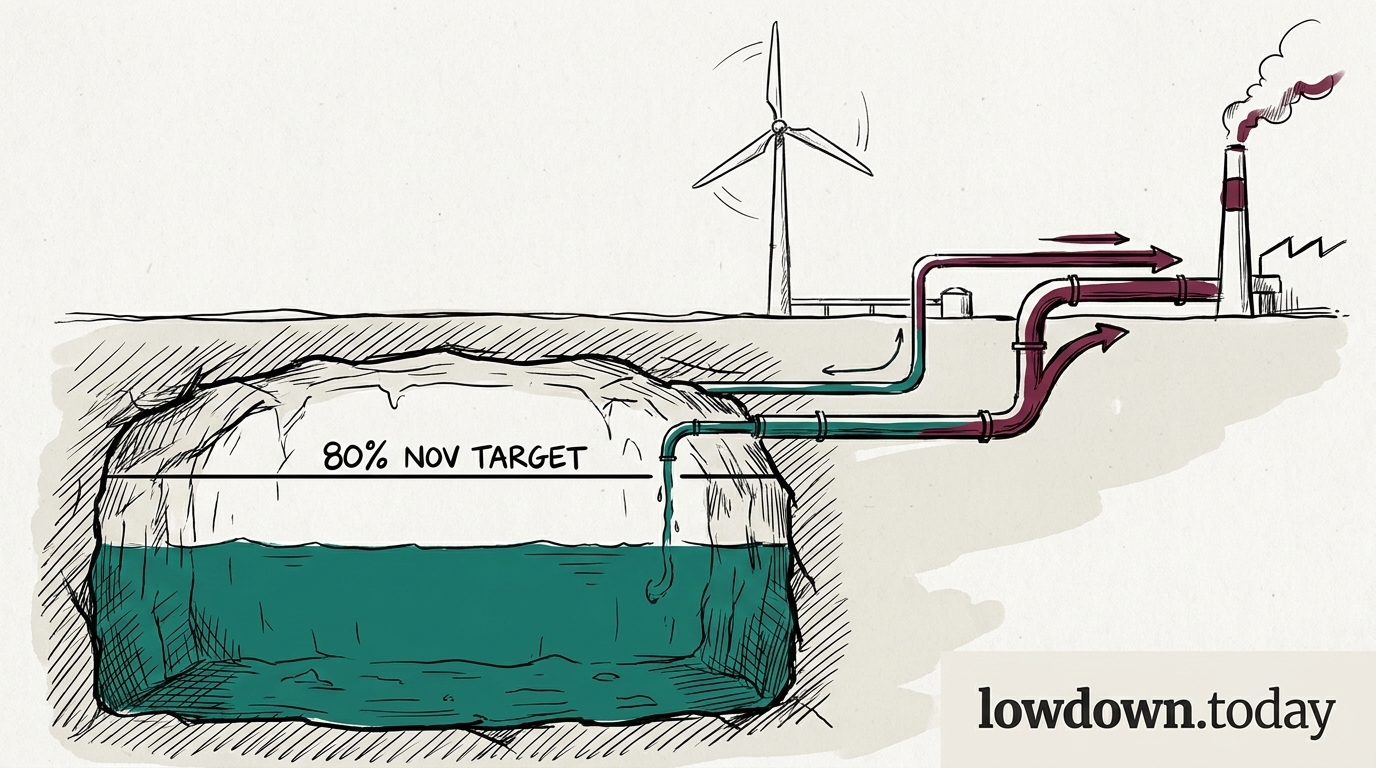
Brussels holds the bloc to 90% on a flexible window while Germany, holding roughly a quarter of EU storage capacity, tracks toward missing its own lower 80% figure by 21 points. A national shortfall this size in the anchor market matters more to bloc security than the flexible timetable alone can absorb.
French power exporters and CRE
French day-ahead rose in step with Germany but by less, reopening a EUR 7-17 premium that makes northward export flows commercially attractive again after the EUR 43.09 discount evaporated in days. CRE separately authorised RTE and Enedis to buy flexibility locally, betting the coming winter's binding constraint is grid congestion rather than a shortage of firm capacity.
TTF trading desk
TTF trading desk
A visible national shortfall like Germany's 21-point gap is a directional signal, not noise, for a desk holding the summer-winter spread. TTF's flat EUR 58-60 range through this week's German price swings says the market has not yet chosen to reprice refill risk into the front of the curve.
German cavern and CCGT operators
German caverns kept buying prompt gas at TTF near EUR 58-60 through the inversion; the wind collapse to 2.4 GW then flipped the spark spread to plus EUR 29 and put turbines back in the same queue. Every day turbines win that bid, injection at a third of the 877 GWh/day pace needed falls further behind.
Slovakia
Slovakia
Slovakia says it dropped its hold-out on the 21st sanctions package only after Ursula von der Leyen personally signed written gas-price and supply guarantees. The Council of the European Union's own 17,238-character release on the package names neither Slovakia nor any guarantee, leaving Bratislava's account unconfirmed by the institutional record.



