Skip to content
You can now search across every topic, entity and event.What's new
European Energy Markets
31JUL

Trump signs nothing, posts three demands

2 min read
09:44UTC

President Trump ended his second Situation Room final determination on Friday 29 May without a signature, then posted three public conditions Iran rejected within hours.

EconomicDeveloping
Key takeaway

The MOU stays unsigned; public demands from both sides have narrowed the diplomatic corridor.

President Donald Trump convened a second White House Situation Room meeting on Friday 29 May, billed as his final determination on the tentative 60-day memorandum of understanding (MOU). After two hours he signed nothing, then posted that Iran must "never have a Nuclear Weapon or Bomb", that the Strait of Hormuz open "immediately, no tolls", and that Iranian mines clear within 30 days 1.

Iran's foreign ministry replied that there were "no negotiations" on its nuclear programme, and Fars News, an IRGC-linked Iranian agency, called the conditions a contradiction of the draft 60-day framework the two sides have circled for weeks.

Trump claimed in his Friday post that the deal was largely settled, while CENTCOM that same weekend put a Hellfire missile through a cargo ship's engine and a suspected mine drifted into Omani waters. His forces moved from waving ships off course to disabling one by munition. The posted demands are words; the missile and the mine are what his forces and the strait actually did.

Iran's rejection tracks the Supreme National Security Council line of 29 May, which framed the unsigned MOU as a 10-point Iranian victory with enrichment recognised . Neither side can move publicly without appearing to concede first.


Deep Analysis

In plain English

Trump held a second high-level meeting to decide whether to sign a deal that would reopen the Strait of Hormuz, a narrow waterway through which roughly one-fifth of the world's oil flows. He walked out without signing, then posted three demands on social media: Iran must give up nuclear weapons permanently, open the strait immediately with no fees, and clear its mines within 30 days. Iran's foreign ministry spokesperson rejected the nuclear demand within hours, stating the programme is off the table. Both sides have now stated, publicly, positions they cannot back down from without losing face at home. That public gap is why markets are nervous: a deal that everyone hoped was close now looks further away.

Deep Analysis
Root Causes

Iran's SNSC requires any text to recognise the right to enrich uranium on Iranian soil, because domestic legitimacy since 2015 has been built on that premise. Trump requires visible nuclear forswearing, because his domestic base framed the war as a disarmament campaign from day one. Those two requirements are structurally incompatible on a single page.

Neither side can move without a domestic narrative shift. Iran cannot trade away enrichment recognition without SNSC internal fracture. Trump cannot accept a text that omits nuclear forswearing without his base reading it as Obama-era capitulation.

What could happen next?
  • Risk

    A deal-collapse reprice from $92 Brent has no floor: the entire $20 monthly fall was deal-optimism premium, not fundamentals-driven.

    Short term · Assessed
  • Consequence

    The House War Powers vote rescheduled to 2 June arrives after the operative period it was meant to govern, leaving the executive unconstrained for a third consecutive deadline.

    Immediate · Assessed
  • Risk

    Pakistan's role as sole remaining diplomatic channel becomes structurally fragile if Trump publicly expands his three conditions, as Islamabad cannot relay terms Khamenei has publicly pre-rejected.

    Short term · Assessed
First Reported In

Update #113 · Trump signs nothing as a Hellfire hits a hull

Washington Post· 31 May 2026
Read original
Different Perspectives
Spain's LNG terminal operators
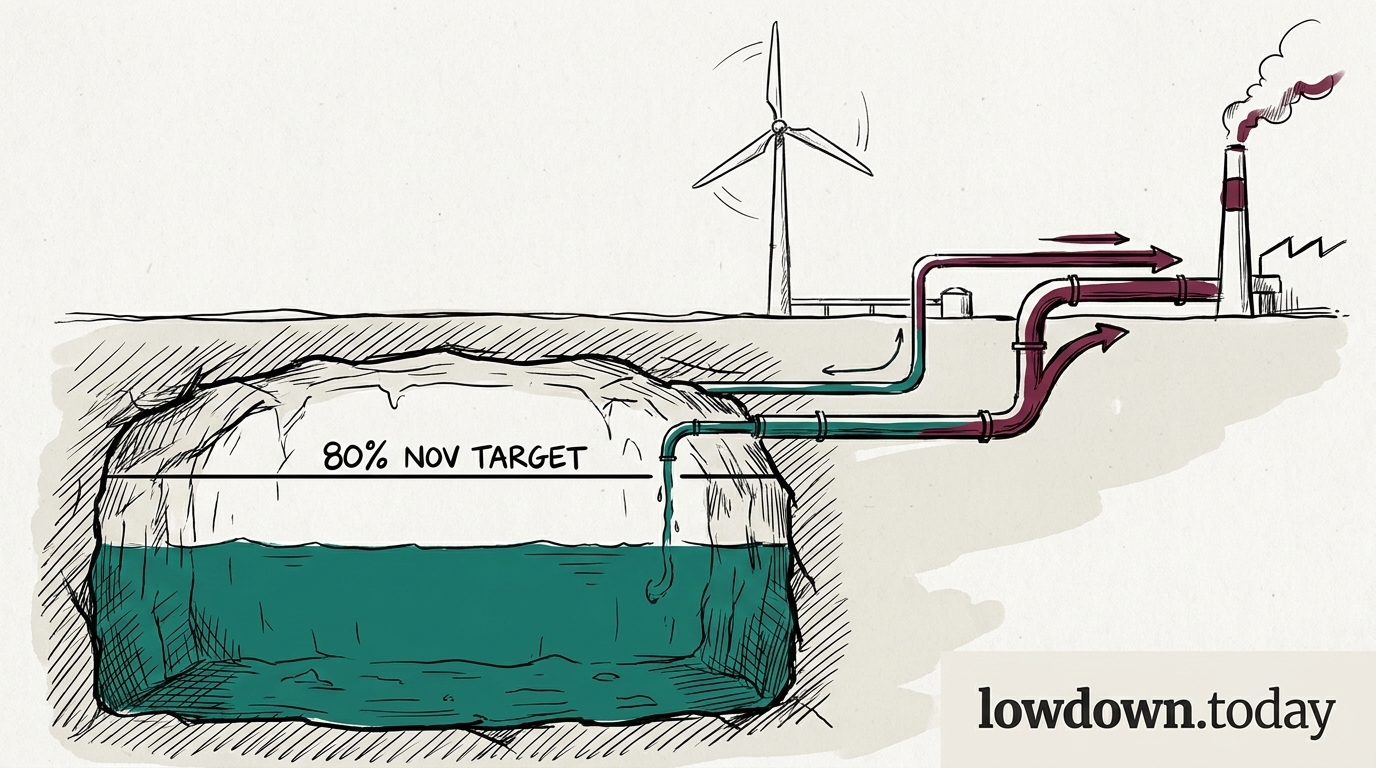
Spain's 9,145 GWh terminal inventory is the largest single stock in the EU LNG network, an option value that can reroute cargoes wherever the winter strip pays best rather than a cavern gas obligation tied to a fixed date. That flexibility matters more as Germany's cavern shortfall pushes more of the winter security question onto import infrastructure.
European Commission
European Commission
Brussels holds the bloc to 90% on a flexible window while Germany, holding roughly a quarter of EU storage capacity, tracks toward missing its own lower 80% figure by 21 points. A national shortfall this size in the anchor market matters more to bloc security than the flexible timetable alone can absorb.
French power exporters and CRE
French day-ahead rose in step with Germany but by less, reopening a EUR 7-17 premium that makes northward export flows commercially attractive again after the EUR 43.09 discount evaporated in days. CRE separately authorised RTE and Enedis to buy flexibility locally, betting the coming winter's binding constraint is grid congestion rather than a shortage of firm capacity.
TTF trading desk
TTF trading desk
A visible national shortfall like Germany's 21-point gap is a directional signal, not noise, for a desk holding the summer-winter spread. TTF's flat EUR 58-60 range through this week's German price swings says the market has not yet chosen to reprice refill risk into the front of the curve.
German cavern and CCGT operators
German caverns kept buying prompt gas at TTF near EUR 58-60 through the inversion; the wind collapse to 2.4 GW then flipped the spark spread to plus EUR 29 and put turbines back in the same queue. Every day turbines win that bid, injection at a third of the 877 GWh/day pace needed falls further behind.
Slovakia
Slovakia
Slovakia says it dropped its hold-out on the 21st sanctions package only after Ursula von der Leyen personally signed written gas-price and supply guarantees. The Council of the European Union's own 17,238-character release on the package names neither Slovakia nor any guarantee, leaving Bratislava's account unconfirmed by the institutional record.



