Skip to content
You can now search across every topic, entity and event.What's new
European Energy Markets
31JUL

Russian LNG ban lands 25 April, no replacement named

3 min read
09:44UTC

The EU Council's short-term contract ban removes roughly 17 bcm/yr of Russian LNG in ten days and no importer has publicly said where the volume will come from.

EconomicDeveloping
Key takeaway

The hardest EU energy-security cut of 2026 takes effect in ten days with no named substitute supply.

The EU Council's short-term contract ban on Russian LNG enters force on 25 April 2026, ten days from the 15 April print, removing approximately 17 bcm per year, around 13% of EU LNG imports across the first eleven months of 2025 1. Long-term contracts follow on 1 January 2027. Importers must operate under a prior-authorisation system requiring proof of non-Russian origin for every cargo, and member states must notify The Commission of remaining Russian gas contracts within one month of entry-into-force.

The distinction against the 27 March transshipment measure matters. That instrument covered re-export to non-EU destinations, not inbound volumes; Bruegel's dataset confirms it did not materially reduce Russian LNG arrivals at EU terminals . The new instrument is the first that actually blocks Russian LNG at the European border, and the supply arithmetic changes on day one rather than across a transition.

What is missing from every source reviewed is a named replacement. Ras Laffan force majeure remains in force , Atlantic cargo diversions to Asia are now close to a dozen , and record March 2026 volumes read as front-loading rather than a durable bridge 2. At March import patterns the cut displaces roughly 1.3 to 1.6 bcm each month; replacing that from US flexible supply requires winning cargoes on a JKM-TTF spread that has not widened.

For procurement desks the compliance load lands on the 25th and the origin-proof paperwork applies to every non-Russian cargo from the first day. Bruegel's refill estimate did not assume another 17 bcm/yr would be removed on top of an already difficult supply picture. Implementation is certain; the open question is which importer breaks cover first on where the volume will come from.


Deep Analysis

In plain English

Russia has been one of Europe's biggest suppliers of liquefied natural gas, even after the 2022 Ukraine invasion. By early 2026, Russian LNG still made up about 13% of what Europe imported by ship. From 25 April 2026 the EU bans short-term and spot contracts for Russian LNG. Before a tanker can dock, importers will need to provide paperwork proving the cargo is not Russian. The problem is that no EU buyer has publicly announced a replacement supply source. The volume being cut, about 17 billion cubic metres per year, is roughly equivalent to all the gas Norway ships to Germany in a year. It is not a minor adjustment; it requires new suppliers, new ships, and new contracts, none of which have been signed.

Deep Analysis
Root Causes

The EU took three years after the February 2022 invasion to move from voluntary Russian LNG reduction targets to a binding short-term contract ban.

The delay reflects two structural constraints: first, several member states (Belgium, Spain, France) had signed long-term LNG offtake agreements directly with Novatek that were not expiring before 2026, creating legal exposure if the ban was applied retroactively to long-term contracts. The ban's scope is therefore limited to short-term and spot contracts.

Second, no replacement supply was contractually arranged before the ban was passed. Bruegel's estimate that Europe needs 180 additional cargoes versus last summer is based on aggregate volumes; it does not address the specific contract structure (FOB versus DES, US terminal slots, regasification capacity bookings) needed to operationalise that volume. The ban passed the political test; it did not pass the supply-chain test.

What could happen next?
  • Risk

    Russian LNG re-labelling through Turkish or Indian intermediaries could make the ban largely symbolic for 3-6 months, as documented in the 2023 crude oil ban precedent.

  • Precedent

    If ACER's new REMIT reporting instruments (ID:2359) successfully close the origin-certification gap, the combination represents the first genuinely enforceable EU energy sanctions regime, with implications for future sanctions design.

First Reported In

Update #2 · TTF EUR 42 as Russian LNG ban enters range

Council of the European Union· 15 Apr 2026
Read original
Different Perspectives
Spain's LNG terminal operators
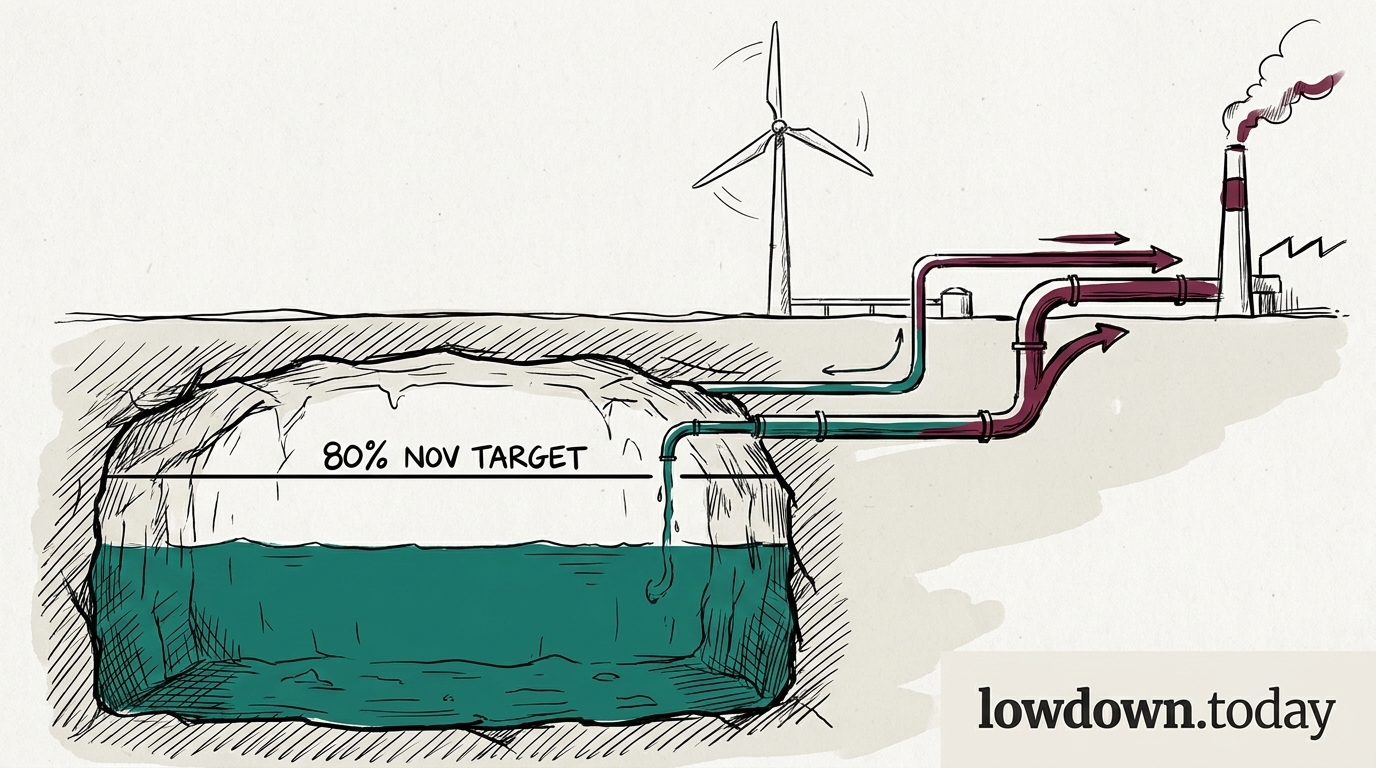
Spain's 9,145 GWh terminal inventory is the largest single stock in the EU LNG network, an option value that can reroute cargoes wherever the winter strip pays best rather than a cavern gas obligation tied to a fixed date. That flexibility matters more as Germany's cavern shortfall pushes more of the winter security question onto import infrastructure.
European Commission
European Commission
Brussels holds the bloc to 90% on a flexible window while Germany, holding roughly a quarter of EU storage capacity, tracks toward missing its own lower 80% figure by 21 points. A national shortfall this size in the anchor market matters more to bloc security than the flexible timetable alone can absorb.
French power exporters and CRE
French day-ahead rose in step with Germany but by less, reopening a EUR 7-17 premium that makes northward export flows commercially attractive again after the EUR 43.09 discount evaporated in days. CRE separately authorised RTE and Enedis to buy flexibility locally, betting the coming winter's binding constraint is grid congestion rather than a shortage of firm capacity.
TTF trading desk
TTF trading desk
A visible national shortfall like Germany's 21-point gap is a directional signal, not noise, for a desk holding the summer-winter spread. TTF's flat EUR 58-60 range through this week's German price swings says the market has not yet chosen to reprice refill risk into the front of the curve.
German cavern and CCGT operators
German caverns kept buying prompt gas at TTF near EUR 58-60 through the inversion; the wind collapse to 2.4 GW then flipped the spark spread to plus EUR 29 and put turbines back in the same queue. Every day turbines win that bid, injection at a third of the 877 GWh/day pace needed falls further behind.
Slovakia
Slovakia
Slovakia says it dropped its hold-out on the 21st sanctions package only after Ursula von der Leyen personally signed written gas-price and supply guarantees. The Council of the European Union's own 17,238-character release on the package names neither Slovakia nor any guarantee, leaving Bratislava's account unconfirmed by the institutional record.



