Skip to content
You can now search across every topic, entity and event.What's new
European Energy Markets
31JUL

Eight LNG cargoes diverted to Asia

3 min read
09:44UTC

Vessel tracking shows Europe losing the cargo-by-cargo competition with Asian buyers, as the JKM-TTF spread collapses to near zero.

EconomicDeveloping
Key takeaway

The JKM-TTF spread at USD 0.10/MMBtu erases Europe's cost advantage for attracting flexible LNG cargoes.

Kpler vessel tracking data shows eight Atlantic LNG cargoes (five US-origin, three Nigerian) have been diverted from Europe to Asia via the Cape of Good Hope since the conflict began in late February. EU weekly LNG imports fell 15% to 3.3 million tonnes as a result.

Behind the diversions sits the JKM-TTF spread, the gap between Asian spot LNG and the European benchmark. It narrowed to USD 0.10/MMBtu in early April, effectively zero. When the spread was positive, Europe could outbid Asia for flexible cargoes; at parity, shippers route to whichever buyer offers better terms on a cargo-by-cargo basis. US LNG still accounts for 58% of EU LNG imports under long-term contracts, but spot volumes follow the Asian premium.

Kpler's broader supply arithmetic is tight. Alternative sources cover under two million of the monthly shortfall. That gap persists until Ras Laffan repairs advance or new US export capacity comes online, Europe competes for a shrinking pool of flexible supply.


Deep Analysis

In plain English

Europe normally imports large quantities of liquefied natural gas (LNG) from the United States and West Africa, shipped across the Atlantic Ocean. Eight of those tanker ships have recently been redirected to Asia instead. This is happening because Asian countries are currently paying similar prices to Europe for gas. When there is no significant price advantage for coming to Europe, shipping companies and traders route cargoes to wherever their contracts or logistics make most sense, which right now is Asia.

Deep Analysis
Root Causes

The cargo diversions reflect a structural feature of global LNG contracts: portfolio LNG suppliers (Shell, TotalEnergies, BP) who purchase US LNG under long-term HH-indexed contracts and resell it on the spot market optimise delivery destinations quarterly, not in real time. Once a diversion decision is made and a vessel is en route via Cape of Good Hope, that cargo is effectively committed for 6-8 weeks regardless of subsequent TTF movements.

The five US-origin cargoes in the diversions are almost certainly portfolio volumes from Shell's Sabine Pass offtake or TotalEnergies' Sabine Pass Train 5 contracts. These companies have explicit Asian portfolio commitments that take precedence over spot European sales when Asian demand is elevated.

What could happen next?
  • Consequence

    The near-zero JKM-TTF spread removes Europe's primary market mechanism for attracting flexible spot LNG cargoes, making any further supply disruption directly additive to the storage deficit.

  • Opportunity

    A Hormuz normalisation that resumes Middle East LNG flows could widen the JKM-TTF spread in Europe's favour within weeks, attracting Atlantic cargoes back and accelerating injection season recovery.

First Reported In

Update #1 · Europe's thinnest gas cushion since 2018

Kpler· 13 Apr 2026
Read original
Causes and effects
This Event
Eight LNG cargoes diverted to Asia
The JKM-TTF spread at USD 0.10/MMBtu eliminates Europe's traditional price premium for attracting flexible cargoes, turning every spot cargo into a bidding contest.
Different Perspectives
Spain's LNG terminal operators
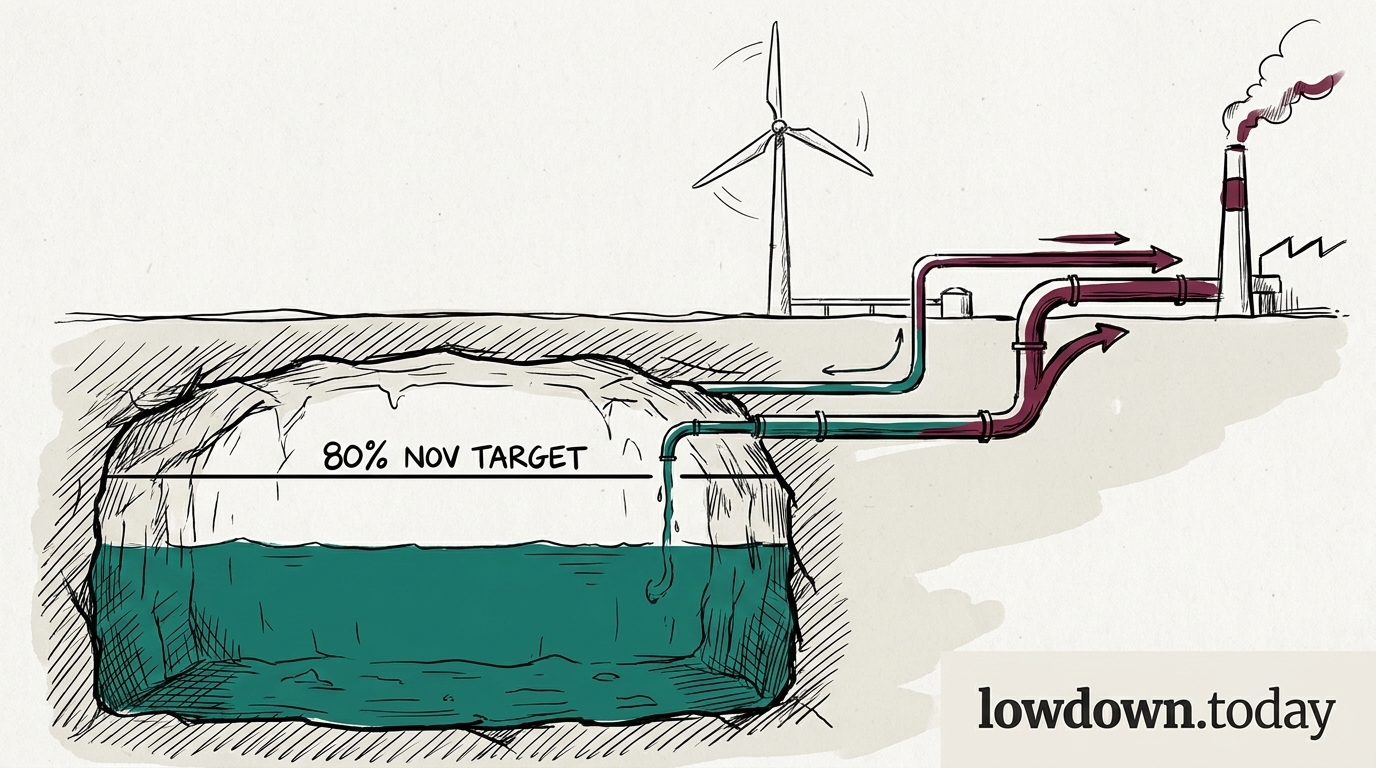
Spain's 9,145 GWh terminal inventory is the largest single stock in the EU LNG network, an option value that can reroute cargoes wherever the winter strip pays best rather than a cavern gas obligation tied to a fixed date. That flexibility matters more as Germany's cavern shortfall pushes more of the winter security question onto import infrastructure.
European Commission
European Commission
Brussels holds the bloc to 90% on a flexible window while Germany, holding roughly a quarter of EU storage capacity, tracks toward missing its own lower 80% figure by 21 points. A national shortfall this size in the anchor market matters more to bloc security than the flexible timetable alone can absorb.
French power exporters and CRE
French day-ahead rose in step with Germany but by less, reopening a EUR 7-17 premium that makes northward export flows commercially attractive again after the EUR 43.09 discount evaporated in days. CRE separately authorised RTE and Enedis to buy flexibility locally, betting the coming winter's binding constraint is grid congestion rather than a shortage of firm capacity.
TTF trading desk
TTF trading desk
A visible national shortfall like Germany's 21-point gap is a directional signal, not noise, for a desk holding the summer-winter spread. TTF's flat EUR 58-60 range through this week's German price swings says the market has not yet chosen to reprice refill risk into the front of the curve.
German cavern and CCGT operators
German caverns kept buying prompt gas at TTF near EUR 58-60 through the inversion; the wind collapse to 2.4 GW then flipped the spark spread to plus EUR 29 and put turbines back in the same queue. Every day turbines win that bid, injection at a third of the 877 GWh/day pace needed falls further behind.
Slovakia
Slovakia
Slovakia says it dropped its hold-out on the 21st sanctions package only after Ursula von der Leyen personally signed written gas-price and supply guarantees. The Council of the European Union's own 17,238-character release on the package names neither Slovakia nor any guarantee, leaving Bratislava's account unconfirmed by the institutional record.



