Skip to content
You can now search across every topic, entity and event.What's new
European Energy Markets
31JUL

Meloni breaks European line to the Gulf

4 min read
09:44UTC

Italian prime minister Giorgia Meloni became the first EU, NATO or G20 leader in the Gulf since the war began. An unnamed supplier has already cut 10 Italian LNG cargoes; European fiscal responses are diverging.

EconomicDeveloping
Key takeaway

Italy's unilateral Gulf trip and 10 lost LNG cargoes confirm physical supply disruption is now ahead of any EU coordination.

Giorgia Meloni travelled to Saudi Arabia, Qatar and the United Arab Emirates on 3 to 4 April, the first leader of any European Union, NATO or G20 member state to visit the Gulf since the war began on 28 February 1. The trip was unannounced before departure. An unnamed Gulf supplier subsequently notified Rome that 10 LNG (liquefied natural gas) cargoes scheduled between April and mid-June would not be delivered, the first publicly disclosed physical supply cut to a European buyer. Italian airports began rationing jet fuel on 7 April.

Domestic responses across the continent are diverging rather than coordinating. Italy cut excise duty on petrol and diesel by 25 cents per litre for 20 days. Germany finalised a €1.6 billion package on 13 April: a 17-cent excise reduction for two months and a tax-free €1,000 employer bonus 2. France rejected a comprehensive fuel-tax cut and allocated €70 million to the road transport sector only. Germany, Italy, Spain, Portugal and Austria have jointly proposed an EU-level windfall tax on energy companies; the European Commission has begun alerting Ireland, Poland and Estonia to expected oil and gas shortages. The blockade-day Brent surge has already pushed pass-through costs onto European forecourts.

The United Kingdom's 40-nation reopening coalition was assembled on the premise that a coordinated European demand-side approach would give diplomatic weight to negotiations on Hormuz. Meloni's Gulf trip dismantles that assumption from the supply side. It is procurement emergency dressed as foreign policy: Italy is lining up Azerbaijan follow-up visits, has deployed aerial defences to the Gulf to protect remaining supply, and has stopped waiting for a collective EU decision.

The practical consequence for the rest of the bloc is fiscal. The divergence between Italy's 25-cent cut, Germany's 17-cent cut, France's transport-sector allocation and the Spain-Portugal-Austria windfall-tax route means the EU cannot present a coordinated energy position in the negotiations the UK coalition was trying to build. Each member state is buying its own political cover at its own cost, and the single market's ability to pool the pain has collapsed before any ministerial meeting has been scheduled.


Deep Analysis

In plain English

Italy's prime minister flew secretly to Saudi Arabia, Qatar, and the United Arab Emirates, the first leader of any European or NATO country to visit the Gulf since this war began. She went because Italy is running short of gas and jet fuel, not because of a coordinated European strategy. An unnamed Gulf supplier told Rome it would not deliver 10 ship-loads of liquefied gas that Italy was expecting between now and mid-June. Italian airports are already rationing jet fuel. The government cut fuel tax to help drivers at the pump. Other European countries are doing different things. Germany spent €1.6 billion on a different type of relief package. France gave a much smaller amount only to the road haulage industry. Spain, Portugal and Austria want a new Europe-wide tax on energy companies. The problem with all these different national responses is that Europe loses negotiating leverage when each country is making its own deals. Italy's separate trip to the Gulf shows that the EU cannot act as one voice when supply is being physically cut off.

What could happen next?
  • Consequence

    Diverging national fiscal responses reduce the EU's credibility as a unified actor in any Hormuz diplomatic negotiation, since Gulf suppliers can play member states against each other.

  • Risk

    Italy's unilateral bilateral track undermines the UK's 40-nation reopening coalition by creating a competing European channel that Gulf suppliers may prefer to engage with individually.

First Reported In

Update #68 · Sanctioned tankers slip the blockade

The National· 14 Apr 2026
Read original
Different Perspectives
Spain's LNG terminal operators
Spain's 9,145 GWh terminal inventory is the largest single stock in the EU LNG network, an option value that can reroute cargoes wherever the winter strip pays best rather than a cavern gas obligation tied to a fixed date. That flexibility matters more as Germany's cavern shortfall pushes more of the winter security question onto import infrastructure.
European Commission
European Commission
Brussels holds the bloc to 90% on a flexible window while Germany, holding roughly a quarter of EU storage capacity, tracks toward missing its own lower 80% figure by 21 points. A national shortfall this size in the anchor market matters more to bloc security than the flexible timetable alone can absorb.
French power exporters and CRE
French day-ahead rose in step with Germany but by less, reopening a EUR 7-17 premium that makes northward export flows commercially attractive again after the EUR 43.09 discount evaporated in days. CRE separately authorised RTE and Enedis to buy flexibility locally, betting the coming winter's binding constraint is grid congestion rather than a shortage of firm capacity.
TTF trading desk
TTF trading desk
A visible national shortfall like Germany's 21-point gap is a directional signal, not noise, for a desk holding the summer-winter spread. TTF's flat EUR 58-60 range through this week's German price swings says the market has not yet chosen to reprice refill risk into the front of the curve.
German cavern and CCGT operators
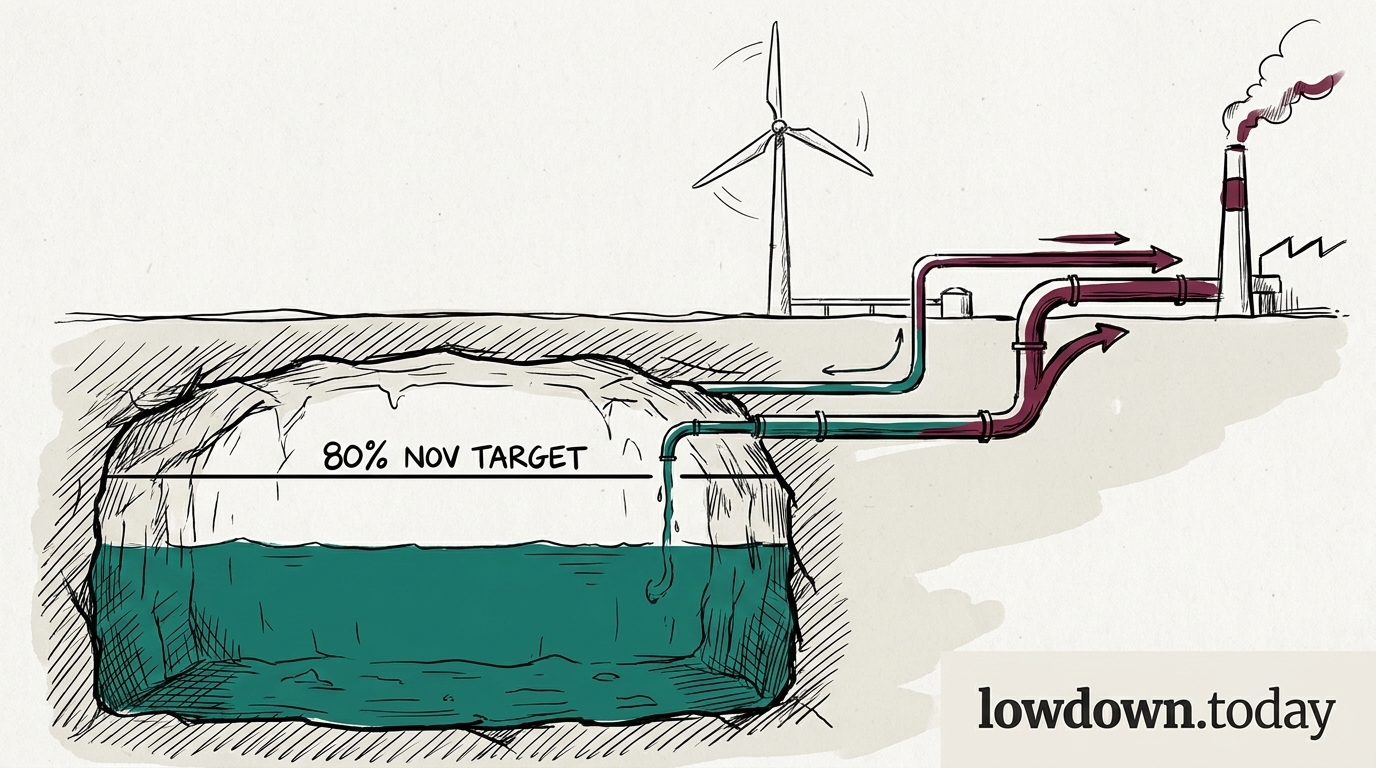
German caverns kept buying prompt gas at TTF near EUR 58-60 through the inversion; the wind collapse to 2.4 GW then flipped the spark spread to plus EUR 29 and put turbines back in the same queue. Every day turbines win that bid, injection at a third of the 877 GWh/day pace needed falls further behind.
Slovakia
Slovakia
Slovakia says it dropped its hold-out on the 21st sanctions package only after Ursula von der Leyen personally signed written gas-price and supply guarantees. The Council of the European Union's own 17,238-character release on the package names neither Slovakia nor any guarantee, leaving Bratislava's account unconfirmed by the institutional record.



