Skip to content
You can now search across every topic, entity and event.What's new
European Energy Markets
31JUL

Iran fires 10 missiles at Ramat David

3 min read
09:44UTC

Iran's IRGC fired at least 10 ballistic missiles at Ramat David airbase in northern Israel on Sunday 7 June; the IDF intercepted all 10 and reported no casualties.

EconomicDeveloping
Key takeaway

Iran put 10 missiles onto an Israeli airbase, raising the volley and the target class at once.

Iran's IRGC (Islamic Revolutionary Guard Corps) fired at least 10 ballistic missiles at Ramat David Airbase in northern Israel on Sunday 7 June, calling it retaliation for an Israeli airstrike on Hezbollah in Beirut's southern suburbs that morning 1. The IDF (Israel Defense Forces) intercepted all 10, and no casualties were reported. Mohsen Rezaei, military adviser to the Supreme Leader, called the salvo "a warning to stop their evil; any new action will be met with a more crushing response" 2.

Iran's 5 June salvo at US bases in Kuwait and Bahrain ran to seven missiles ; this one ran to ten, and the target moved from Gulf-state interceptors to an Israeli military airbase. The exchange has crossed from Gulf proxies onto Israeli soil within two days.

The Beirut strike Tehran named as its trigger sits in the Lebanon thread Iran has tied to its US talks . That front has run hot since the weekend, with the IDF killing a Hezbollah engineer on 4 June and a Lebanese army colonel on 6 June . Iran has built Lebanon into a tripwire, and Beirut tripped it.


Deep Analysis

In plain English

Iran's military launched 10 ballistic missiles at an Israeli air force base called Ramat David in northern Israel on 7 June. Israel's air defence systems shot all of them down before they caused damage, with zero casualties reported by either side. Iran said the launch was payback for Israeli airstrikes on Hezbollah (the Lebanese armed group Iran backs) in Beirut. Mohsen Rezaei, a senior figure in the IRGC (Iran's Revolutionary Guard, the elite military force that answers directly to Iran's supreme leader), called it a warning. Three days earlier, Iran had fired seven missiles at US bases in Kuwait and Bahrain. This salvo was bigger and aimed at Israel itself, not at American targets in Gulf countries.

Deep Analysis
Root Causes

Iran's coupling of the Lebanon front to nuclear talks, formalised in Araghchi's public framing since May 2026, means any IDF strike on Hezbollah commanders in Beirut now triggers a mandatory IRGC response under the regime's publicly stated red-line logic.

The IRGC cannot visibly absorb IDF Beirut strikes without undermining the coercive leverage Tehran uses to resist concessions on its uranium stockpile. Iran has no de-escalation mechanism available below a formal diplomatic agreement it has not yet reached.

Escalation

Upward: the salvo size grew from 7 (5 June, Gulf states) to 10 (7 June, Israeli soil), and the target class shifted from US coalition assets to Israeli national military infrastructure. The ceiling is not yet visible; Rezaei's language ('more crushing response') preserves the option of larger salvos.

What could happen next?
  • Risk

    A second IDF strike inside Iran, which followed within 24 hours, risks triggering the 'more crushing response' Rezaei threatened, potentially with larger salvos or expanded target sets.

  • Consequence

    Each IRGC volley against Israeli soil draws down intercept magazine stocks; Bahrain's PAC-3 already at 87% depletion, placing the burden on Iron Dome and Arrow-3 for Israeli coverage.

First Reported In

Update #121 · Trump said don't strike; Israel struck Iran

Institute for the Study of War· 8 Jun 2026
Read original
Different Perspectives
Spain's LNG terminal operators
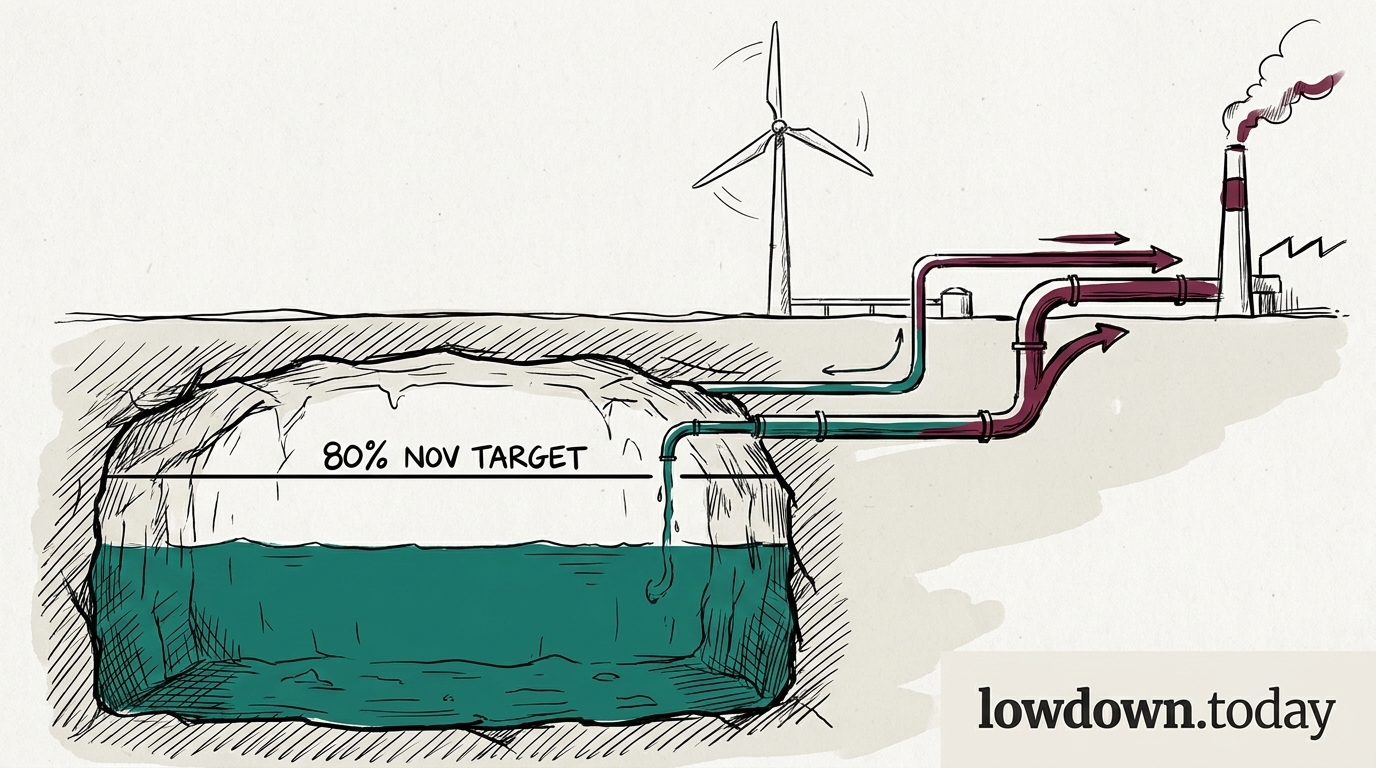
Spain's 9,145 GWh terminal inventory is the largest single stock in the EU LNG network, an option value that can reroute cargoes wherever the winter strip pays best rather than a cavern gas obligation tied to a fixed date. That flexibility matters more as Germany's cavern shortfall pushes more of the winter security question onto import infrastructure.
European Commission
European Commission
Brussels holds the bloc to 90% on a flexible window while Germany, holding roughly a quarter of EU storage capacity, tracks toward missing its own lower 80% figure by 21 points. A national shortfall this size in the anchor market matters more to bloc security than the flexible timetable alone can absorb.
French power exporters and CRE
French day-ahead rose in step with Germany but by less, reopening a EUR 7-17 premium that makes northward export flows commercially attractive again after the EUR 43.09 discount evaporated in days. CRE separately authorised RTE and Enedis to buy flexibility locally, betting the coming winter's binding constraint is grid congestion rather than a shortage of firm capacity.
TTF trading desk
TTF trading desk
A visible national shortfall like Germany's 21-point gap is a directional signal, not noise, for a desk holding the summer-winter spread. TTF's flat EUR 58-60 range through this week's German price swings says the market has not yet chosen to reprice refill risk into the front of the curve.
German cavern and CCGT operators
German caverns kept buying prompt gas at TTF near EUR 58-60 through the inversion; the wind collapse to 2.4 GW then flipped the spark spread to plus EUR 29 and put turbines back in the same queue. Every day turbines win that bid, injection at a third of the 877 GWh/day pace needed falls further behind.
Slovakia
Slovakia
Slovakia says it dropped its hold-out on the 21st sanctions package only after Ursula von der Leyen personally signed written gas-price and supply guarantees. The Council of the European Union's own 17,238-character release on the package names neither Slovakia nor any guarantee, leaving Bratislava's account unconfirmed by the institutional record.



