Skip to content
You can now search across every topic, entity and event.What's new
European Energy Markets
31JUL

Bahrain runs low on Patriot interceptors

2 min read
09:44UTC

Bahrain's stock of PAC-3 interceptors is an estimated 87% depleted, leaving roughly eight rounds, and its 50-round resupply runs on an 18-month timeline that leaves the gap open now.

EconomicAssessed
Key takeaway

Bahrain's air-defence shield is nearly out of interceptors with replacements 18 months off, so Iranian strikes keep landing.

Bahrain's stock of Patriot Advanced Capability-3 (PAC-3) interceptors is an estimated 87% depleted, leaving roughly eight rounds, according to inventory analysis drawn from US Federal Register notices 1. PAC-3 rounds are single-use missiles that destroy incoming ballistic and cruise missiles, and every interception spends one from that count.

Marco Rubio's 2 May emergency resupply authorisation covered Qatar, Kuwait, the UAE and Israel; Bahrain was excluded . A 1 June Federal Register notice added 50 PAC-3 Missile Segment Enhancement (MSE) rounds for the island, but on a standard procurement timeline of roughly 18 months. New missiles ordered now do not arrive in time to matter for this barrage.

The IRGC struck Bahrain on 3 June even as its sirens sounded, part of the same Gulf campaign that hit Sirik Island and Kuwait on 1 June . The IRGC is probing a magazine it knows is emptying. A defender rationing eight rounds against an 18-month wait has to let some inbound threats through, which is the quiet arithmetic behind why the Kuwait International Airport terminal and the wider Gulf barrages get through. Bahrain hosts the US Fifth Fleet headquarters, putting the most prized target in the region under the thinnest cover.


Deep Analysis

In plain English

Bahrain is a small Gulf island state that hosts the US Navy's Fifth Fleet headquarters. Iran has been attacking it regularly throughout the 2026 conflict. Bahrain's main defence against incoming missiles is the Patriot PAC-3 system, American-made interceptors that shoot down attacking rockets. Based on analysis of publicly available US government procurement documents, Bahrain had used up about 87% of its PAC-3 interceptors before the 3 June Iranian barrage, leaving only around eight rounds. The problem is that replacement missiles take about 18 months to produce and deliver through normal channels, and Bahrain was left out of an emergency resupply package the US Secretary of State approved in May for Qatar, Kuwait, UAE, and Israel. A 1 June notice shows 50 replacement rounds were ordered for Bahrain, but at standard timelines they would not arrive until late 2027. With just eight rounds left and Iran probing with repeated strikes, Bahrain's air defences are running on fumes.

Deep Analysis
Root Causes

Bahrain's PAC-3 gap has two structural causes. First, Bahrain was specifically excluded from Rubio's 2 May emergency resupply authorisation, which covered Qatar, Kuwait, UAE, and Israel. No public explanation was given for the exclusion; the most plausible operational reading is that CENTCOM assessed Bahrain's Fifth Fleet headquarters as covered by carrier-based defence rather than ground-based PAC-3. That assessment predated the 3 June barrage tempo.

Second, the 18-month standard procurement pipeline reflects a production-capacity constraint at Lockheed Martin's facility in Lufkin, Texas, which produces PAC-3 and PAC-3 MSE at approximately 240 rounds per year across all customers. That facility was already backlogged by Ukrainian HIMARS-adjacent component orders and South Korean PAC-3 upgrades. Emergency production surge would require Congressional authorisation of an accelerated multi-year contract, which has not been requested.

What could happen next?
  • Risk

    With approximately eight PAC-3 rounds remaining, a sustained IRGC barrage on NSA Bahrain over two days could exhaust Bahrain's terminal-phase ground-based intercept capacity entirely, leaving the Fifth Fleet headquarters reliant on carrier-based AEGIS or undefended.

  • Consequence

    Bahrain's exclusion from the 2 May emergency resupply creates a public accountability record: if Fifth Fleet sustains damage from a missile that PAC-3 would have intercepted, the exclusion decision is on record as the proximate cause.

First Reported In

Update #117 · Iran's drone finds Kuwait's arrivals hall

Fortune· 4 Jun 2026
Read original
Different Perspectives
Spain's LNG terminal operators
Spain's 9,145 GWh terminal inventory is the largest single stock in the EU LNG network, an option value that can reroute cargoes wherever the winter strip pays best rather than a cavern gas obligation tied to a fixed date. That flexibility matters more as Germany's cavern shortfall pushes more of the winter security question onto import infrastructure.
European Commission
European Commission
Brussels holds the bloc to 90% on a flexible window while Germany, holding roughly a quarter of EU storage capacity, tracks toward missing its own lower 80% figure by 21 points. A national shortfall this size in the anchor market matters more to bloc security than the flexible timetable alone can absorb.
French power exporters and CRE
French day-ahead rose in step with Germany but by less, reopening a EUR 7-17 premium that makes northward export flows commercially attractive again after the EUR 43.09 discount evaporated in days. CRE separately authorised RTE and Enedis to buy flexibility locally, betting the coming winter's binding constraint is grid congestion rather than a shortage of firm capacity.
TTF trading desk
TTF trading desk
A visible national shortfall like Germany's 21-point gap is a directional signal, not noise, for a desk holding the summer-winter spread. TTF's flat EUR 58-60 range through this week's German price swings says the market has not yet chosen to reprice refill risk into the front of the curve.
German cavern and CCGT operators
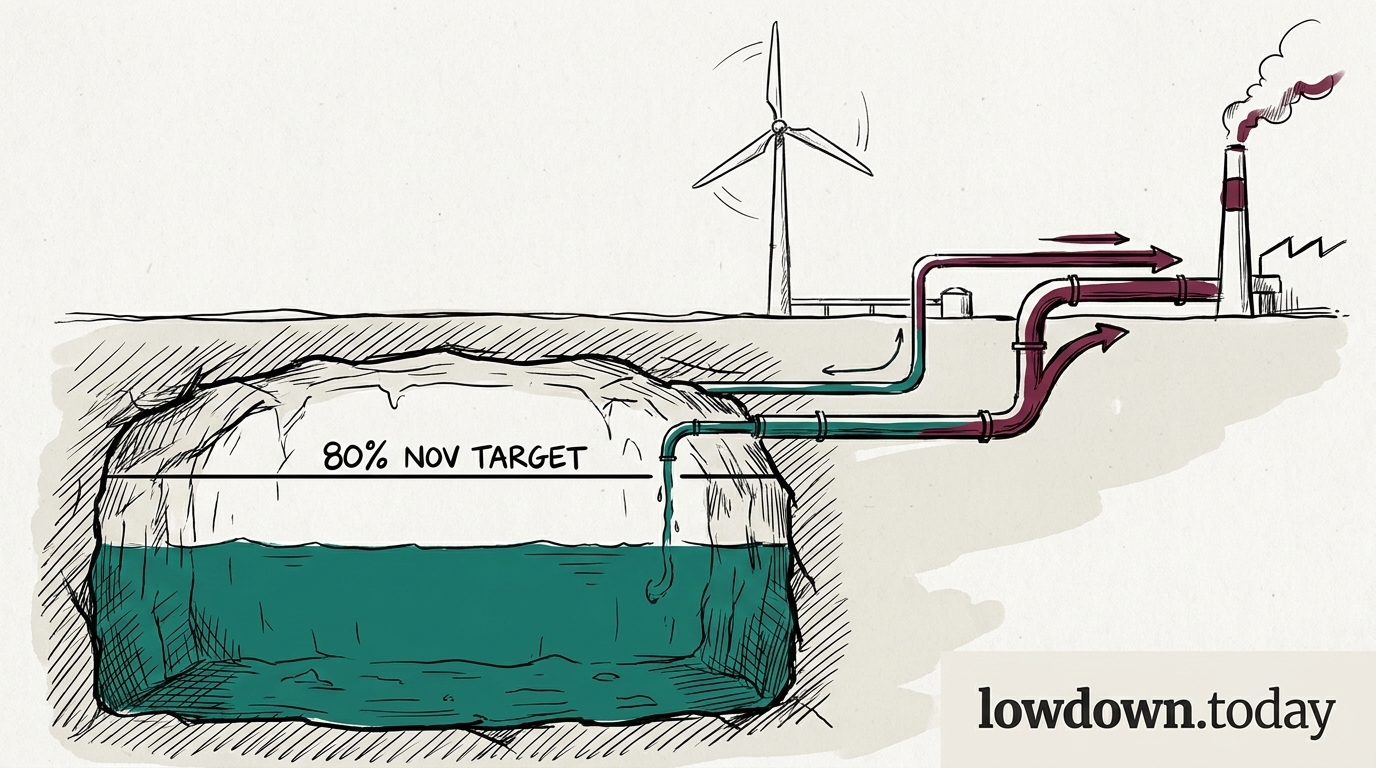
German caverns kept buying prompt gas at TTF near EUR 58-60 through the inversion; the wind collapse to 2.4 GW then flipped the spark spread to plus EUR 29 and put turbines back in the same queue. Every day turbines win that bid, injection at a third of the 877 GWh/day pace needed falls further behind.
Slovakia
Slovakia
Slovakia says it dropped its hold-out on the 21st sanctions package only after Ursula von der Leyen personally signed written gas-price and supply guarantees. The Council of the European Union's own 17,238-character release on the package names neither Slovakia nor any guarantee, leaving Bratislava's account unconfirmed by the institutional record.



