Skip to content
You can now search across every topic, entity and event.What's new
European Energy Markets
31JUL

Iran hits Jordan and three Gulf states

2 min read
09:44UTC

Iran fired ten missiles at Jordan's Azraq base on 9 July and struck Bahrain, Kuwait and Qatar the same day, the war's widest single-day spread, yet oil and Washington's paper trail both stayed flat.

EconomicDeveloping
Key takeaway

Iran struck four countries in a day and threatened the UAE, yet Washington's paper and oil both stayed flat.

Iran fired ten ballistic missiles at Jordan's Azraq air base, which hosts US troops and aircraft, on 9 July; Jordan reported eight intercepted and no casualties. 1 The same day the Islamic Revolutionary Guard Corps (IRGC) struck Bahrain's Fifth Fleet headquarters, Kuwait and Qatar with one-way attack drones and missiles, and targeted a Patriot interceptor battery, a mobile surface-to-air missile unit, on Qatari soil. 2

Jordan is the first non-Gulf, no-coastline partner drawn onto the strike map, extending a retaliation that through 8 July had run as a US-Iran and Gulf-coastal exchange . Bahrain's interior ministry ordered residents to shelter and sirens sounded, while Kuwait shut its Flight Information Region (FIR), the block of airspace it controls, to all but vetted arrivals. 3 The IRGC named the United Arab Emirates (UAE) as its next target if US strikes continue. 4

Two systems that normally price escalation stayed still. Across 8 to 10 July The White House signed only an aircraft-tariff proclamation, unrelated to the war it was prosecuting, and nothing on Iran. 5 Trump had already called the 16 June ceasefire memorandum over , but a Truth Social line is not a signed instrument.

One reading holds the flat signals correct: Jordan stopped eight of ten missiles, no one died, and the Doha channel is paused rather than dead. 6 Aviation authorities lean the same way, reopening Qatar's Doha FIR to near-normal within a day and leaving Kuwait's as the only Gulf airspace still shut. 7 The named Army dead and the strait's near-closure still show real cost accruing inside that bounded exchange, so "contained" reads as a market bet rather than a settled fact.


Deep Analysis

In plain English

Iran's paramilitary Revolutionary Guard Corps, known as the IRGC, fired missiles and drones at four countries in a single day: Jordan, Bahrain, Kuwait and Qatar, and warned a fifth, the United Arab Emirates, that it could be next. What makes this notable is Jordan, since unlike the Gulf states it has no coastline on the waterway Iran has been fighting over and no direct role in the standoff. It was hit simply because it hosts American troops and aircraft at Azraq air base. Jordan's air defences shot down eight of the ten missiles fired at it and nobody was killed, but the message was clear: any country that hosts US forces is now a potential target, whatever its relationship to the original dispute.

Deep Analysis
Root Causes

Jordan's exposure is structural, not political: Azraq hosts US aircraft under bilateral defence arrangements that predate this conflict and have nothing to do with Hormuz, oil transit or the Gulf littoral dispute driving the rest of the war.

Once Iran treats hosting US forces as the qualifying condition for a target, rather than bordering the Gulf or profiting from the blockade, every basing partner from Jordan to a prospective UAE becomes reachable regardless of its role in the underlying dispute.

The same logic explains the explicit UAE threat. Abu Dhabi has no direct stake in the Hormuz standoff but hosts US forces, which is now sufficient grounds for inclusion on Iran's list.

Escalation

Untested: the IRGC has named the UAE as a fifth target but has not yet struck it. Whether that threat is acted on will show whether Iran is still expanding geographically or has reached the edge of its intended spread.

What could happen next?
  • Precedent

    Iran has established that hosting US forces, not Gulf geography, is now the qualifying condition for inclusion on its target list.

  • Risk

    A struck UAE would be the fifth country hit in the current wave and the second, after Jordan, with no direct Hormuz stake.

First Reported In

Update #151 · Iran widens war to Jordan; oil shrugs

The Times of Israel· 10 Jul 2026
Read original
Different Perspectives
Spain's LNG terminal operators
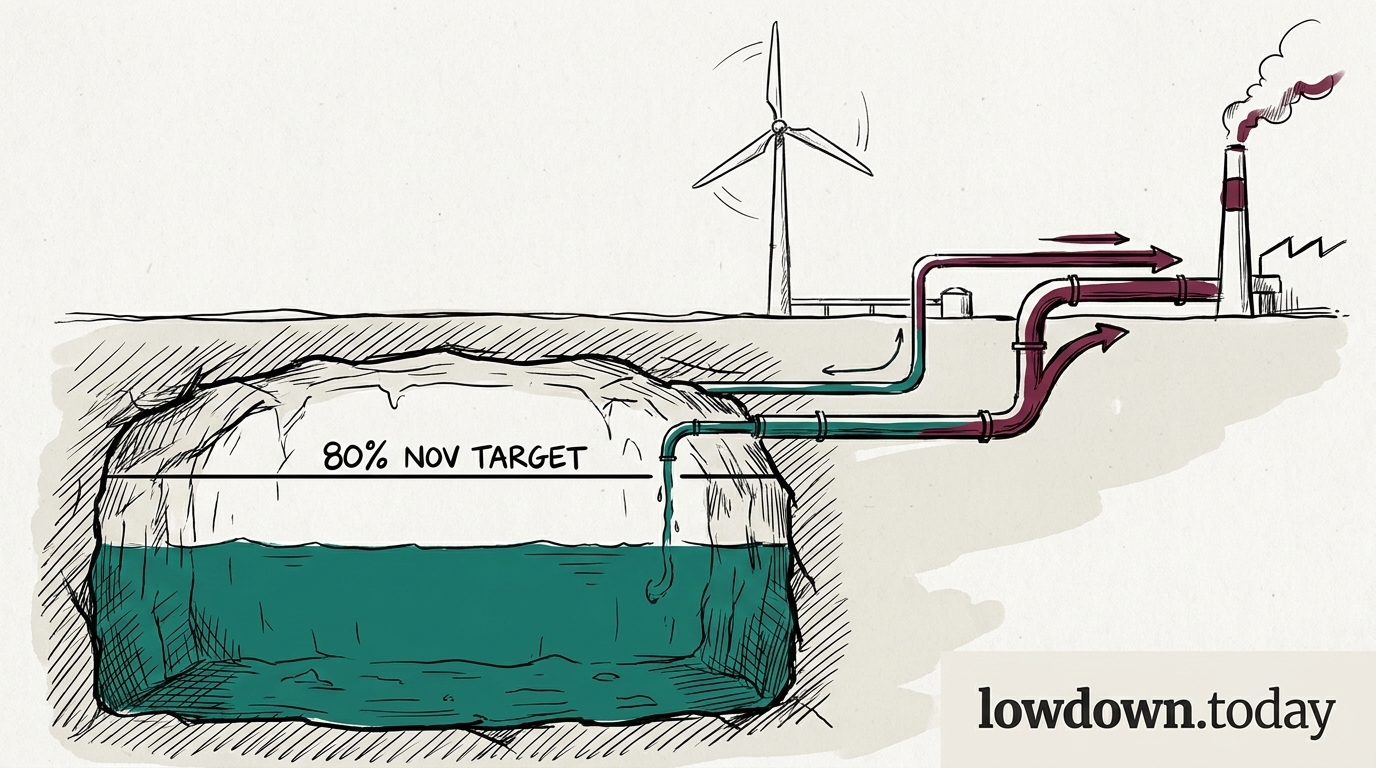
Spain's 9,145 GWh terminal inventory is the largest single stock in the EU LNG network, an option value that can reroute cargoes wherever the winter strip pays best rather than a cavern gas obligation tied to a fixed date. That flexibility matters more as Germany's cavern shortfall pushes more of the winter security question onto import infrastructure.
European Commission
European Commission
Brussels holds the bloc to 90% on a flexible window while Germany, holding roughly a quarter of EU storage capacity, tracks toward missing its own lower 80% figure by 21 points. A national shortfall this size in the anchor market matters more to bloc security than the flexible timetable alone can absorb.
French power exporters and CRE
French day-ahead rose in step with Germany but by less, reopening a EUR 7-17 premium that makes northward export flows commercially attractive again after the EUR 43.09 discount evaporated in days. CRE separately authorised RTE and Enedis to buy flexibility locally, betting the coming winter's binding constraint is grid congestion rather than a shortage of firm capacity.
TTF trading desk
TTF trading desk
A visible national shortfall like Germany's 21-point gap is a directional signal, not noise, for a desk holding the summer-winter spread. TTF's flat EUR 58-60 range through this week's German price swings says the market has not yet chosen to reprice refill risk into the front of the curve.
German cavern and CCGT operators
German caverns kept buying prompt gas at TTF near EUR 58-60 through the inversion; the wind collapse to 2.4 GW then flipped the spark spread to plus EUR 29 and put turbines back in the same queue. Every day turbines win that bid, injection at a third of the 877 GWh/day pace needed falls further behind.
Slovakia
Slovakia
Slovakia says it dropped its hold-out on the 21st sanctions package only after Ursula von der Leyen personally signed written gas-price and supply guarantees. The Council of the European Union's own 17,238-character release on the package names neither Slovakia nor any guarantee, leaving Bratislava's account unconfirmed by the institutional record.



