Skip to content
You can now search across every topic, entity and event.What's new
European Energy Markets
31JUL

IRGC thanks Jordanians for helping it aim

3 min read
09:44UTC

The IRGC says its 21st Nasr-2 wave destroyed 20 hangars at Azraq and Aqaba and damaged C-17 and P-8 aircraft, and it thanked Jordanians for supplying intelligence. No US, Jordanian or Kuwaiti source corroborates any of it.

EconomicDeveloping
Key takeaway

Tehran's uncorroborated claim thanks Jordanian soldiers for intelligence, a line aimed at Amman's domestic politics.

The IRGC (Islamic Revolutionary Guard Corps) Aerospace Force claimed on 20 July that the 21st wave of its Operation Nasr-2 struck the Azraq area and Aqaba Airport in Jordan, destroying 20 hangars used to station troops, killing "dozens of American terrorist forces" and heavily damaging C-17 cargo transports and P-8 surveillance aircraft 1. No US, Jordanian or Kuwaiti source corroborates any part of it.

Press TV, Iran's state broadcaster, carried the account, so the figures stand as Tehran's assertion and nothing more. The IRGC is Iran's parallel military, answerable to the supreme leader rather than to the regular general staff, and its Aerospace Force holds the missile and drone inventory that has been used against Gulf and Jordanian targets throughout this war.

The line worth reading twice sits at the end of the statement. The IRGC thanked "the Jordanian public and members of the country's armed forces for providing intelligence" 2. Nothing in that sentence carries military value. Coordinates for a base hit repeatedly since 9 July do not need publicising, and a real source inside a partner military would not be advertised in a broadcast. The likelier audience sits in Amman: naming no one but implicating everyone, the line invites Jordanians to wonder which of their own soldiers helped, at a moment when the kingdom is already fielding questions about the base where American service members died . Jordan has not responded.

The banner moved as well. Iran's regular army, the Artesh, claimed the Gulf target set under its own name on 16 July and called it Operation Saeqeh , and by 18 July Iranian state media had that campaign running to phases 14 and 15 across Kuwait, Jordan and Bahrain . This wave arrives under a different label from a different institution. Two Iranian militaries claiming the same enemies in the same week says more about who is competing for credit in Tehran than about what happened at Aqaba.


Deep Analysis

In plain English

Iran's Revolutionary Guard says it struck a Jordanian air base and airport, claiming to have destroyed hangars and damaged US aircraft, and thanking ordinary Jordanians for supplying intelligence. None of this has been confirmed by Jordan, the US or Kuwait, so it should be read as an Iranian claim, not an established fact. The 'thanks to Jordanians' line is new and inflammatory: it implies people inside Jordan helped Iran target a US ally, something Jordan's government has not responded to.

What could happen next?
  • Risk

    An unconfirmed claim of Jordanian civilian intelligence-sharing could strain US-Jordan trust even if the underlying strike claim proves false, since the accusation itself is now public.

  • Precedent

    Two Iranian services claiming the same Jordanian target set within days suggests competition for domestic credit is now shaping which branch announces which strike.

First Reported In

Update #157 · IAEA takes up Darkhovin as utilities become targets

Press TV· 20 Jul 2026
Read original
Different Perspectives
Spain's LNG terminal operators
Spain's 9,145 GWh terminal inventory is the largest single stock in the EU LNG network, an option value that can reroute cargoes wherever the winter strip pays best rather than a cavern gas obligation tied to a fixed date. That flexibility matters more as Germany's cavern shortfall pushes more of the winter security question onto import infrastructure.
European Commission
European Commission
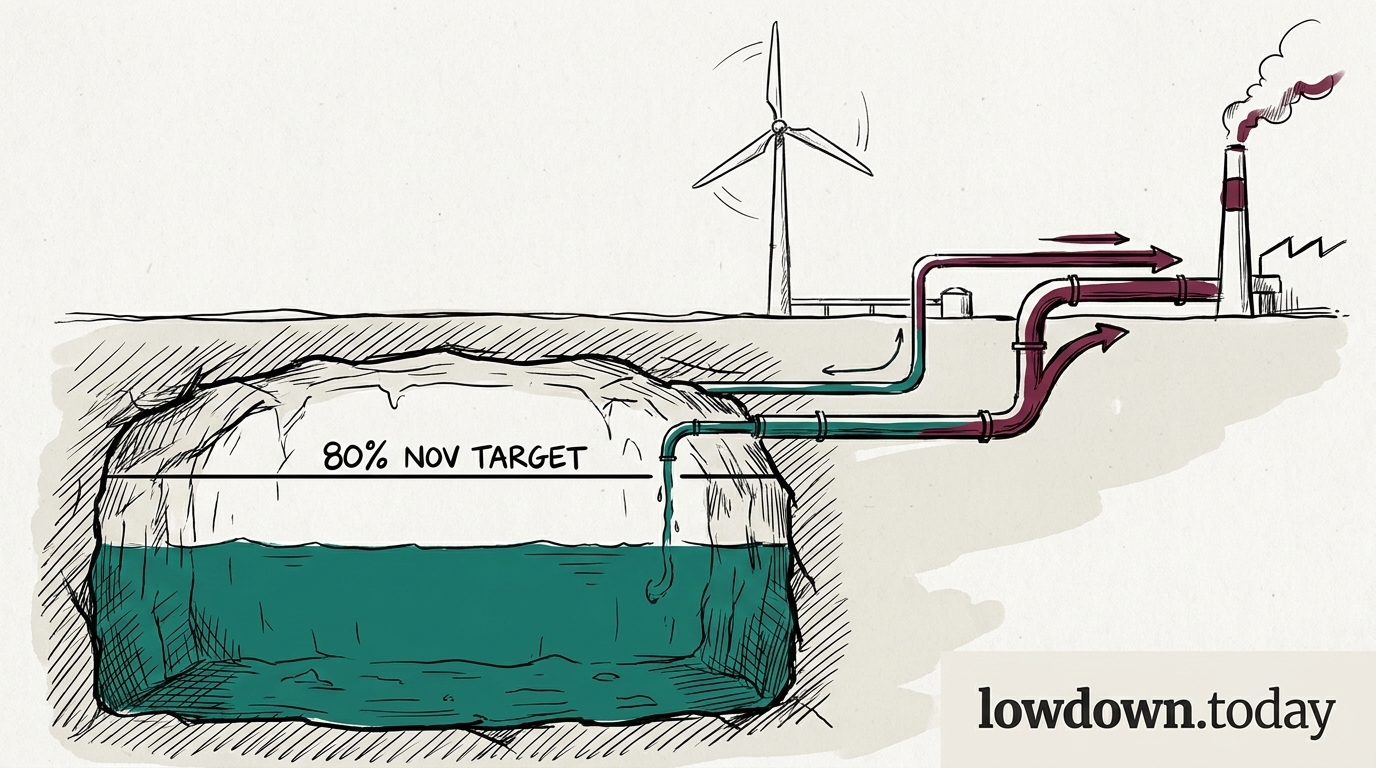
Brussels holds the bloc to 90% on a flexible window while Germany, holding roughly a quarter of EU storage capacity, tracks toward missing its own lower 80% figure by 21 points. A national shortfall this size in the anchor market matters more to bloc security than the flexible timetable alone can absorb.
French power exporters and CRE
French day-ahead rose in step with Germany but by less, reopening a EUR 7-17 premium that makes northward export flows commercially attractive again after the EUR 43.09 discount evaporated in days. CRE separately authorised RTE and Enedis to buy flexibility locally, betting the coming winter's binding constraint is grid congestion rather than a shortage of firm capacity.
TTF trading desk
TTF trading desk
A visible national shortfall like Germany's 21-point gap is a directional signal, not noise, for a desk holding the summer-winter spread. TTF's flat EUR 58-60 range through this week's German price swings says the market has not yet chosen to reprice refill risk into the front of the curve.
German cavern and CCGT operators
German caverns kept buying prompt gas at TTF near EUR 58-60 through the inversion; the wind collapse to 2.4 GW then flipped the spark spread to plus EUR 29 and put turbines back in the same queue. Every day turbines win that bid, injection at a third of the 877 GWh/day pace needed falls further behind.
Slovakia
Slovakia
Slovakia says it dropped its hold-out on the 21st sanctions package only after Ursula von der Leyen personally signed written gas-price and supply guarantees. The Council of the European Union's own 17,238-character release on the package names neither Slovakia nor any guarantee, leaving Bratislava's account unconfirmed by the institutional record.



