Skip to content
You can now search across every topic, entity and event.What's new
European Energy Markets
31JUL

Hormuz trickle: five then seven vessels

3 min read
09:44UTC

Kpler logged five vessel transits through the Strait of Hormuz on 9 April and seven on 10 April, against a pre-war baseline of 120 to 140 a day. ADNOC's chief executive told reporters the strait is not open.

EconomicDeveloping
Key takeaway

Hormuz is delivering fewer transits under ceasefire than under Iran's own toll regime.

Kpler recorded 5 vessel transits through the Strait of Hormuz on 9 April and 7 on 10 April, against a pre-war baseline of 120 to 140 daily 1. The ceasefire is delivering fewer movements than the 20 transits per day Iran's own toll regime was carrying on 5 April . More than 600 vessels remain stranded inside the Gulf, including 325 oil tankers.

Sultan Al Jaber, chief executive of ADNOC (Abu Dhabi National Oil Company), told reporters on Friday that "the strait of Hormuz is not open. Access is being restricted, conditioned and controlled" 2. Ana Subasic, a Kpler analyst, projects a ceiling of 10 to 15 transits per day even if the ceasefire fully holds.

That ceiling is roughly one-tenth of the pre-war baseline and half of Iran's own toll volume last week. It implies structurally tight oil throughput regardless of Brent's headline price , and no single-day breakthrough is likely to restore pre-war flow. The Gulf is moving at a trickle because the physical problem in the water is larger than the political problem in the hotel in Islamabad.


Deep Analysis

In plain English

Before the war, 120 to 140 ships passed through the Strait of Hormuz every day carrying oil from Gulf states to the rest of the world. In the three days since the ceasefire, that number has fallen to five or seven — not much more than zero. The ceasefire stopped the bombing, but it did not clear the sea mines, lift the shipping insurance bans, or dissolve the Iranian inspection system. A political peace agreement does not automatically move oil.

Deep Analysis
Root Causes

The trickle is not a ceasefire failure in the usual sense. It reflects three compounding physical constraints that the diplomatic process cannot resolve: uncharted Iranian mines making navigation hazardous, the IRGC corridor system restricting passage to specific channels near Larak Island, and the withdrawal of war-risk insurance coverage from standard commercial operators.

The UN Security Council's 11-2 vote for a Hormuz reopening resolution was vetoed by Russia and China — both of whom benefit from the toll architecture their own tankers already use. The multilateral route to maritime normalisation is therefore closed, leaving only bilateral US-Iran negotiation or unilateral force, neither of which resolves the physical mine problem.

What could happen next?
  • Consequence

    Brent crude will remain structurally elevated at 40-60% above pre-war levels until mine clearance and insurance normalisation occur, regardless of which diplomatic outcome Islamabad produces.

  • Risk

    GL-U expiry on 19 April would simultaneously criminalise the 325 stranded tankers' cargo under US sanctions while they remain physically unable to move, creating a compound maritime-legal crisis.

First Reported In

Update #65 · Iran lost its own minefield

Al Jazeera· 11 Apr 2026
Read original
Different Perspectives
Spain's LNG terminal operators
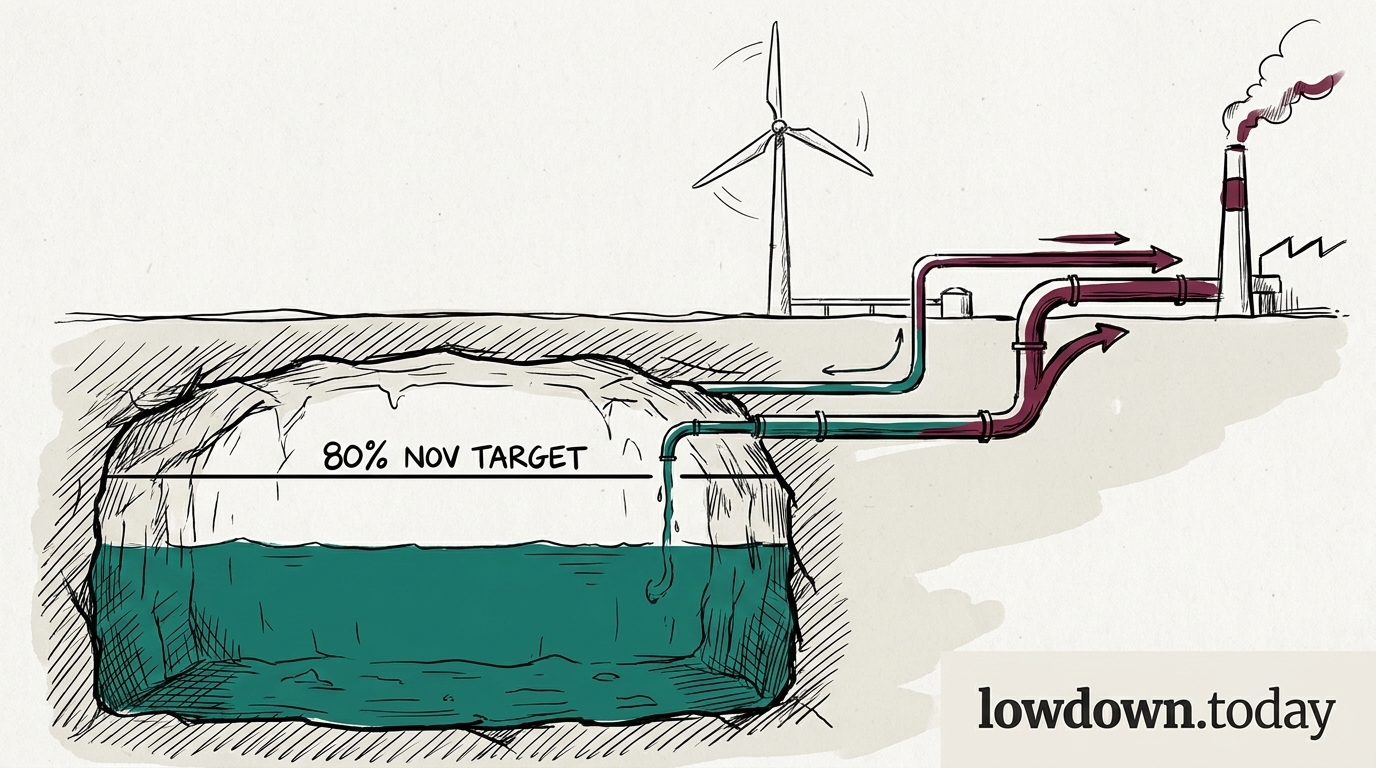
Spain's 9,145 GWh terminal inventory is the largest single stock in the EU LNG network, an option value that can reroute cargoes wherever the winter strip pays best rather than a cavern gas obligation tied to a fixed date. That flexibility matters more as Germany's cavern shortfall pushes more of the winter security question onto import infrastructure.
European Commission
European Commission
Brussels holds the bloc to 90% on a flexible window while Germany, holding roughly a quarter of EU storage capacity, tracks toward missing its own lower 80% figure by 21 points. A national shortfall this size in the anchor market matters more to bloc security than the flexible timetable alone can absorb.
French power exporters and CRE
French day-ahead rose in step with Germany but by less, reopening a EUR 7-17 premium that makes northward export flows commercially attractive again after the EUR 43.09 discount evaporated in days. CRE separately authorised RTE and Enedis to buy flexibility locally, betting the coming winter's binding constraint is grid congestion rather than a shortage of firm capacity.
TTF trading desk
TTF trading desk
A visible national shortfall like Germany's 21-point gap is a directional signal, not noise, for a desk holding the summer-winter spread. TTF's flat EUR 58-60 range through this week's German price swings says the market has not yet chosen to reprice refill risk into the front of the curve.
German cavern and CCGT operators
German caverns kept buying prompt gas at TTF near EUR 58-60 through the inversion; the wind collapse to 2.4 GW then flipped the spark spread to plus EUR 29 and put turbines back in the same queue. Every day turbines win that bid, injection at a third of the 877 GWh/day pace needed falls further behind.
Slovakia
Slovakia
Slovakia says it dropped its hold-out on the 21st sanctions package only after Ursula von der Leyen personally signed written gas-price and supply guarantees. The Council of the European Union's own 17,238-character release on the package names neither Slovakia nor any guarantee, leaving Bratislava's account unconfirmed by the institutional record.



