Skip to content
You can now search across every topic, entity and event.What's new
European Energy Markets
31JUL

Hezbollah kills Lebanon deal in hours

3 min read
09:44UTC

The US, Israel and Lebanon signed a framework on 27 June tying Israeli withdrawal to Hezbollah's disarmament; Hezbollah's Naim Qassem rejected it as null and humiliating within hours.

EconomicDeveloping
Key takeaway

Hezbollah killed the Lebanon framework the same day three governments signed it.

The United States, Israel and Lebanon signed a trilateral framework on 27 June tying a phased Israeli withdrawal to Hezbollah's disarmament across Lebanon rather than to a Litani River line. Israel's ambassador Yechiel Leiter, Lebanon's ambassador Nada Hamadeh and US State Department Counselor Daniel Holler signed after four days of Washington talks, which followed the collapse of the Lebanon-Israel Round 5 negotiations on 25 June . 1

Within hours, Hezbollah's secretary-general Naim Qassem rejected the framework as "null", "humiliating" and "a surrender of sovereignty", and insisted Israeli withdrawal must come first. 2 Hezbollah is the Lebanese armed movement the deal was written to constrain. By conditioning withdrawal on disarmament rather than a Litani-line pullback, the framework asks the group to give up the capability that defines it.

The rejection reaches Iran's nuclear file. Iran set a Lebanon ceasefire as its precondition for nuclear talks , so a framework the implementing party refuses to honour keeps that gate shut and hands Tehran a standing reason to stall. Qassem went further, saying the US-Iran memorandum should replace the Lebanon framework and casting his refusal as Tehran's position. 3 The framework joins the Islamabad memorandum as signed paper the actor on the ground will not enforce.


Deep Analysis

In plain English

The United States, Israel and Lebanon's government signed a deal in Washington on 27 June that was meant to end the fighting in Lebanon. The deal would require Israel to pull its troops back from Lebanon, but only after the armed group Hezbollah disarmed across the whole country rather than only near the border. Hezbollah's leader Naim Qassem rejected this within hours of the signing, calling it null and humiliating. Hezbollah is a powerful military and political force in Lebanon that has refused to give up its weapons for decades. Its rejection matters beyond Lebanon: Iran, which backs Hezbollah, had said it would only restart nuclear talks with the US once the Lebanon conflict was settled. Qassem's refusal gives Tehran a reason to keep those nuclear talks frozen.

Deep Analysis
Root Causes

The framework asks Hezbollah to surrender its deterrence capability before Israel concedes territory, reversing Hezbollah's operational priority. Qassem stated explicitly that Israeli withdrawal must come first. That sequencing incompatibility is not a negotiating misunderstanding; it is a structural conflict between two parties that each require the other to make the first irreversible concession.

Iran set a Lebanon ceasefire as an explicit precondition for nuclear talks . Hezbollah's rejection of any Lebanon framework that does not include a prior Israeli withdrawal keeps that precondition permanently unmet, giving Tehran a standing justification to stall nuclear inspections and a final deal. Whether this is coordinated strategy or a structural alignment of interests, the effect is the same: the Lebanon track blocks the nuclear track.

Escalation

The same-day rejection of the framework by Hezbollah effectively nullifies a four-day Washington negotiating marathon. With both the Lebanon diplomatic track and the nuclear inspection track now blocked, the conflict has no active de-escalation pathway: CENTCOM enforcement and IRGC maritime attacks will continue as the only operative channels of US-Iran communication.

What could happen next?
  • Consequence

    Qassem's rejection collapses the Lebanon framework before any implementation begins, returning both Israel and Hezbollah to an unstable ceasefire with no agreed exit mechanism and no disarmament timeline.

    Immediate · Assessed
  • Risk

    Iran's nuclear precondition ties the fate of the Islamabad MOU's core disarmament clause to Lebanon's political settlement: as long as Hezbollah rejects any framework, Tehran holds a structural veto over IAEA inspections without having to say so directly.

    Medium term · Assessed
  • Meaning

    Qassem's explicit invocation of the Iran-US MOU as the replacement for the Lebanon framework is the clearest signal yet that Hezbollah treats itself as a party to the Islamabad process rather than a sub-issue within it, which would require any future negotiation to include Hezbollah at the table.

    Medium term · Reported
First Reported In

Update #140 · US bombs Iran, and the oil market shrugs

Al Jazeera· 28 Jun 2026
Read original
Causes and effects
This Event
Hezbollah kills Lebanon deal in hours
A framework the group it most constrains refuses to honour keeps Iran's nuclear precondition unmet and the border war alive.
Different Perspectives
Spain's LNG terminal operators
Spain's 9,145 GWh terminal inventory is the largest single stock in the EU LNG network, an option value that can reroute cargoes wherever the winter strip pays best rather than a cavern gas obligation tied to a fixed date. That flexibility matters more as Germany's cavern shortfall pushes more of the winter security question onto import infrastructure.
European Commission
European Commission
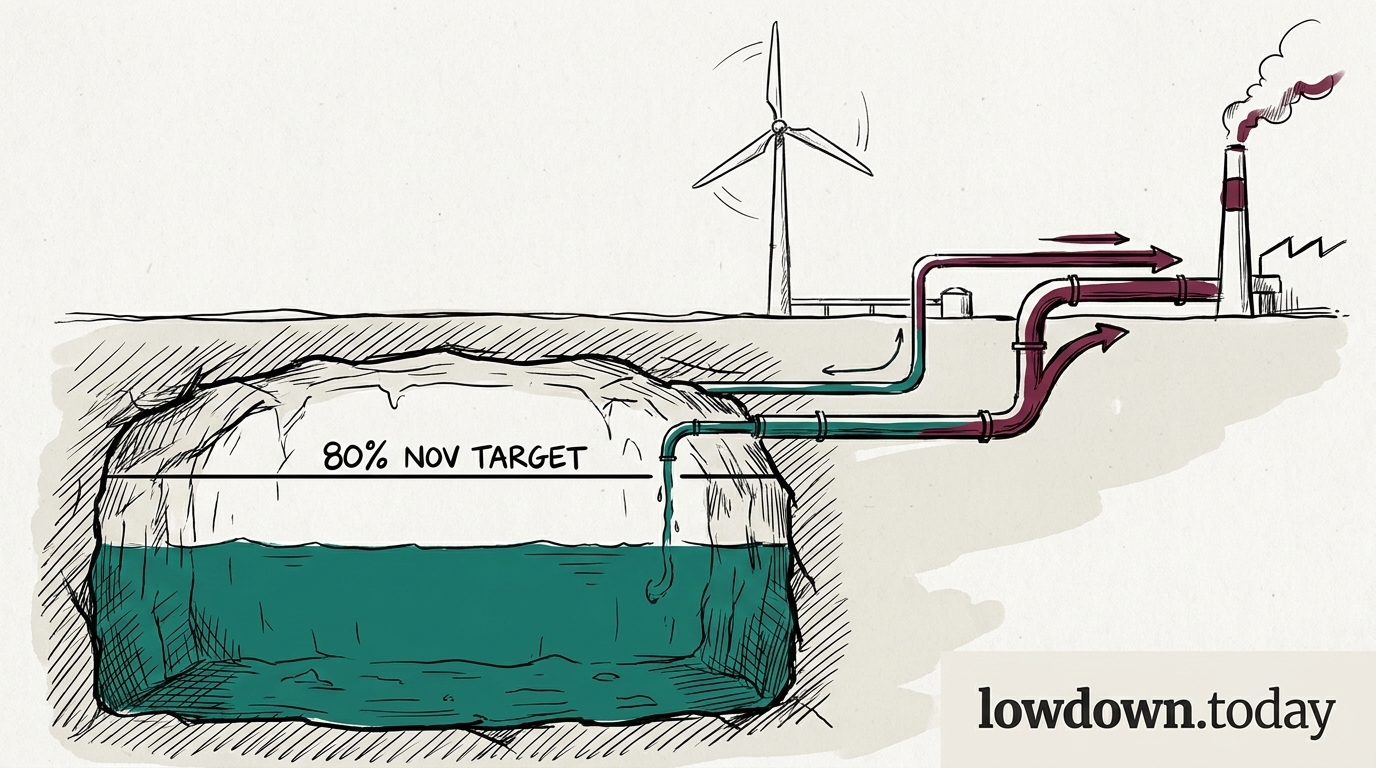
Brussels holds the bloc to 90% on a flexible window while Germany, holding roughly a quarter of EU storage capacity, tracks toward missing its own lower 80% figure by 21 points. A national shortfall this size in the anchor market matters more to bloc security than the flexible timetable alone can absorb.
French power exporters and CRE
French day-ahead rose in step with Germany but by less, reopening a EUR 7-17 premium that makes northward export flows commercially attractive again after the EUR 43.09 discount evaporated in days. CRE separately authorised RTE and Enedis to buy flexibility locally, betting the coming winter's binding constraint is grid congestion rather than a shortage of firm capacity.
TTF trading desk
TTF trading desk
A visible national shortfall like Germany's 21-point gap is a directional signal, not noise, for a desk holding the summer-winter spread. TTF's flat EUR 58-60 range through this week's German price swings says the market has not yet chosen to reprice refill risk into the front of the curve.
German cavern and CCGT operators
German caverns kept buying prompt gas at TTF near EUR 58-60 through the inversion; the wind collapse to 2.4 GW then flipped the spark spread to plus EUR 29 and put turbines back in the same queue. Every day turbines win that bid, injection at a third of the 877 GWh/day pace needed falls further behind.
Slovakia
Slovakia
Slovakia says it dropped its hold-out on the 21st sanctions package only after Ursula von der Leyen personally signed written gas-price and supply guarantees. The Council of the European Union's own 17,238-character release on the package names neither Slovakia nor any guarantee, leaving Bratislava's account unconfirmed by the institutional record.



