Skip to content
You can now search across every topic, entity and event.What's new
European Energy Markets
31JUL

Hamas: stop hitting Gulf neighbours

4 min read
09:44UTC

Iran's closest Palestinian ally publicly asked Tehran to stop hitting Gulf neighbours — a rebuke its own elected president failed to enforce.

EconomicDeveloping
Key takeaway

Gulf financial leverage over Hamas has demonstrably overridden ideological solidarity with Iran.

Hamas publicly called on Iran to "avoid targeting neighbouring countries" while affirming Tehran's right to retaliate against the United States and Israel 1. The statement came from an organisation headquartered in Doha — a city that has absorbed Iranian ballistic missiles repeatedly since 28 February and was targeted again on Saturday with four missiles and several drones.

The political bureau's position in Qatar creates a dependency that now openly contradicts its dependence on Iranian patronage. Qatar hosts Hamas's senior leadership, funds its operations, and pledged $1 billion to Trump's Board of Peace initiative. When Iranian missiles land on Qatari soil, Hamas's two benefactors are at war with each other. The organisation's military wing needs Iranian weapons. Its political wing needs Qatari territory. On Saturday, territory won. Hamas has absorbed every escalation of this conflict without publicly criticising its patron. What changed was the accumulation of Gulf Arab fury: the UN Security Council's Resolution 2817 condemned Iran's Gulf attacks with a record 135 co-sponsors ; the Arab League Secretary-General called the strikes "treacherous" — a term implying betrayal of the 2023 Saudi-China brokered rapprochement ; Iranian drones hit a Bahraini desalination plant, the island's sole water lifeline ; migrant workers were killed in Saudi Arabia by a drone aimed at nearby radar systems . The pressure on Hamas's Doha hosts became untenable.

The statement's futility is its most revealing element. President Pezeshkian ordered Gulf strikes halted on 7 March. Hours later, Parliament Speaker Ghalibaf reversed the commitment, declaring Gulf nations hosting US bases remained targets 2. The IRGC continued firing. Hamas is now asking the Revolutionary Guards to exercise restraint that Iran's own constitutional chain of command could not impose — an appeal to an institution that has publicly demonstrated it takes orders from no civilian authority, foreign or domestic. The IRGC's 31 autonomous provincial commands have sustained coordinated operations across The Gulf even after the destruction of their aerospace and drone headquarters in Tehran . An organisation that disregards its own president is unlikely to heed a Palestinian faction whose survival depends on Iranian money.


Deep Analysis

In plain English

Hamas depends on Qatar for money and political shelter — Qatar hosts Hamas's leadership and funds its operations. Qatar has repeatedly absorbed Iranian missile strikes. Qatar applied sufficient pressure that Hamas did something unprecedented: it publicly told its primary military patron to change tactics. The problem is that Iran's missile forces answer to Supreme Leader Khamenei, constitutionally insulated from both elected officials and external allies. Hamas has demanded something it has no mechanism to deliver — but the fact that it spoke at all reveals the scale of Qatari financial pressure that was applied.

Deep Analysis
Synthesis

Hamas's appeal reveals a secondary fracture in the Axis of Resistance that Tehran cannot paper over with ideology. For the first time, an Iranian-aligned armed group has publicly demanded Iran change its military tactics — demonstrating that Gulf financial leverage can fracture the Axis where state diplomacy has failed. This simultaneously expands Qatar's soft power within the conflict and diminishes Hamas's standing within the Axis as an actor that will subordinate Iranian strategic priorities to its own institutional survival.

Root Causes

Iran's dual-state structure constitutionally separates IRGC command, which reports to the Supreme Leader, from civilian government authority. This is not a malfunction — it is a design feature of the Islamic Republic established to ensure revolutionary forces cannot be constrained by elected moderates. Gulf states and Hamas are both directing appeals at the wrong institutional address: Pezeshkian's government cannot compel the IRGC any more than Hamas can.

Escalation

The appeal is directionally significant but operationally inert. The IRGC Aerospace Force reports directly to Khamenei under Article 150 of Iran's constitution, bypassing both the elected president and parliament. Hamas adds no new coercive mechanism to pressures that have already failed — Pezeshkian's halt order, Ghalibaf's reversal, and continued IRGC strikes confirm this. The more consequential question is whether Qatar uses Hamas's public compliance as a bargaining chip in direct back-channel negotiations with Tehran — that channel is not yet publicly visible.

What could happen next?
  • Meaning

    The Axis of Resistance is not ideologically monolithic; Gulf financial dependency creates coercive leverage that overrides solidarity when host-state survival is at stake.

    Immediate · Assessed
  • Consequence

    Qatar may leverage Hamas's public compliance as a diplomatic asset in back-channel negotiations with Tehran seeking a halt to Gulf state strikes.

    Short term · Suggested
  • Risk

    If IRGC continues Gulf strikes despite Hamas's appeal, Hamas's authority within the Axis will be further diminished — weakening its post-war political position in Gaza reconstruction negotiations.

    Medium term · Suggested
  • Precedent

    First instance of an Iranian-aligned group publicly demanding Iran change its military tactics establishes a precedent for Axis internal dissent that future crises may deepen.

    Long term · Suggested
First Reported In

Update #36 · Israel plans full Litani seizure

Al Jazeera· 15 Mar 2026
Read original
Causes and effects
Different Perspectives
Spain's LNG terminal operators
Spain's 9,145 GWh terminal inventory is the largest single stock in the EU LNG network, an option value that can reroute cargoes wherever the winter strip pays best rather than a cavern gas obligation tied to a fixed date. That flexibility matters more as Germany's cavern shortfall pushes more of the winter security question onto import infrastructure.
European Commission
European Commission
Brussels holds the bloc to 90% on a flexible window while Germany, holding roughly a quarter of EU storage capacity, tracks toward missing its own lower 80% figure by 21 points. A national shortfall this size in the anchor market matters more to bloc security than the flexible timetable alone can absorb.
French power exporters and CRE
French day-ahead rose in step with Germany but by less, reopening a EUR 7-17 premium that makes northward export flows commercially attractive again after the EUR 43.09 discount evaporated in days. CRE separately authorised RTE and Enedis to buy flexibility locally, betting the coming winter's binding constraint is grid congestion rather than a shortage of firm capacity.
TTF trading desk
TTF trading desk
A visible national shortfall like Germany's 21-point gap is a directional signal, not noise, for a desk holding the summer-winter spread. TTF's flat EUR 58-60 range through this week's German price swings says the market has not yet chosen to reprice refill risk into the front of the curve.
German cavern and CCGT operators
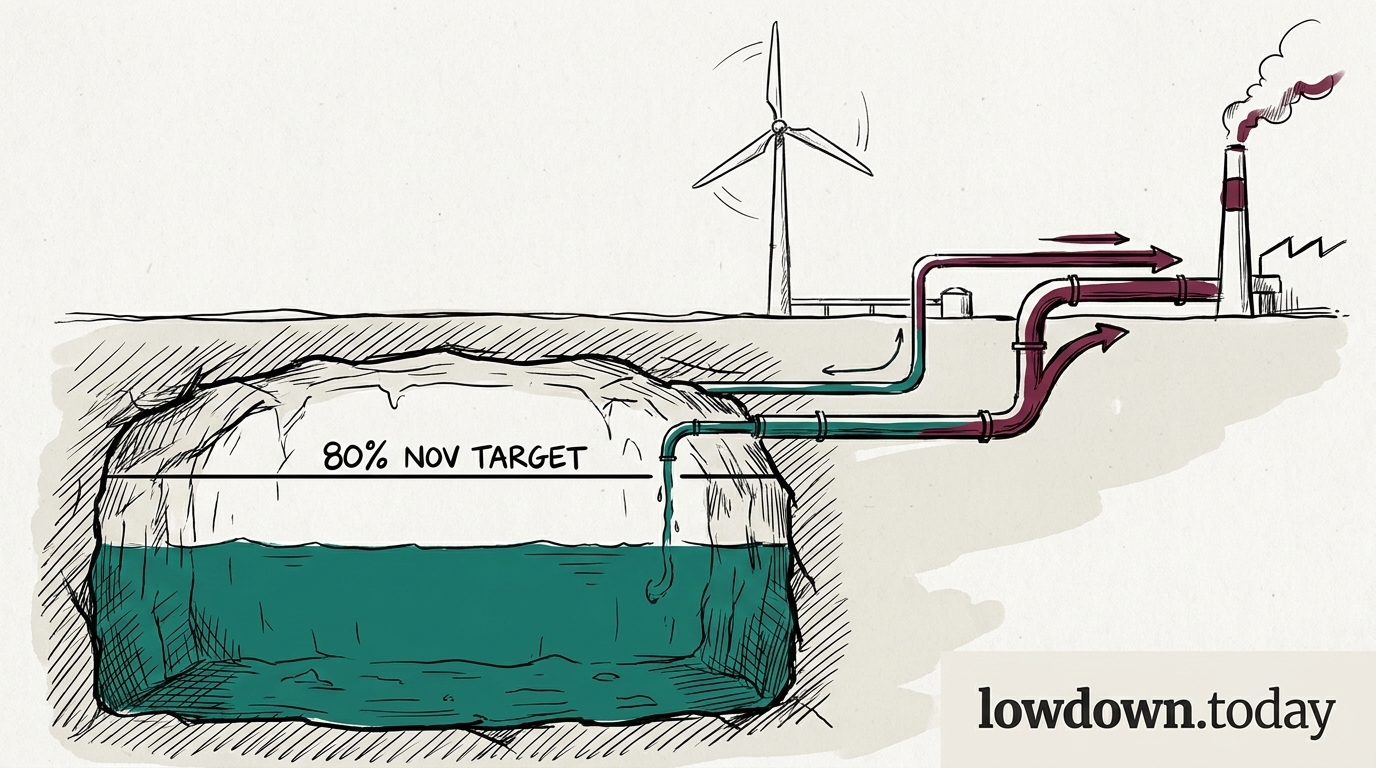
German caverns kept buying prompt gas at TTF near EUR 58-60 through the inversion; the wind collapse to 2.4 GW then flipped the spark spread to plus EUR 29 and put turbines back in the same queue. Every day turbines win that bid, injection at a third of the 877 GWh/day pace needed falls further behind.
Slovakia
Slovakia
Slovakia says it dropped its hold-out on the 21st sanctions package only after Ursula von der Leyen personally signed written gas-price and supply guarantees. The Council of the European Union's own 17,238-character release on the package names neither Slovakia nor any guarantee, leaving Bratislava's account unconfirmed by the institutional record.



