Skip to content
You can now search across every topic, entity and event.What's new
European Energy Markets
31JUL

Iran threatens Gulf oil sites

4 min read
09:44UTC

Tehran warned that if its oil infrastructure is destroyed, Saudi, Emirati, and Kuwaiti installations will follow — extending the oil-for-oil escalation from a bilateral exchange to a Gulf-wide threat.

EconomicDeveloping
Key takeaway

Iran has converted nominally neutral Gulf states into declared targets, ending regional bystander status.

Iran responded to the Kharg strikes within hours via state media: if its oil infrastructure is destroyed, it will strike Saudi, Emirati, and Kuwaiti oil facilities. The threat extends the oil-for-oil escalation pattern that began when Israel struck Tehran's Shahran refineries and the IRGC retaliated against Haifa's refinery within hours . That exchange was bilateral — combatant against combatant. Iran's new declaration pulls The Gulf's remaining accessible oil producers into the destruction chain.

The arithmetic behind the threat is specific. Saudi Arabia produces roughly 9 million barrels per day, the UAE approximately 3.2 million, and Kuwait 2.7 million — together accounting for nearly 15 million barrels per day, or about 15% of global supply. Kuwait has already declared force majeure on all exports . Combined with Iraq's production cuts of approximately 1.5 million barrels per day, roughly 3.5 million barrels per day of Gulf capacity was already shut in or unable to reach market before this threat was issued. Iran's counter-threat targets the remainder. If executed, it would remove the majority of the world's swing production capacity from the market simultaneously.

This is the logic of mutual assured economic destruction applied to hydrocarbons. Iran exports roughly 1.5 million barrels per day through Kharg, nearly all to China . Destroying that terminal eliminates Iran's primary revenue source but removes a relatively small share of global supply. Iran's counter-strike on Gulf facilities would remove a share ten times larger. The asymmetry is the point: Iran cannot match American military capability, but it can ensure that the economic consequences of attacking its oil infrastructure fall disproportionately on the US and its allies through global energy markets. Brent closed Friday at $103.14 — up 41.5% since the war began — and the IEA's record 400-million-barrel strategic reserve release has already failed to hold prices below $100.

The Gulf states named in Iran's threat have spent the conflict trying to avoid exactly this position. Saudi Arabia, the UAE, and Bahrain voted for the UN Security Council resolution condemning Iran's attacks , but Bahrain — struck by over 75 missiles and 123 drones — abstained on Russia's ceasefire resolution rather than endorse any text that might constrain the US campaign . The Arab League's secretary-general called Iran's conduct "treacherous" , reflecting the collapse of the 2023 Saudi-China brokered rapprochement. These states are now named targets in a counter-threat triggered not by their own actions but by a potential American decision over which they have no veto. The population of the three threatened countries exceeds 45 million people whose water desalination, electricity generation, and economic survival depend on the oil infrastructure Iran has promised to destroy.


Deep Analysis

In plain English

Iran announced that if its own oil terminal is destroyed, it will attack oil facilities in Saudi Arabia, the UAE, and Kuwait. These countries are not direct parties to the US-Iran or Israel-Iran conflict — they have been maintaining careful neutrality. But their oil infrastructure handles a significant share of the world's supply. Saudi Arabia's Abqaiq processing facility alone handles roughly 7% of global daily oil. Iran is telling the world: 'Destroy our oil and we will remove far more than just ours from the global market.' This converts a bilateral confrontation into a potential regional catastrophe.

Deep Analysis
Synthesis

The oil-for-oil threat structure creates a perverse deterrence paradox: the more the US restrains itself from destroying Kharg — to avoid triggering Iran's counter-threat — the more intact Iran's retaliatory capacity remains. US restraint preserves the very capability it fears. This means the Kharg conditional may not deter Iran from Gulf actions; it may instead incentivise Iran to keep the Hormuz threat active precisely because it constrains the US from executing the strike that would remove Iran's retaliatory leverage.

Root Causes

Iran's threat reflects its forward defence doctrine: impose costs beyond the immediate conflict perimeter to deter further US escalation. The IRGC has maintained pre-positioned strike packages for Gulf infrastructure since at least 2019, demonstrated live capability in the Abqaiq attack, and has sustained those capabilities despite ongoing US-Israeli operations.

Escalation

This threat achieves horizontal escalation — extending the conflict's damage potential to nominally neutral parties. Gulf states had maintained studied ambiguity about alignment. Iran's explicit threat forces a binary choice: seek US security guarantees (which pulls them into the conflict) or seek Iranian assurances (which requires acknowledging Iranian coercive authority over their infrastructure). Neither option is their preference.

What could happen next?
  • Consequence

    Gulf Cooperation Council states can no longer maintain studied neutrality — Iran has explicitly converted their infrastructure into declared retaliatory targets, forcing an alignment decision.

    Short term · Assessed
  • Risk

    A successful strike on Abqaiq-scale Gulf infrastructure would likely trigger treaty-level discussions about the durability of US security guarantees and the 1945 Quincy Agreement framework with Saudi Arabia.

    Short term · Suggested
  • Precedent

    Iran's explicit public threat against GCC bystander infrastructure marks the first time in this conflict that non-belligerent states have been named as retaliatory targets, expanding the conflict's potential geographic scope.

    Immediate · Assessed
  • Risk

    If Iran executes even partial Gulf infrastructure strikes, marine insurance suspension could make the Persian Gulf commercially non-navigable for non-military vessels, compounding Hormuz closure effects.

    Immediate · Suggested
First Reported In

Update #35 · Kharg Island struck; oil terminal spared

CNN· 14 Mar 2026
Read original
Different Perspectives
Spain's LNG terminal operators
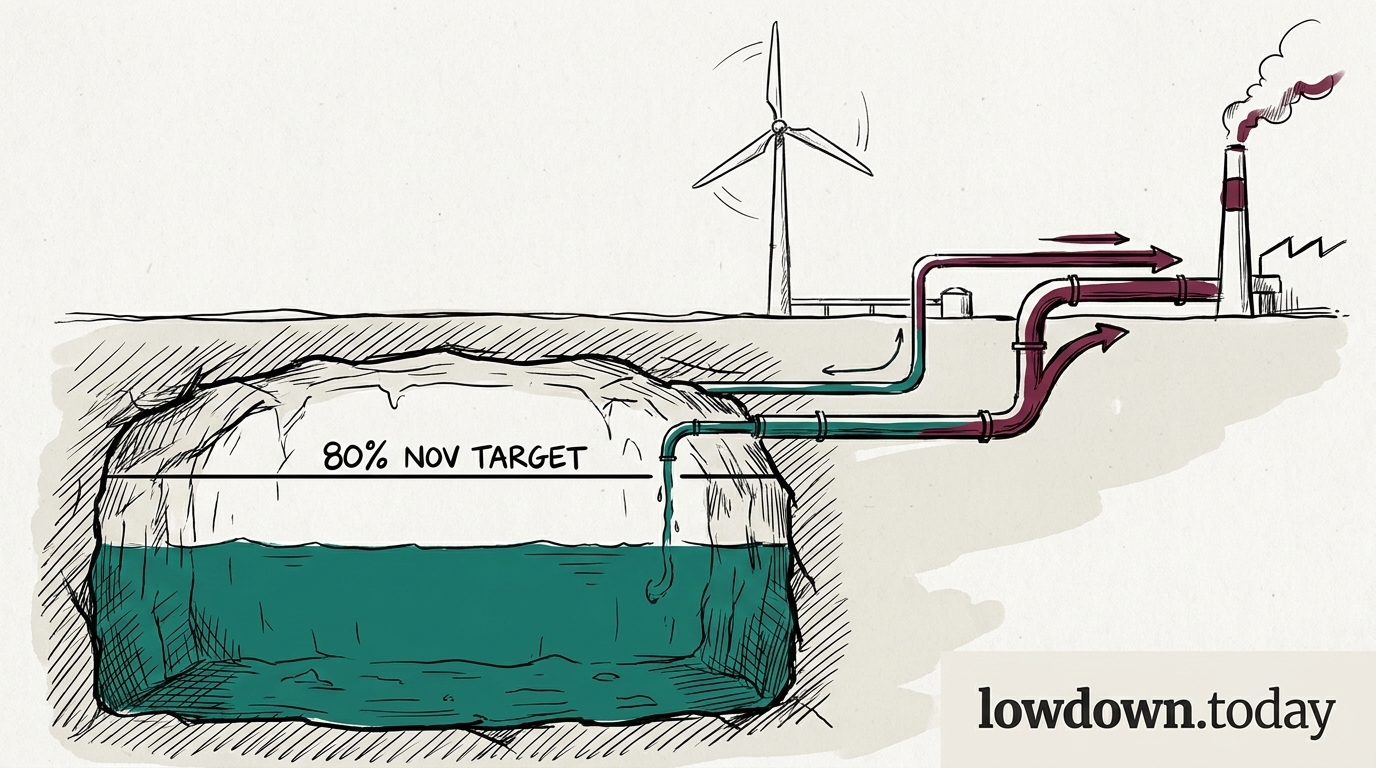
Spain's 9,145 GWh terminal inventory is the largest single stock in the EU LNG network, an option value that can reroute cargoes wherever the winter strip pays best rather than a cavern gas obligation tied to a fixed date. That flexibility matters more as Germany's cavern shortfall pushes more of the winter security question onto import infrastructure.
European Commission
European Commission
Brussels holds the bloc to 90% on a flexible window while Germany, holding roughly a quarter of EU storage capacity, tracks toward missing its own lower 80% figure by 21 points. A national shortfall this size in the anchor market matters more to bloc security than the flexible timetable alone can absorb.
French power exporters and CRE
French day-ahead rose in step with Germany but by less, reopening a EUR 7-17 premium that makes northward export flows commercially attractive again after the EUR 43.09 discount evaporated in days. CRE separately authorised RTE and Enedis to buy flexibility locally, betting the coming winter's binding constraint is grid congestion rather than a shortage of firm capacity.
TTF trading desk
TTF trading desk
A visible national shortfall like Germany's 21-point gap is a directional signal, not noise, for a desk holding the summer-winter spread. TTF's flat EUR 58-60 range through this week's German price swings says the market has not yet chosen to reprice refill risk into the front of the curve.
German cavern and CCGT operators
German caverns kept buying prompt gas at TTF near EUR 58-60 through the inversion; the wind collapse to 2.4 GW then flipped the spark spread to plus EUR 29 and put turbines back in the same queue. Every day turbines win that bid, injection at a third of the 877 GWh/day pace needed falls further behind.
Slovakia
Slovakia
Slovakia says it dropped its hold-out on the 21st sanctions package only after Ursula von der Leyen personally signed written gas-price and supply guarantees. The Council of the European Union's own 17,238-character release on the package names neither Slovakia nor any guarantee, leaving Bratislava's account unconfirmed by the institutional record.



