Skip to content
You can now search across every topic, entity and event.What's new
Data Centres: Boom and Backlash
4AUG

FERC delays its grid rule to 2027

3 min read
10:53UTC

FERC met its end-June deadline on 18 June, then chose its slowest tool: show-cause orders to all six US grid operators instead of the connection rule it promised in April. Any binding standard now slips to 2027 at the earliest.

IndustryDeveloping
Key takeaway

FERC's slowest tool pushes any binding large-load connection rule to 2027, after most near-term capacity is committed.

The Federal Energy Regulatory Commission (FERC), the US regulator for interstate power transmission, met its end-June deadline on 18 June and then reached for its slowest instrument. Rather than issue the large-load connection rule it pledged in April , FERC sent Section 206 show-cause orders, which compel each operator to justify or change its existing rules, to all six US regional transmission organisations (RTOs): PJM, MISO, SPP, CAISO, ISO-NE and NYISO 1.

Each RTO must now defend or reform its tariffs across five areas, from study processes to co-location terms, the same co-located load question PJM was ordered to file on in May . Resource-adequacy reports are due 20 July, show-cause responses 17 August, and public comments 16 September, with the RM26-4-000 docket left open and no rule attached. Industry lawyers expect six to eighteen months from a show-cause order to a final order, which puts any binding standard in 2027 at the earliest.

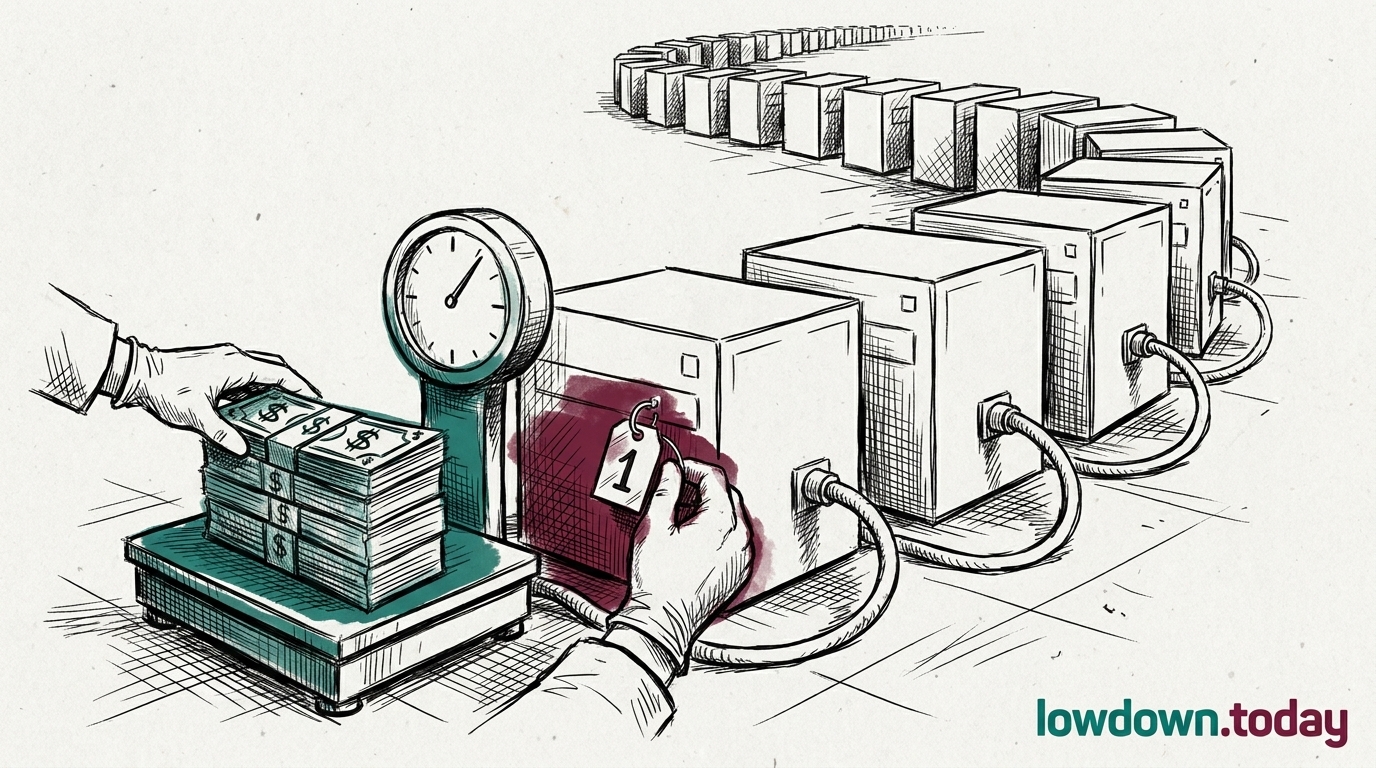
Show-cause puts the burden on each operator to prove its existing rules are just and reasonable, which reads as aggressive but actually buys time: FERC can let six separate proceedings run rather than defend one nationwide rule through the appeal courts. Six dockets also multiply the points where reform can stall or be litigated, and connection-side certainty slips past the window in which most near-term capacity is being committed. FERC counted 75 GW of new summer capacity since 2025, yet PJM still declared a grid emergency in May .

Deep Analysis

In plain English

FERC is the US Federal Energy Regulatory Commission, the federal agency that sets the rules for how electricity flows across state lines. In April 2026, FERC promised it would publish new rules by the end of June on how data centres get connected to the national grid, since the existing queue was taking years to clear. On 18 June, FERC met that deadline, but only barely: instead of publishing new rules, it sent formal questions to the six companies that run different regions of the US electricity grid, asking them to explain or reform their own existing rules. Those six companies, called RTOs (Regional Transmission Organisations), manage the grid in different regions: PJM covers the eastern US, MISO the Midwest, SPP the central plains, CAISO California, ISO-NE New England, and NYISO New York. Each has its own rules for how data centres connect. The responses are due through September 2026, meaning no binding new rule can arrive before 2027 at the earliest.

Deep Analysis
Root Causes

FERC's procedural choice reflects two structural problems it cannot solve by rulemaking alone.

First, the six US RTOs operate under different state utility commissions with different regulatory priorities. PJM's co-location problem, driven by Northern Virginia's hyperscale density, is structurally different from CAISO's, where BTM generation is already restricted under California air-quality rules. A single FERC rule must accommodate that variance, which requires the show-cause process to surface each RTO's specific constraints before FERC can write a standard.

Second, FERC has no authority over behind-the-meter generation that never crosses the interstate transmission system. The fastest-growing segment of data-centre power, captive co-located gas plants like Project Kilby, sits outside FERC's primary jurisdiction entirely. Show-cause orders to RTOs cannot reach that category of demand; they address only the grid-connection queue for facilities that do use the transmission system.

Escalation

FERC's choice of show-cause over direct rulemaking signals institutional caution rather than escalation. The direction is toward slower resolution, not faster. Three of the six RTOs face Fifth Amendment challenges to their curtailment authority, which may have influenced FERC's choice to build a stronger evidentiary record through show-cause before issuing a rule that could face the same legal exposure.

What could happen next?
  • Consequence

    Binding large-load connection standards across all six US RTOs will not arrive before 2027 at the earliest, leaving the period of maximum data-centre investment without a federal framework for the most contested terms.

    Medium term · Assessed
  • Risk

    Six separate show-cause responses may produce six divergent tariff reforms, creating regulatory arbitrage between grid territories that operators can exploit by choosing connection location.

    Medium term · Suggested
  • Opportunity

    The 20 July resource-adequacy reports due from RTOs will produce the first official disclosure of each region's data-centre load forecast, creating a public data baseline the industry has previously had only through unofficial ERCOT disclosures.

    Immediate · Assessed
First Reported In

Update #8 · Data centres build their own power plants

FERC· 28 Jun 2026
Read original
Different Perspectives
Government of Odisha
Odisha signed a $1.5bn agreement with HCLTech and Sarvam AI on 24 July for a sovereign AI data centre in Bhubaneswar, targeting 2028 operations. While regulators elsewhere price developers out of the queue, Odisha is bidding state financial assistance to bring capacity in, betting the AI infrastructure boom is worth courting rather than rationing.
Switch Datacenters and Uithoorn
The developer, the municipality, Liander and dozens of greenhouse growers signed a waste-heat agreement letting a 60 MVA facility proceed under a provincial rule that bans sites above 5 MVA. The public-interest exception argues the site relieves rather than adds to grid congestion, working around a standing ban from inside rather than waiting for it to change.
Iskandar Puteri residents
Residents protested in February over falling water pressure they attribute to ZDATA's 300 MW construction; ZDATA disputes causation and has not yet resolved the dispute with its wastewater-only pivot. The complaint sits unadjudicated while the operator advertises compliance to state authorities the residents cannot address directly.
Microsoft
Microsoft
DC Byte reports Microsoft looking to the Nordics for new capacity while Dublin's regional share falls to 15 per cent, though this is a market-intelligence inference rather than a company statement. Microsoft keeps its existing Dublin cloud region, which is costly to relocate, while directing new investment where power is cheaper and the queue is shorter.
ISO New England
ISO New England
ISO-NE proposed excluding new large loads from its Installed Capacity Requirement entirely, forcing data centres to bring their own generation or accept curtailment, even though New England's demand has been flat or falling for a decade. The reform is pre-emptive, written before the region has felt the strain PJM and MISO already report.
Ofgem
Ofgem
Ofgem opened its Data Centre Commitment Fee consultation on 29 July, arguing that free options on grid capacity let developers bank places on ten sites and abandon nine, crowding out projects that would build. It expects the deposit to filter the queue before the rule even takes final form.

